
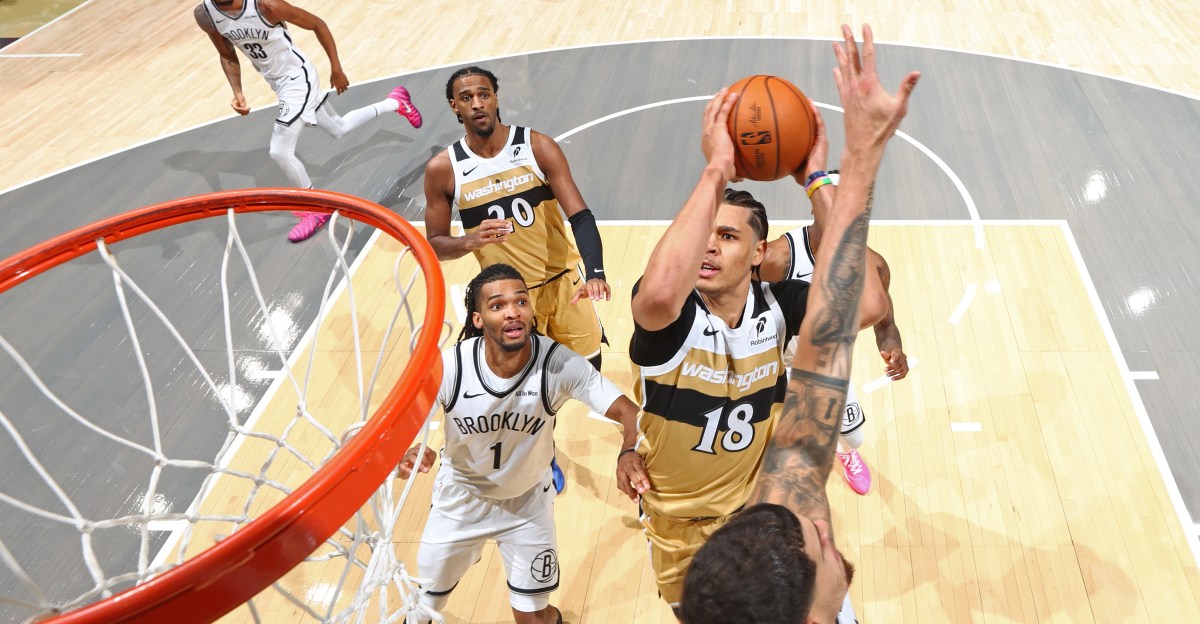
Sure, the Wizards lost by 23 to a Brooklyn Nets squad sporting an identical 1-11 record, but it marked a resounding success — Washington snapped a six-game streak of allowing opponents at least 12 offensive rebounds, and a two-game streak giving up at least 20 offensive boards. This is the stuff dreams are made of.
I jest — ChatGPT tells me dreams are made of neural noise, memory fragments, emotional residue, and your brain’s best attempt to make sense of all that chaos. Why does that feel like ChatGPT is sub-tweeting this year’s Wizards?

Wizards center Alex Sarr played his worst game of the season in the team’s loss to the Brooklyn Nets. Getty Images
So, I’ll take the blame for this one. I wrote a check-up article for yesterday that lauded the play of Alex Sarr and gestured at hope the rest of the team would get better. In grand #SoWizards tradition, Sarr played his worst game of the season, and the Wizards could not contain the NBA’s 24th ranked offense.
In what figured to be one of their better chances to get a win, they lost by 23. Their next opportunity to get blown out by a bad team is Nov. 28 at the Indiana Pacers. The Wizards have other chances to get blown out but those will be against good or mediocre teams, not one of the league’s worst. Plan accordingly.
Kyshawn George had a strong overall game — 29 points with a 124 offensive rating (almost +9 relative to league average). He also fouled out for the third time in 12 games played this season. He’s had five or more fouls 9 times, and 4 or more in 11 games. At the risk of getting too technical, that’s too much.Sarr has played well so far this season, but was ineffective last night against Brooklyn. He joined George in fouling out.Bilal Coulibaly returned to the starting lineup after missing four games with some muscle tightness. He shot just 2-6, but contributed some rebounds, assists, and steals.CJ McCollum and Khris Middleton weren’t bad, I guess.Michael Porter Jr. played like a man trying to convince contending teams to trade for him — 34 points, 9 rebounds, 7 assists. I’m sure he’d love to see Wizards defenders more often.
Below are the four factors that decide wins and losses in basketball — shooting (efg), rebounding (offensive rebounds), ball handling (turnovers), fouling (free throws made).
The four factors are measured by:
eFG% (effective field goal percentage, which accounts for the three-point shot)OREB% (offensive rebound percentage)TOV% (turnover percentage — turnovers divided by possessions)FTM/FGA (free throws made divided by field goal attempts)FOUR FACTORSNETSWIZARDSLGAVGeFG%63.9%51.2%54.3%OREB%18.9%7.5%26.4%TOV%14.1%10.1%13.3%FTM/FGA0.3540.2380.227PACE99100.5ORTG130107115.6
PPA is my overall production metric, which credits players for things they do that help a team win (scoring, rebounding, playmaking, defending) and dings them for things that hurt (missed shots, turnovers, bad defense, fouls).
PPA is a per possession metric designed for larger data sets. In small sample sizes, the numbers can get weird. In PPA, 100 is average, higher is better and replacement level is 45. For a single game, replacement level isn’t much use, and I reiterate the caution about small samples sometimes producing weird results.
POSS is the number of possessions each player was on the floor in this game.
ORTG = offensive rating, which is points produced per individual possessions x 100. League average so far this season is 115.1. Points produced is not the same as points scored. It includes the value of assists and offensive rebounds, as well as sharing credit when receiving an assist.
USG = offensive usage rate. Average is 20%.
ORTG and USG are versions of stats created by former Wizards assistant coach Dean Oliver and modified by me. ORTG is an efficiency measure that accounts for the value of shooting, offensive rebounds, assists and turnovers. USG includes shooting from the floor and free throw line, offensive rebounds, assists and turnovers.
+PTS = “Plus Points” is a measure of the points gained or lost by each player based on their efficiency in this game compared to league average efficiency on the same number of possessions. A player with an offensive rating (points produced per possession x 100) of 100 who uses 20 possessions would produce 20 points. If the league average efficiency is 114, the league — on average — would produced 22.8 points in the same 20 possessions. So, the player in this hypothetical would have a +PTS score of -2.8.
Players are sorted by total production in the game.
WIZARDSMINPOSSORTGUSG+PTSPPA+/-Kyshawn George326612434.6%1.9141-15CJ McCollum326712619.9%1.41290Khris Middleton275713917.7%2.41283Bilal Coulibaly285711212.5%-0.3103-1Bub Carrington204211912.0%0.2105-25Corey Kispert15319510.6%-0.754-8Cam Whitmore132710123.3%-1.046-13Marvin Bagley III17358215.6%-1.8-5-6Alex Sarr23488022.1%-3.8-41-2Tre Johnson17356125.3%-4.9-110-25Tristan Vukcevic7148114.3%-0.770-8Justin Champagnie71310825.9%-0.338-15AJ Johnson36014.7%-1.0-950NETSMINPOSSORTGUSG+PTSPPA+/-Michael Porter Jr.347014931.0%7.226417Tyrese Martin265414624.1%4.029626Nic Claxton306314721.3%4.220214Noah Clowney306212812.3%1.010716Ziaire Williams306213213.7%1.47713Egor Demin204111915.4%0.2102-3Terance Mann296010618.4%-1.16610Drake Powell19399515.4%-1.28013Day’Ron Sharpe163210921.5%-0.5649Jalen Wilson2530216.0%1.45220Tyson Etienne2510148.0%-0.300E.J. Liddell25032.0%-1.700