
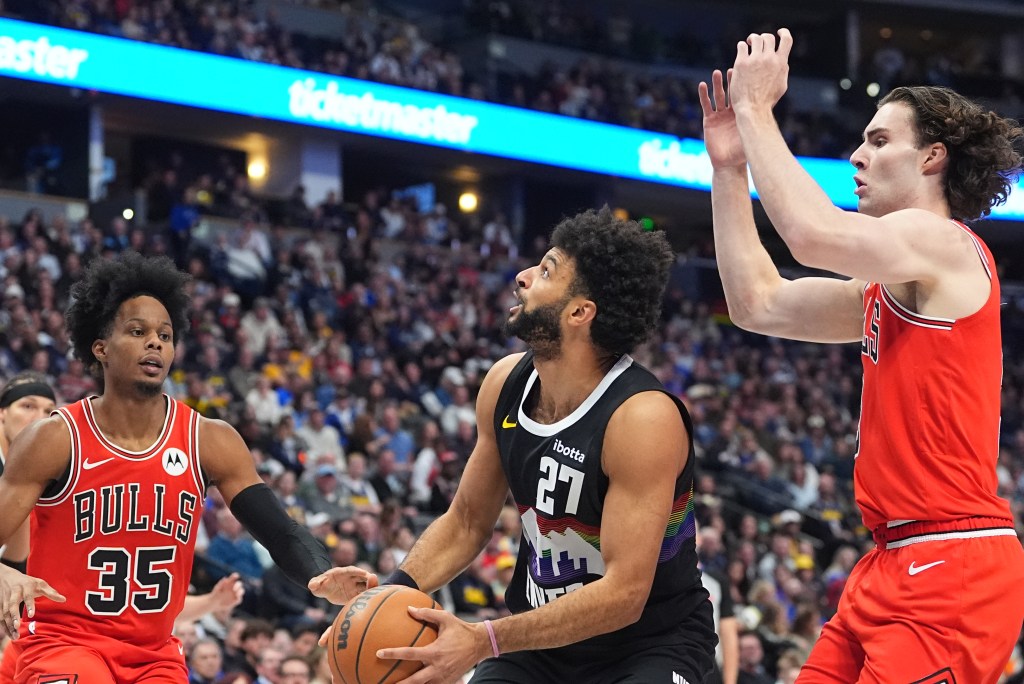
Billy Donovan couldn’t believe his eyes.
It was too easy. Midway through the second quarter of the Chicago Bulls’ double-overtime loss Sunday in Utah, Jazz guard Isaiah Collier curled over a screen at the top of the key. Bulls forward Julian Phillips had ducked under the initial screen, emerging on the other side already low in his defensive stance.
What came next wasn’t fancy or complex.
Guard Keyonte George passed the ball to Collier, then moved across the arc to accept a dribble hand-off. Phillips picked him up on the switch. George received the ball, planted his right foot and torched past Phillips with a single dribble. He needed only one more touch before he entered the paint unencumbered, waltzing past three scrambling defenders who were a step too late in helping before he rolled the basket through the rim.
Donovan tipped his head to the sky, jaw clenched in frustration tinged with disgust.
“We just can’t afford that,” he said after the loss.
These simple errors define a Bulls defense that hasn’t held its water in the early weeks of the NBA season. Despite outperforming expectations with a 7-6 record, the Bulls have been bleeding points in both wins and losses as they rank 19th in the league in defensive rating (115.9).
And win or lose, the defensive shortcomings always point back to the same source: The Bulls can’t stop their opponents from getting to the rim.
The Bulls give up the league’s fifth-most points in the paint (54.9 per game). A glaring 77% of those points were scored within the restricted area, one of the most valuable scoring targets on the court.
For the top scorers in the league, the Bulls defense offers the relative resistance at the rim of an off-brand piece of tissue paper. Opposing teams make a league-high 21.1 shots per game in the restricted area. The most egregious example occurred in a Nov. 7 loss to the Milwaukee Bucks in which Giannis Antetokounmpo took 21 shots in the restricted area and made 14.
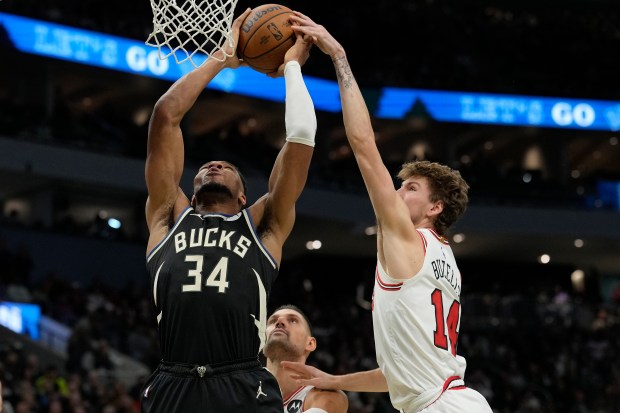 Bucks forward Giannis Antetokounmpo shoots against Bulls forward Matas Buzelis on Nov. 7, 2025, at Fiserv Forum in Milwaukee. (Patrick McDermott/Getty Images)
Bulls opponents are shooting 66.2% in the restricted area, far from the highest figure in the league. (For reference, the Sacramento Kings allow opponents to shoot a league-high 74.6% inside the restricted area.) But due to their high volume of opportunities, opponents still profit at the rim against the Bulls more than any other team.
Early in the season, Donovan blamed this lack of rim protection on a lack of physicality from the Bulls, who struggled to contest players on their path to the basket. He hounded players to force their bodies into plays, inciting a quiet transformation as the Bulls have drawn nine charges in their first 13 games.
But last-minute rotations serve only as a stopgap. The source of the problem in the paint is rooted where most drives to the rim begin — the 3-point arc.
“It’s really, really, really hard to bring help on straight blow-bys,” Donovan said. “If a guy catches it and just goes right by the defender, it’s nearly impossible to get over there quick enough. You’ve got to be able to handle at least one dribble effectively.”
Donovan doesn’t pretend this is easy. He believes closing out to be one of the hardest aspects of defense, matched only by recovery in transition. NBA players are too quick, intelligent and shifty on the perimeter. It takes significant preparation, discipline and communication to effectively knock guards off their trajectory toward the basket.
And sometimes a blow-by exists as the lesser of two evils. If the Bulls are trying to run a sharpshooter off the 3-point arc, they’re willing to accept the sacrifice of giving that player a path to the rim. Donovan can live with that type of acquiescence.
But those instances are the exception, not the norm. The Bulls often give up blow-by drives after simple guard-to-guard passes and dribble hand-offs above the break — the exact scenario in which George flew past Phillips at the top of the key in Utah.
These are uncomplicated plays. Sometimes they trigger a perimeter switch. More often they simply ask a Bulls defender to cut his feet and take an appropriate first step to force a driving guard to take a parabolic path to the rim rather than a straight line.
Donovan pointed to this weakness again after the loss to the Jazz, in which the Bulls were blown by 22 times as Utah scored nine baskets in the restricted area.
“There’s got to be a little bit more resistance on the ball,” Donovan said.
Guard Josh Giddey draws the most ire — and opponent attention — for his individual defense. Giddey is the first to admit his weaknesses. Although he can utilize his length as a 6-foot-7 jumbo guard, Giddey’s choppy footwork on the perimeter often leaves him stranded as a liability more than an asset.
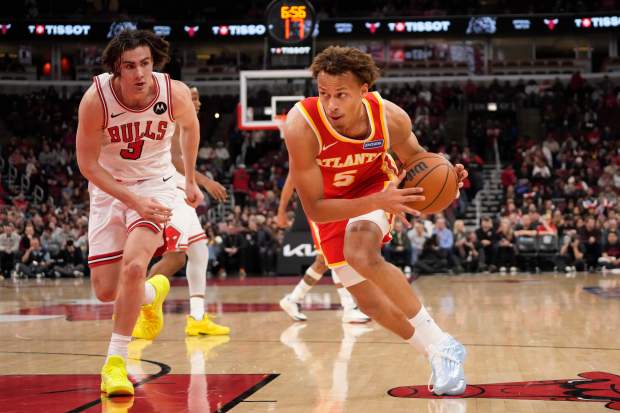 Bulls guard Josh Giddey defends Hawks guard Dyson Daniels on Oct. 27, 2025, at the United Center. (AP Photo/David Banks)
Teams hunt Giddey as a result, creating schemes that force him to switch onto their best player through screens and off-ball shifts. And opponents know one of the best avenues to the rim against the Bulls is paved by getting Giddey to fly out to the perimeter in an overeager closeout.
For a team that already struggles defensively, this glaring weakness has been a sore spot throughout Giddey’s short tenure with the team. But although Giddey often produces the most eye-popping errors at the perimeter, Donovan doesn’t believe the Bulls can lay the blame on him.
“It really comes down to the personal pride of one-on-one guarding,” Donovan said. “He’s tried to do that. But to be honest with you, for us defensively — it’s not just Josh; I’m not putting it all on Josh — our team, we’ve got to be much, much better at containing the basketball.”
For forward Isaac Okoro, the most stalwart defender on the Bulls roster, shoring up this weakness comes down to a basic basketball aphorism: KYP, or Know Your Personnel.
The Bulls show their hand too early and too often in closing out to driving threats, rushing their approach toward their assignment and giving up a lane to the basket as a result. This only worsens once an initial blow-by occurs — defenders spring into scramble mode, impatiently attempting to close off any new opportunities.
“We’re closing out to guys that want to drive, and that opens up the paint and that causes other drives and other closeouts and sprays and open 3s,” Okoro said. “We’ve got to know who we’re closing out to and when we’re just containing the drive.”
It’s a simple theory to explain. The application is more complicated — and leaves almost zero margin for error. But the Bulls don’t have a choice.
Without shutting off this deluge of points at the rim, their defense will remain a sieve through which points — and losses — will continue to flow.