
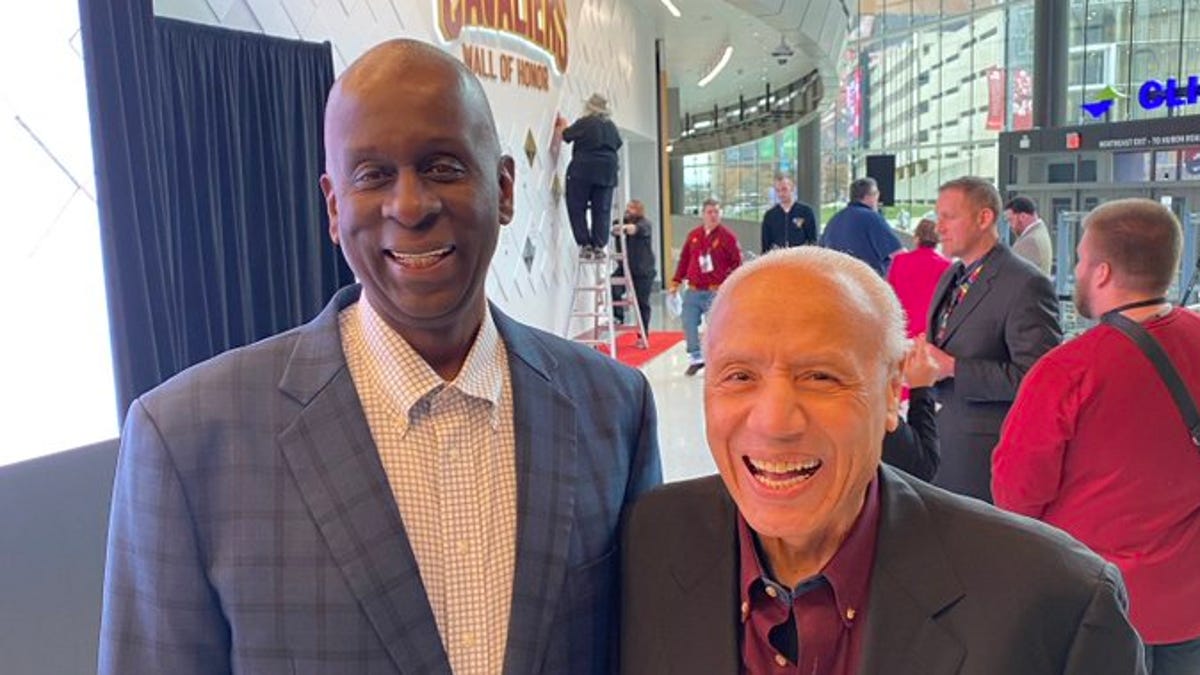
Before the Detroit Pistons claimed the franchise’s first NBA title in 1989, the Pistons had to overcome a formidable regular season test from Cleveland, coached by the late great Lenny Wilkens.
The late Lenny Wilkens coached a record 2,487 regular season NBA games. And on 1,332 of those occasions, as the coach of the Seattle SuperSonics, Portland Trail Blazers, Cleveland Cavaliers, Atlanta Hawks, Toronto Raptors and New York Knicks, his teams were victorious.
Sixty of Wilkens’ coaching wins came against the Detroit Pistons.
But for rabid Pistons fans, three of those wins registered by Wilkens as the coach of the Cavaliers against the Pistons during the 1988-89 NBA season were particularly agonizing because at the time it appeared that Cleveland was in a better position to win a NBA title, which both teams and cities were vying to do for the first time.
“We won 57 games (57-25) that season,” recalled Phil Hubbard, an All-American basketball player at the University of Michigan, who began his NBA career in 1979 with the Pistons before he was sent to Cleveland on Feb. 16, 1982, as part of a trade that brought future Pistons “Bad Boy” Bill Laimbeer to Detroit. “With Lenny’s arrival in Cleveland (in 1986) we began to find our way. Before, it was like we were stuck in the mud or quicksand, but Lenny changed our franchise and put us in the right position to win.”
At the beginning of the 1988-89 season, there was no denying the winning that was taking place in Cleveland orchestrated by Wilkens, a Naismith Memorial Basketball Hall of Fame inductee as a player and coach, who died at the age of 88 on Nov. 9. That season, the Cavaliers posted the best record (35-11) in the Eastern Conference at the All Star Break, and also registered victories against the Pistons the first three times the Central Division rivals faced each other.
Cleveland’s early dominance over Detroit that season was captured in a March 1, 1989, Detroit Free Press story written by the late Drew Sharp under the headline: “Cavs rope Pistons, 115-99.” In the article, Sharp described how “Cleveland unmercifully picked the Pistons apart in the third quarter,” while making it “painfully obvious which is the stronger team.” In the story, Sharp also reported that the Pistons suffered the loss before a capacity crowd of 20,246 at the Richfield Coliseum in Richfield, Ohio.
“Those were good crowds and we always played hard for them,” said Hubbard, who provided veteran leadership for the Cavaliers in a reserve role during the 1988-89 season on a team led by three members of the 1989 Eastern Conference All Star Team: Mark Price, Brad Daugherty and Larry Nance Sr.
While speaking on the afternoon of Nov. 13, Hubbard explained that the Cavaliers’ Feb. 28, 1989, victory over the Pistons came with a price, literally, when Cleveland’s standout point guard Price absorbed an elbow to the head delivered in the fourth quarter by Pistons power forward Rick Mahorn, who was later fined $5,000 for what the NBA Vice President of Operations Rod Thorn called an “intentional and flagrant elbow.” Price suffered a concussion and missed the next two games, including a March 3, 1989, showdown at The Palace of Auburn Hills, won by the Pistons, 96-90.
Adding to the heightened tension before that game, as reported by the late Corky Meinecke in the March 4, 1989, Free Press, was a death threat received by Wilkens over the phone while the Cavaliers were staying at the Northfield Hilton, roughly 4½ hours before tipoff. The death threat was followed by a bomb threat received by the hotel’s front desk, which forced the hotel to be evacuated.
Out of that mayhem emerged an inspired Pistons team, coached by Hall of Famer Chuck Daly, that won 25 of the team’s next 28 games to close the regular season with a 63-19 record, which set the stage for a triumphant playoff run that produced the Pistons’ first NBA Championship. For Cleveland, it was an altogether different story, as the Cavaliers never regained their momentum from earlier in the season and suffered a stunning defeat in a first-round playoff series against the Michael Jordan-led Chicago Bulls, a team Cleveland had defeated six consecutive times in the regular season. But through it all, Hubbard said Wilkens never lost his trademark composure.
“He was always a person under control no matter what the situation was; that was his demeanor,” said Hubbard, whose 10-year run as an NBA player ended with the 1988-89 season.
However, the 68-year-old Hubbard says he had an opportunity to benefit even more from Wilkens’ wisdom and composure after his playing days.
“You may think you know your coach when you’re playing for him, but you never really know who your coach is until you get to know him on another level, and that’s what happened for me,” said Hubbard, who was hired by Wilkens in 1997 to join the Atlanta Hawks coaching staff as one of Wilkens’ assistant coaches. “I had a chance to learn the coaching profession from one of the greatest coaches of all time and learn about Lenny Wilkens the man during all of the lunches and breakfasts and dinners we had together. I learned about his relationship with his mother and how hard it was for him growing up (in the Bedford Stuyvesant neighborhood of Brooklyn, New York).”
Like his mentor, Coach Wilkens, Hubbard — the 15th overall pick in the 1979 NBA Draft, who was one of three players selected by the Pistons in the first round that year along with current Detroit Pistons color analyst for FanDuel Sports Network Greg Kelser (fourth overall pick out of Michigan State) and Roy Hamilton (10th overall from UCLA) — says he is a born “competitor” who would have loved to have contributed to the back-to-back “Bad Boys” Pistons championship teams in 1989-90 if his basketball-playing journey had kept him in Detroit.
But the Canton, Ohio, native says returning to his home state and having a chance to form a lasting relationship with basketball royalty was quite a prize as well.
“Lenny Wilkens was a great coach and an even better person,” Hubbard said about the second Black coach in NBA history, who led the Seattle SuperSonics to a NBA title in 1979 and also was the head coach of the gold-medal winning U.S. Olympic Basketball Team at the 1996 Atlanta Games. “He also was a good family man who cared about all the people in his life.
“That’s my man!”
Scott Talley is a native Detroiter, a proud product of Detroit Public Schools and a lifelong lover of Detroit culture in its diverse forms. In his second tour with the Free Press, which he grew up reading as a child, he is excited and humbled to cover the city’s neighborhoods and the many interesting people who define its various communities. Contact him at stalley@freepress.com or follow him on Twitter @STalleyfreep. Read more of Scott’s stories at www.freep.com/mosaic/detroit-is/. Please help us grow great community-focused journalism by becoming a subscriber.