
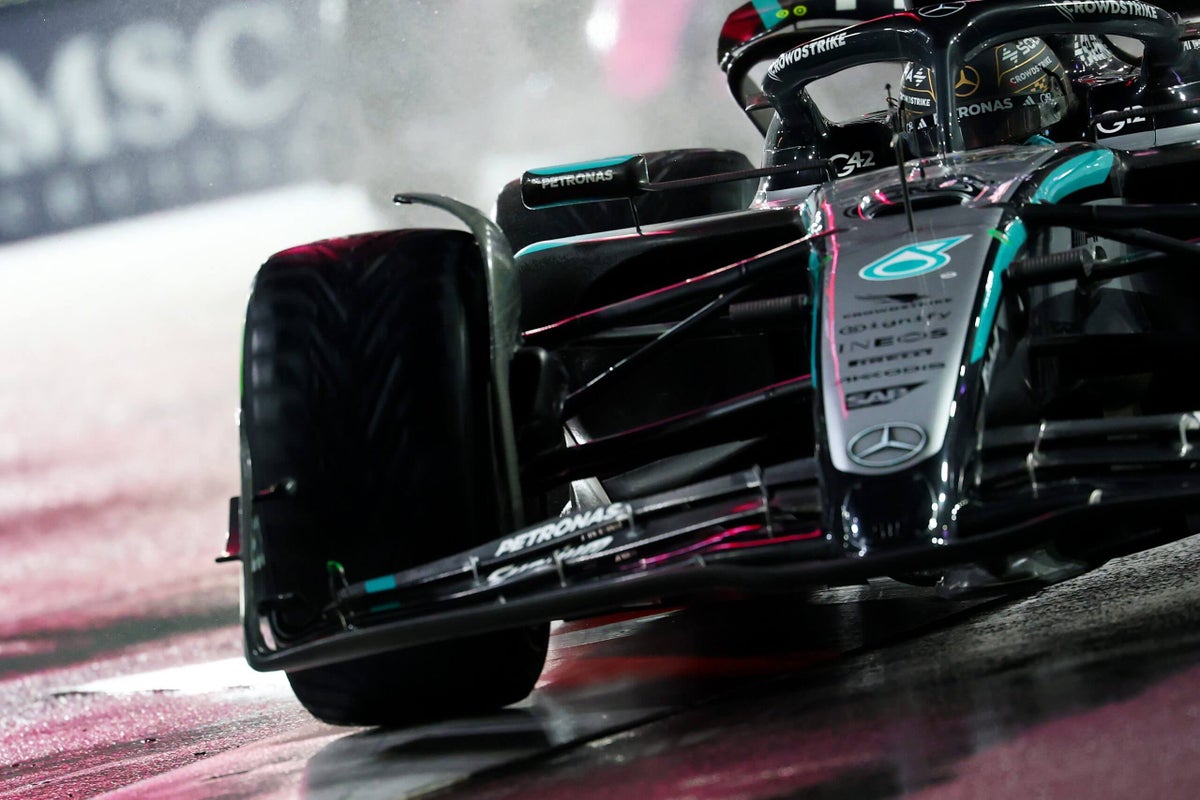
LAS VEGAS — Mercedes’ announcement on Thursday that American billionaire George Kurtz had become a co-owner was a landmark moment for one of Formula One’s biggest, most successful teams.
Kurtz, the founder and CEO of cybersecurity giant CrowdStrike, acquired a 15 percent stake in Toto Wolff’s investment company that owns one-third of the Mercedes F1, giving Kurtz an effective 5 percent stake in the team. He’ll also serve as its new technology advisor.
Kurtz’s involvement wasn’t as striking as the sums involved. A deal worth $300 million (£230 million) put a $6 billion (£4.6 million) valuation on the Mercedes team — a F1 record.
The commercial boom that F1 has enjoyed over the last decade has been transformative and incredibly lucrative for owners. Entire teams were changing hands for as little as $200 million five years ago, when Dorilton Capital bought Williams. According to Forbes, even F1’s smallest team, Haas, is now worth $1.5 billion, while the rest of the grid surpasses the $2 billion mark. It put Ferrari as the most valuable team at $6.5 billion.
The $6 billion figure makes Mercedes one of the most valuable teams not only in F1, but all of world sport. Using Forbes’ estimates, Mercedes is worth more than eight of the 32 NFL franchises, 24 of the 30 NBA teams, and ahead of soccer giants including Liverpool ($5.4 billion), Barcelona ($5.65 billion), and Paris Saint-Germain ($4.6 billion).
F1 benefits from its innate global reach, with races held in 21 countries each year. To secure a similar level of international appeal, the major American sporting leagues have moved to include overseas games as part of their regular-season scheduling — the NFL plays six games in five countries in 2025, the most in a single season. Mercedes and its fellow F1 teams already have a broad international footprint, allowing their valuations to rise to levels comparable to those of franchises in America’s “Big Four” leagues.
It’s a remarkable turnaround from where the Brackley-based F1 operation was less than 20 years ago. In 2008, Honda sold the team for a symbolic fee of £1 to exit the sport, with a takeover by Ross Brawn helping save it from going out of business. The rebranded Brawn GP operation won both titles in 2009, going down as one of the greatest fairytale stories in F1 history, before Mercedes invested and rebranded the team ahead of the 2010 season.
Mercedes has hit massive peaks under Wolff, who became a shareholder in 2013 and took the reins as team principal and CEO. It won a record eighth consecutive F1 teams’ championships between 2014 and 2021, with Lewis Hamilton winning six drivers’ titles in the same period.
Commercially, it also reached new heights. In 2014, it recorded a revenue of £146.9m and made a £77m loss; in 2024, revenue hit £636m and profits were £120m. Wolff said at the F1 Business Forum on Thursday in Las Vegas that the Mercedes F1 team would surpass $1 billion (£763 million) in revenue this year.
Sixty percent of Mercedes’ F1 revenue last year came from sponsorship and licensing agreements. It has enjoyed a long-standing title partnership with Malaysian state oil company Petronas. INEOS is a principal partner and one-third shareholder in the team, with the new valuation giving it a significant return on its £208m investment back in 2020. Mercedes’ other big sponsors include Meta, Adidas, Snapdragon, TeamViewer and UBS. The deal with CrowdStrike in 2019 helped lay the foundations for Kurtz’s eventual buy-in.
Wolff was intentional with sponsorship. He spoke at the forum about cutting back on the partner roster when he started in 2013. “I felt that some of the brands didn’t fit the brand of Mercedes, and we’re doing it in the same way today,” Wolff said, adding that he wanted to make sure the big brands that do fit “stay there forever because it’s just a no-brainer.”
In an interview with CNBC on Thursday to discuss the deal with Kurtz, Wolff highlighted the “tremendous growth” that F1’s fanbase has enjoyed. He pointed to the U.S. Grand Prix in October, which drew a race weekend crowd of more than 400,000, as proof of the sport’s pull.

Toto Wolff and George Russell celebrate during qualifying at the 2025 Canadian GP (Mark Sutton / Getty Images)
“I think those are very good indicators, also that our fan demographic is getting younger. Our strongest group is 15 (to) 24-year-old females, 42 percent females overall, whilst not losing the hardcore fan of the past.
“The indicators are positive, but the underlying product, the sport, needs to be good. The entertainment factor needs to be good whilst staying honest to who we are and what we are.”
The budget cap has supercharged valuations across the entire F1 grid, too. The FIA set the cap at $145 million in 2021, limiting spending for the first time. As well as fostering financial stability in a sport that had a reputation for teams going out of business and budgets spiraling out of control, it also meant shareholders now had an anchor for their investments.
Discussing the valuation in the CNBC interview, Wolff said that although “we’re still undervalued compared to American (sports) teams,” there was significant upside for Kurtz. Kurtz himself thought the U.S. market had been “really underserved,” giving F1 great room for continued growth.
That upside is felt across the paddock as investors, consortia and even countries all try to benefit from F1’s surge. Last year, Qatar’s sovereign wealth fund took a one-third stake in Audi’s future F1 operation (currently Sauber). Ryan Reynolds and Rob McElhenney’s consortium bought shares in Alpine last year on the back of their success with Wrexham. Dorilton Capital’s chairman, Matthew Savage, told The Athletic he receives multiple enquiries per week about taking a stake in or buying the team, but that the group has no intention of selling.
So why would Wolff sell even a small chunk now?
It’s not about the money. What appealed to Wolff about working with Kurtz was Kurtz’s success not only in business but also in motorsport. Kurtz is a pro-am class winner at the 24 Hours of Le Mans and races in the IMSA SportsCar Championship in the United States. “That is a skill or a niche, a combination of understanding that is important for us,” Wolff said.
The deal will also give Mercedes a chance to lean heavily on CrowdStrike’s technical capabilities as a partner. Wolff noted at the F1 Business Forum that sponsors are no longer looking for a simple return on investment in which they put a sticker on the car, but are instead actively collaborating to improve their operations and enhance on-track performance.
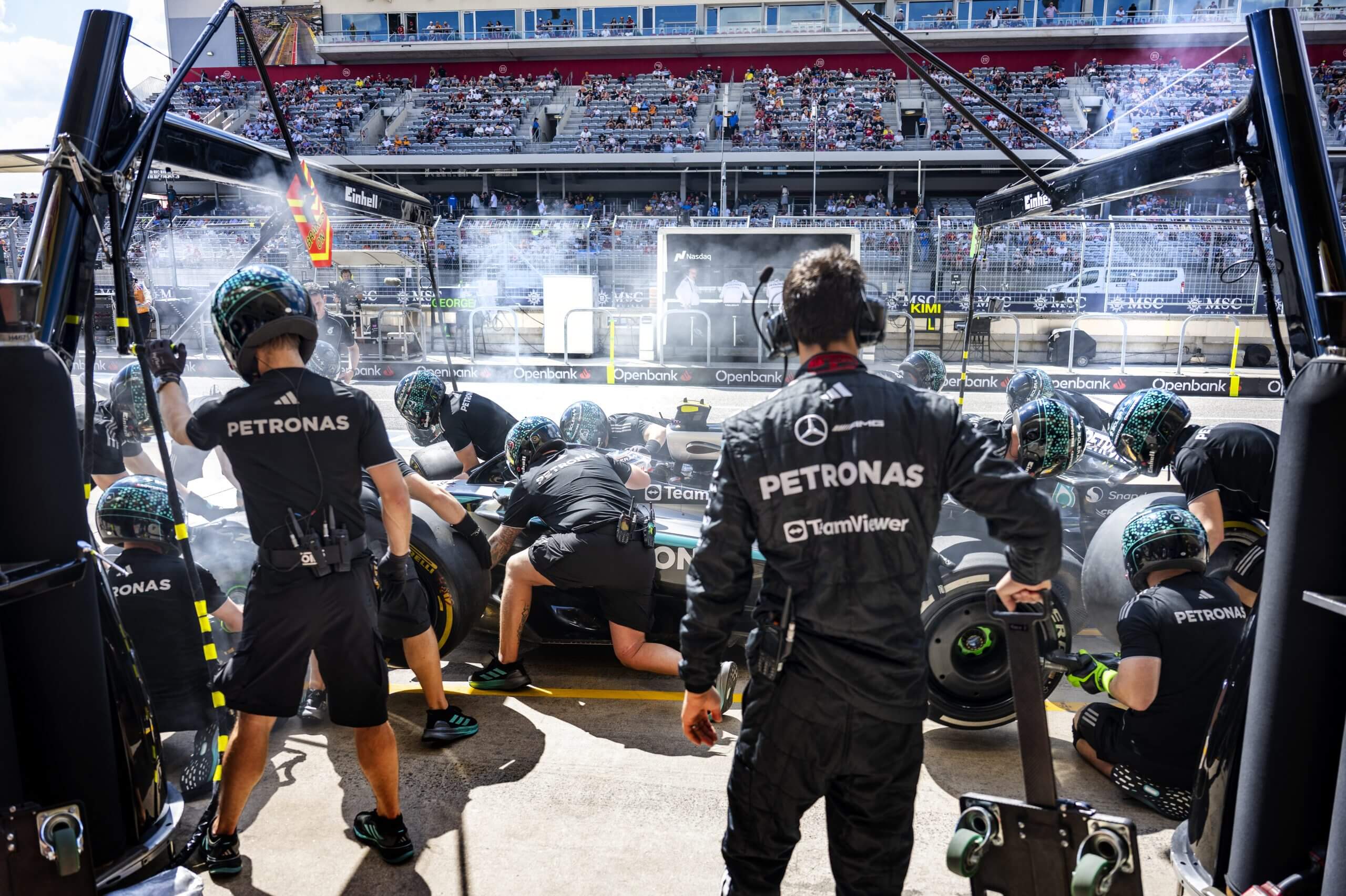
Smoke comes off hot brakes as Mercedes driver Kimi Antonelli makes a pit stop during the practice session for the United States Grand Prix (JIM WATSON/AFP via Getty Images)
But the sale of part of the shareholding is not the start of any exit strategy for Wolff from Mercedes. He remains the hands-on leader as team principal and CEO, and is committed as ever to returning it to the very top of the F1 pecking order after seeing Red Bull and McLaren beat it to titles in the past four seasons.
“When I started this adventure with Mercedes, we were in there for the long term,” Wolff said on CNBC. “I was in partnership with Mercedes for 20 years in touring cars, in smaller formulas, a shareholder of the Formula E team with them. This is the kind of journey that we had.”
The deal naturally creates a bit of financial liquidity, but is more about working with who Wolff deems to be the right partner in Kurtz and CrowdStrike. As Wolff put it, “we’re not sellers.”
Bringing Kurtz into the fold will not change the ownership structure. Wolff, INEOS and Mercedes-Benz each holding a one-third stake in the team. Wolff has referred to himself, INEOS chairman Sir Jim Ratcliffe and Mercedes-Benz chairman Ola Källenius as the “three amigos,” all of whom have enjoyed the wave of success through their investments.
Wolff’s one-third stake is held by his investment company, Motorsport Investment Limited, which he owns along with long-standing business partner Rene Barger. Wolff and Barger both sit on the team’s board, which also has equal representation from INEOS and Mercedes-Benz. Kurtz will not be part of the board.
$6 billion is a dizzying valuation for an F1 team, given where the sport was less than a decade ago. It speaks to the transformation not only of F1 itself, but also of Wolff’s role as the catalyst for Mercedes’ success both on and off the race track.