
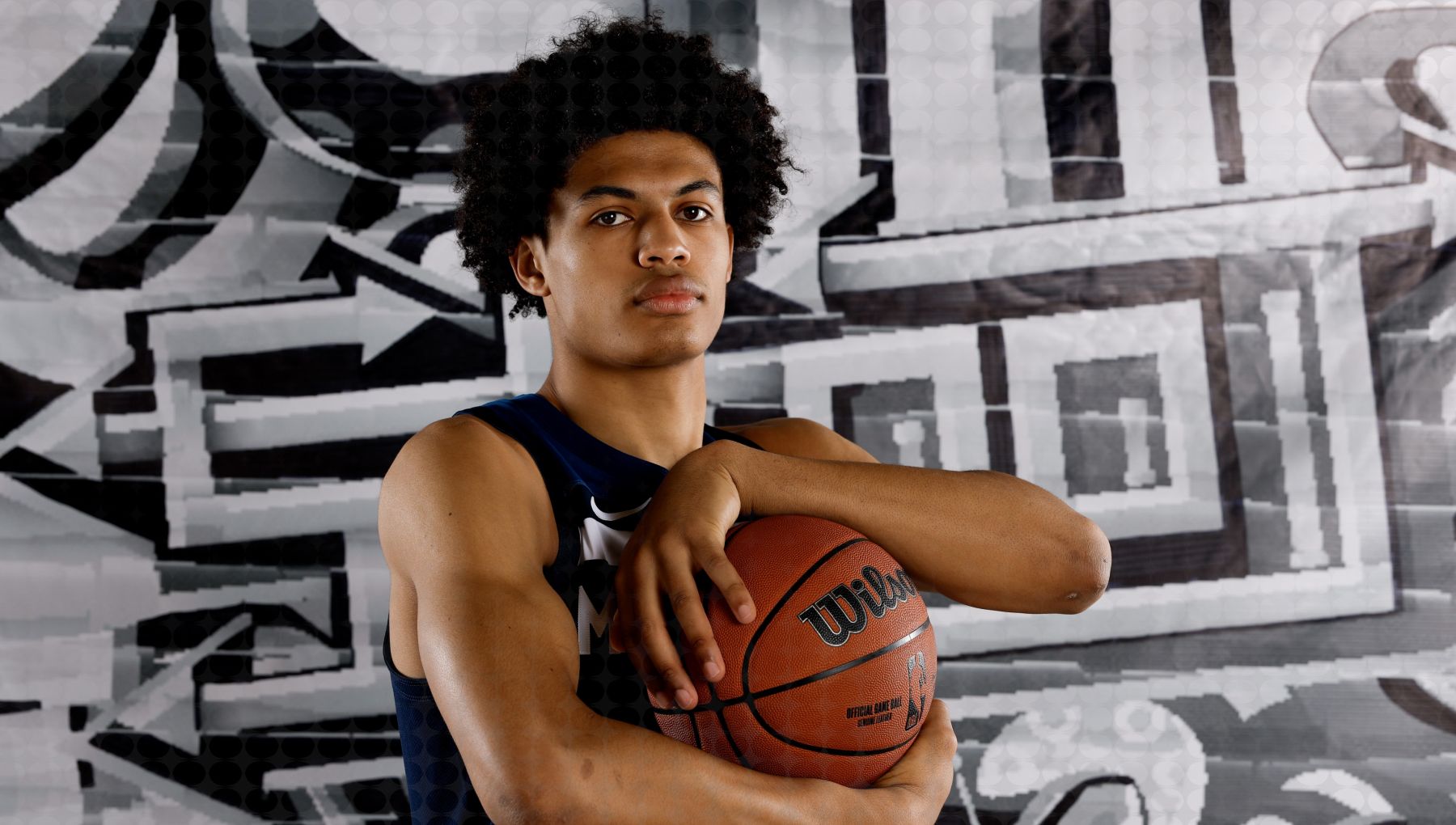
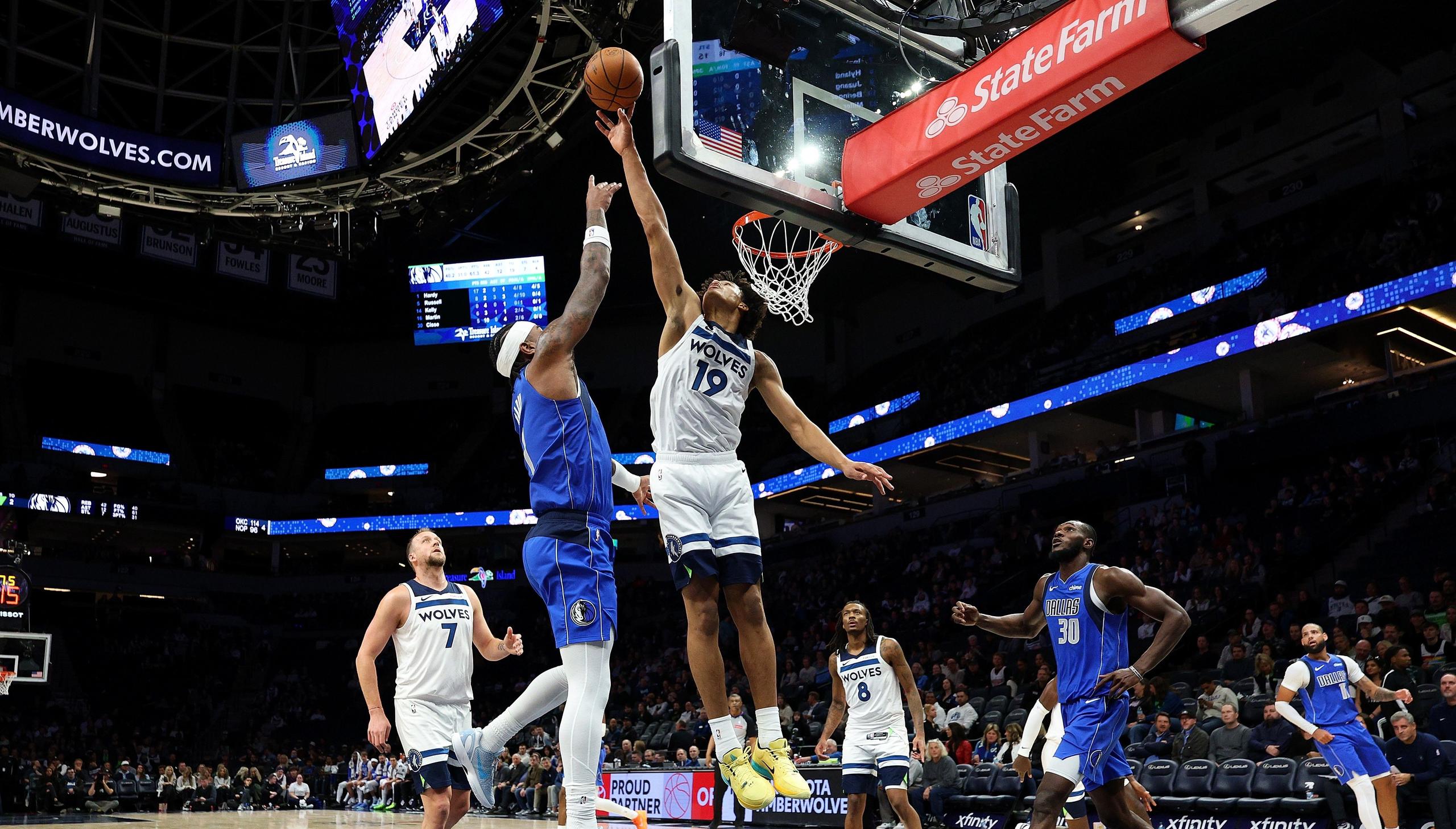
Joan Beringer (Photo by David Berding/Getty Images)
Joan Beringer’s rookie season has been as much about learning as it has been about on-court production. The 18-year-old French center, selected 17th overall in the 2025 NBA Draft, has averaged 2.0 points, 1.3 rebounds, and 0.2 blocks in 4.1 minutes per game while shooting above 70 percent from the field. His minutes have been brief, but the Minnesota Timberwolves view his development as a long-term investment built around habits, discipline, and feel.
Beringer arrived in the league with a nontraditional developmental path for a first-round pick. He did not log multiple seasons of senior-level European experience or NCAA competition. Instead, he rose through French youth clubs — first Saint-Joseph Strasbourg, then the SIG Strasbourg academy system at the U18 and Espoirs levels — before making one professional stop: a single season with Cedevita Olimpija in Slovenia, where he split time between the senior team in the Adriatic League and EuroCup and the club’s junior/reserve affiliates. Minnesota’s staff believes that limited professional mileage, combined with elite physical tools, gives them a clean slate to mold.
Before the season began, Timberwolves head coach Chris Finch said Beringer arrived with the most important trait a raw prospect can bring.
“He has come in and attacked it; he only knows one way to play, which is great,” Finch said. “He has no bad NBA habits. He’s as pure as they come when it comes to that. Which is great because we can now teach him exactly what we want to teach him. He’s surrounded by incredible pros on this team. I think that’s certainly going to help him. What he has is an unbelievable feel, and he’s just not afraid of the moment or environment.”
Building a Foundation of Routine and Professionalism
Beringer said the biggest early adjustments of his rookie season haven’t just involved learning plays or terminology, but understanding the daily discipline required to succeed in the NBA. Building a consistent routine, handling the physical demands of practices and travel, and approaching each day with purpose have become core focuses. He credits Minnesota’s veterans — Rudy Gobert, Naz Reid, Mike Conley, and Joe Ingles — for showing him what it means to carry himself like a professional on and off the floor.
“Probably my routine,” Beringer told RG.org. “My routine, and also how I work and the way to be a real pro.”
He said the support from teammates has been constant, helping him navigate the early growing pains of adjusting to the NBA at 19 years old. Whether through advice during drills, film breakdowns, or simple encouragement, the Wolves’ locker room has made the transition easier.
“On the team, I really learn from everyone,” he said. “Everybody is really kind and helps me a lot. I learn from everybody.”
The coaching staff has echoed that guidance, emphasizing defense, communication, and sharp execution during the short stints Beringer receives behind Gobert and Reid. With limited minutes available, the expectation is that he impacts the game quickly and cleanly when his number is called.
“First my defense — how to be present in defense,” Beringer said. “I try to always be good in my role. If I play five, six, seven minutes, I try to be good in my role, and the coach pushes me in this way.”
By mid-November, head coach Chris Finch said Beringer was progressing exactly as the team hoped. The Wolves expected a steep learning curve, but Finch said the rookie’s willingness to absorb information, take coaching, and adjust to the speed of the league has been a strong early indicator.
“He’s right on track,” Finch said. “Right now, it’s a bonus when we can get him these types of minutes. You can see him get more comfortable with the speed of the game, the recognition, physicality — it just takes reps. We love where he’s at.
“We’re going to keep bringing him along slow,” he explained. “He’ll probably head down to Iowa at some point so he can get real good run and extended minutes. That experience and exposure will be huge for him when he comes back up.”
The Gobert Influence and the French Connection
Although Beringer’s current NBA role is built around simple responsibilities — sprinting the floor, diving to the rim, and finishing plays created for him — the Timberwolves have carved out significant time for him to expand the skills he’ll need long-term. Coaches have worked with him on touch around the basket, improving his angles on seals and rolls, and beginning to introduce face-up work at the elbows and short corners. Those sessions have become a daily focus as the organization tries to broaden what he can eventually become while still keeping his in-game role streamlined.
“My feeling with the board and developing my face-up work,” he said. “I try to fix some limits and learn everything. I’m really open to everything, but now really focused on my face-up and all that stuff.”
Defensively, the Wolves see Beringer’s length, mobility, and instincts as the foundation of his future value. But for a young big — especially one transitioning from Europe to the NBA — timing, communication, and discipline often take the longest to develop. Minnesota has emphasized those areas every day in practice, pairing him with assistant coaches to drill coverages, drop technique, verticality, and weak-side rotations. Beringer said the message has been simple: anchor possessions, communicate loudly, and let effort set his baseline.
“I try to be present in defense and be good on all the defensive stuff,” Beringer said. “I put my energy on the court and impact the game with that energy.”
A major part of Beringer’s development has come through working closely with Gobert, a four-time NBA Defensive Player of the Year, a seven-time NBA All-Defensive First Team selection, and last season’s NBA All-Defensive Second Team center. Both share French roots, long frames, late-blooming basketball backgrounds, and the experience of arriving in the NBA raw but physically gifted.
“He’s been getting more and more comfortable,” Gobert said. “He’s been putting in a lot of work every day. He has that connection already with our guys. I tell him that even if you play three minutes, you have to be ready in those minutes and impact the game. He’s getting better and more comfortable. It’s fun to watch him evolve. He just turned 19, so it’s early, but he has the right attitude.”
Beringer said Gobert’s influence has been invaluable.
“His defense — he’s one of the best defenders in the league,” Beringer said of Gobert. “How he reads the game, his feeling of the game, and he’s a friend, so he can help me on the court and off the court. It’s a bonus for me. I really appreciate it.”
Gobert said the mentorship is intentional — and believes Beringer’s foundation gives him a real chance to grow into a meaningful contributor.
“It makes me happy and excited to watch him,” Gobert said. “For him to play with experienced guys is great for his development — understanding how to screen, how to maximize what teammates do. All those things are going to be important for his career.”
What Scouts Saw in His Rise Through Europe
Multiple league scouts who tracked Beringer’s rise from France to Slovenia and through the pre-draft process said his developmental curve has been far steeper than expected. One scout who evaluated him closely during the 2024–25 European season and again at Summer League said the growth in his feel and timing — areas that lagged behind his physical tools early on — now stands out as a major reason Minnesota is optimistic.
“You could see it pretty early in Summer League,” an NBA scout told RG.org. “The tools were obvious — the length, the pop, the way he moves — that stuff was always going to translate. What surprised a lot of us was how much his feel had jumped from when he was in France to his year in Slovenia. He picked things up fast over there. By the time he got to Summer League, he looked like a guy who’d already taken a big step. He’s still raw, but the progression has been real.”
Another international scout who followed Beringer since early in his career in France to his stint with Cedevita Olimpija said the biggest surprise has been how quickly he adapted to stronger competition. That evaluator emphasized that while Beringer was always an elite athlete with length, mobility, and vertical pop, his ability to read actions, anticipate plays, and process the game improved dramatically overseas before carrying over into Las Vegas.
“I saw him when he was still in France, and the feel wasn’t there yet,” an NBA international scout told RG.org. “He was all tools — long, springy, ran hard — but the game moved a little too fast for him. When he got to Slovenia, you could tell things started to click. His reads improved, his timing improved. By Summer League, he looked like a different player. The physical profile was always going to get attention, but the way his feel has come along is what really stands out.”
A separate Western Conference scout, who has visited Minnesota multiple times since training camp, said the Timberwolves themselves have been impressed — not just with Beringer’s tools, but with his professionalism, work habits, and willingness to absorb information. The scout added that having Gobert — another French center who arrived in the NBA with raw tools and had to learn the communication side of the position — gives Beringer an advantage few young bigs have.
“People in that building rave about how willing he is to learn,” the Western Conference scout told RG.org. “For a kid that young, the work habits are already there. He shows up early, he listens, he asks questions — that’s not normal for a 19-year-old big. And you have to remember: English isn’t his first language. For centers, communication is everything. He’s learning a new system, a new terminology, a new culture, all at once. Having Gobert there — someone who lived that exact transition — is huge for him. He honestly couldn’t ask for a better mentor. He’s still acclimating to the NBA, but once he gets comfortable, they think he’s going to be a real difference-maker. The tools are obvious, but the mindset is what gives him a real chance.”
Comfort in Minnesota and What Comes Next
Off the floor, Beringer said the transition to Minnesota has been easier than many expect for a teenager moving thousands of miles from home. He grew up in Sélestat, a small town in northeastern France with a population of just over 19,000 — a place defined by quiet routines, open spaces, and a slower pace of life. Minnesota’s environment, he said, has provided a familiar sense of calm amid the chaos of learning the NBA.
“I’m a fishing guy,” he said. “I love fishing in Minnesota because there are a lot of lakes here. I really enjoy it.”
Those similarities have helped ease the cultural jump he’s navigating at 19 years old, from language to food to daily expectations. He said the support from fans has added another layer of comfort.
“The fans are really kind,” Beringer said. “Even when I’m on the court, they’re always excited. I’m very happy.”
Beringer’s rookie season resembles a developmental redshirt — a year focused on strengthening his base, sharpening defensive responsibilities, learning NBA coverages, improving recognition speed, and adjusting to the pace of a league unlike anything he’s experienced before.
The Timberwolves believe the combination of his environment, mentor group and work habits will accelerate his growth once the game slows down for him.