
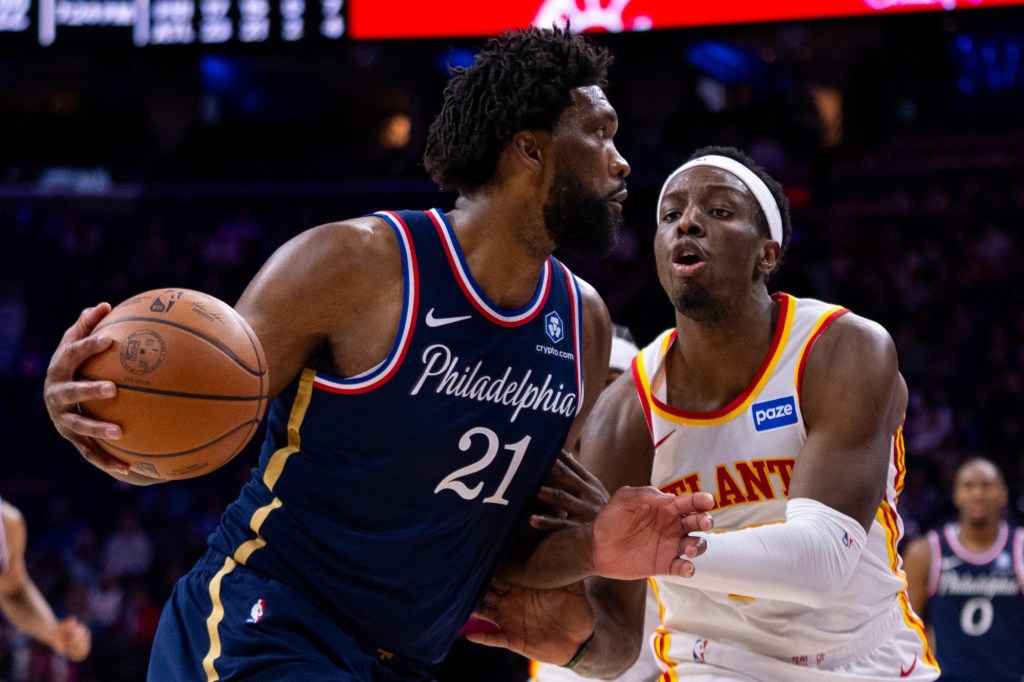
PHILADELPHIA — It took until Game 19 of the 76ers season for Joel Embiid, Paul George and Tyrese Maxey to be on the court simultaneously for the first time.
That number — 19 — is how many games Embiid’s body allowed him last season. It’s the number of minutes the trio logged together in Sunday’s 142-134 loss to the Atlanta Hawks in two overtimes.
And it’s three more than the total number of times that the Big 3 the 76ers assembled with so much fanfare in the summer of 2024 have been on the court together.
So if it seems that this debate over injuries and availability has grown tired, Sunday was a reminder that the 76ers’ latest, greatest chance at ending its title drought just crossed the 300-minute mark of on-court experimentation.
The work that many fans would love to see as completed remains, thanks to that avalanche of injuries, very much in progress.
“It’s just like the Boston game,” Embiid said after 30 minutes on court, lobbying to play the first OT session. “It feels like the first game of the season. You build on it. Not even mad about tonight. I’m just happy that I got a chance to play a game of basketball, build on it, and go from that to the next game.”
Embiid played six of the first nine games of the season, then missed nine straight with soreness in his right knee, not the one with the surgically repaired meniscus he was managing. George missed the season’s first 12 games in rehabbing his own knee injury.
It all was starting to resemble last year’s morass of injuries. Embiid, Maxey and George played 15 games together in George’s first season as a 76er, the team going 7-8. The Big 3 were on the court together for 294 minutes.
The two oft-injured ships happened to pass Sunday night, rendezvousing with rookie VJ Edgecombe’s return from a three-game absence from calf tightness for another first-time unit.
Embiid played 30 minutes, shooting 6-for-14 from the field, with four rebounds and two assists. He looked engaged if not always aggressive on the defensive end. Offensively, he started 4-for-6 from the field but trailed off late, though a few of the looks were quality.
George talked his way into a season-high 28 minutes in his fifth game, shooting 6-for-17 from the field for 16 points, plus seven rebounds, four assists and five steals. He was 2-for-8 from 3-point range on a day when the 76ers shot 23 percent (10-for-44) from deep.
“It was great to get out there with those guys, just log minutes together,” George said. “I think it was a ton of excitement, but we’ve obviously got work to do. But it was great, for how hard we’ve been trying to work to get back on the court and play and be available, to be able to be out there tonight.”
George exited in the first overtime with back tightness that he deemed not a problem.
Edgecombe hit his minutes restriction of 21 by the end of regulation, with seven points on 3-for-6 shooting.
The assembled product of all three on the court together was occasionally fluid but … well, it looked like three guys who’ve seldom played together and even more rarely practiced at full speed.
“There’s a place to go with the basketball,” coach Nick Nurse said of integrating Embiid. “There’s a whole bunch of stuff we can run through him. He draws a lot of attention to get other guys freed up. And then you don’t have it. But I thought the guys did a decent job of still creating some pretty decent shots.”
Embiid had just one shot from the field in a four-minute stint to end regulation. He missed his only shot of OT, a 16-foot rainbow that was a good look but rimmed off back iron.
He and Maxey settled into periods of two-man game, a cornerstone that seemed to come back with little issue.
“Obviously when you get down to it, the game is tight. You always feel like we always have that in our back pocket,” Embiid said. “We haven’t been able to use it, at least for my first seven games that I played, but when the game is close, you feel like we always have that. We know we have that connection. We’ve got that chemistry. But as we go on for the rest of the season, I think it’s all about, obviously, involving everybody else playing together.”
The challenge is to expand that comfort zone to incorporate more options. The 76ers offensive rating fell to 20th in the NBA in the month of November, largely without Embiid. They are 6-9 since a 4-0 start to the season, but there are aspects of the non-Embiid game plan worth preserving with him back.
“It’s different, because he’s still really good,” Maxey said. “We’ve still got to give him the ball. We’ve also got to run our stuff. It’s going to come with time. That’s our first time playing in the game with VJ and Joel. … We haven’t really practiced with that group, so it’s kind of hard. But that’s no excuse.”
“It’s going to take some time,” guard Quentin Grimes said. “Everybody’s going take time to get their rhythm back. Paul’s slowly coming back, VJ missing a couple of games. So it takes time. We’ve just got to get that rhythm on the court. We haven’t practiced much as a whole unit together, but as time goes on, we started learning how to play with each other, what everybody likes to do, their tendencies.”
Much as Embiid’s latest absence seemed to drag on, it was in fitting with the preseason plan. On the 76ers’ media day in September, Embiid said he’d take it day by day all season. If things unexpectedly cropped up and his body needed time to recuperate, he would take it. That applied to the left knee that has dogged him since February 2024, and it applied to any unforeseen new issues.
That adjustment phase upon his return is an inherent part of that plan. And with more practice and repetition, maybe it too will lessen.
“It’s going to happen,” Embiid said of the injury setbacks, before quickly diverting the conversation in a different direction. “You can’t put your head down and whine about it. You have to keep working hard and get back at it as close as possible. What can you do? The only thing you can do is keep doing the right things, focusing on the right things and just go from there.”