
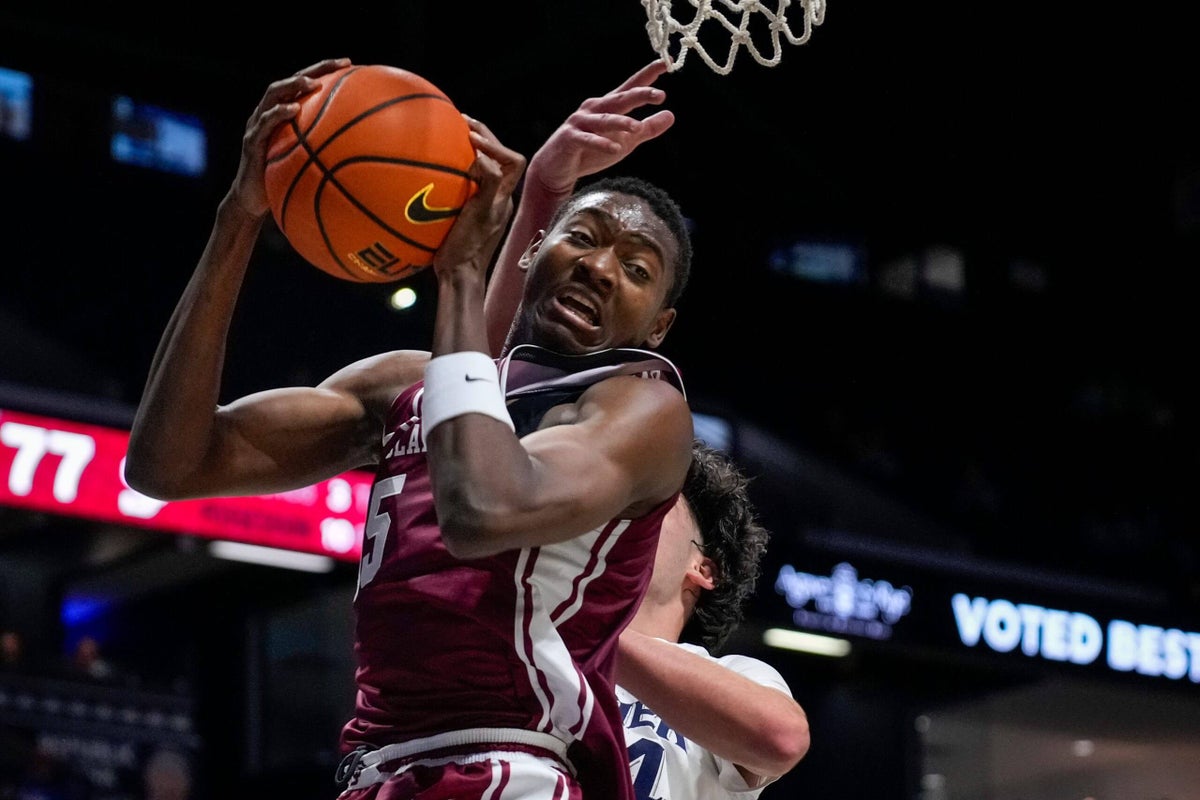
Thierry Darlan caught the ball on the left wing, took two dribbles and skyed for a rim-rattling dunk that sent the crowd, his teammates and the play-by-play announcer into a frenzy.
A 6-foot-8, 210-pound guard, Darlan was playing with the G League Ignite when he posterized the Stockton Kings during the 2023-24 season. He spent two seasons in the NBA’s developmental league, hopeful that his time there would lead to a major NBA contract.
Fast-forward two years, and the uniform has changed, but not the end goal. Darlan, 21, is still playing and pursuing an NBA career, but now he’s doing so in college basketball at Santa Clara University, a Jesuit school in Silicon Valley.
“To be honest, I never saw myself being back in school,” Darlan told The Athletic. “But the NBA is still the goal, that’s what I’m here for, trying to get more experience, trying to get better.”
Originally from the Central African Republic, Darlan prepped at NBA Academy Africa in Senegal before landing in the G League. Launched in 2001 and formerly called the D League, it’s home (mostly) to recent NBA draftees and players on two-way contracts, players aspiring to be full-time NBA contributors.
In September, the NCAA surprised the college basketball world by announcing that Darlan was eligible for college hoops despite his professional track. When Darlan made his Santa Clara debut on Nov. 4, scoring 13 points and grabbing 13 rebounds in 28 minutes against Cal Poly Humboldt, he became the first G League alum to suit up in a college game. But based on what the NCAA has said — and otherwise approved in the last few weeks — he won’t be the last.
College coaches have been largely critical, directing their ire at the NCAA, furious that the governing body seemingly reversed its eligibility rules overnight. Michigan State’s Tom Izzo called it “embarrassing” and “ridiculous.” Purdue’s Matt Painter was “at a loss for words,” and initially wondered if it was a well-timed prank.
By NCAA rules, athletes must maintain “amateur status” to compete in college sports. Basketball athletes who hit three criteria — five years or less removed from high school graduation; NCAA qualifiers out of high school; didn’t enter the NBA Draft — can make a case for college eligibility.
For decades, the NCAA has granted international athletes eligibility, even if they have some pro experience. Because Europe doesn’t have a college athletic system like the U.S., international athletes often play in leagues while making enough to cover basic expenses, like travel or lodging — a far cry from the pros in the NBA or EuroLeague who regularly cash million-dollar checks. Some G League players fit similar profiles, which is why two other G League alums also have been given the nod to enter the college ranks.
And given the name, image and likeness money now available to college athletes, the gig is more attractive than before. Players can make more money in college than in the G League, by far.
In October, London Johnson, a four-star recruit from the 2022 class who played three seasons in the G League, announced his commitment to Louisville. The 6-foot-3 guard from Norcross, Ga., who averaged just under eight points per game in three seasons, played for the G League Ignite, the NBA’s development squad for young draft prospects that was shut down in 2024. He’s expected to join the Cardinals this winter, redshirt the rest of this season and play in 2026-27.
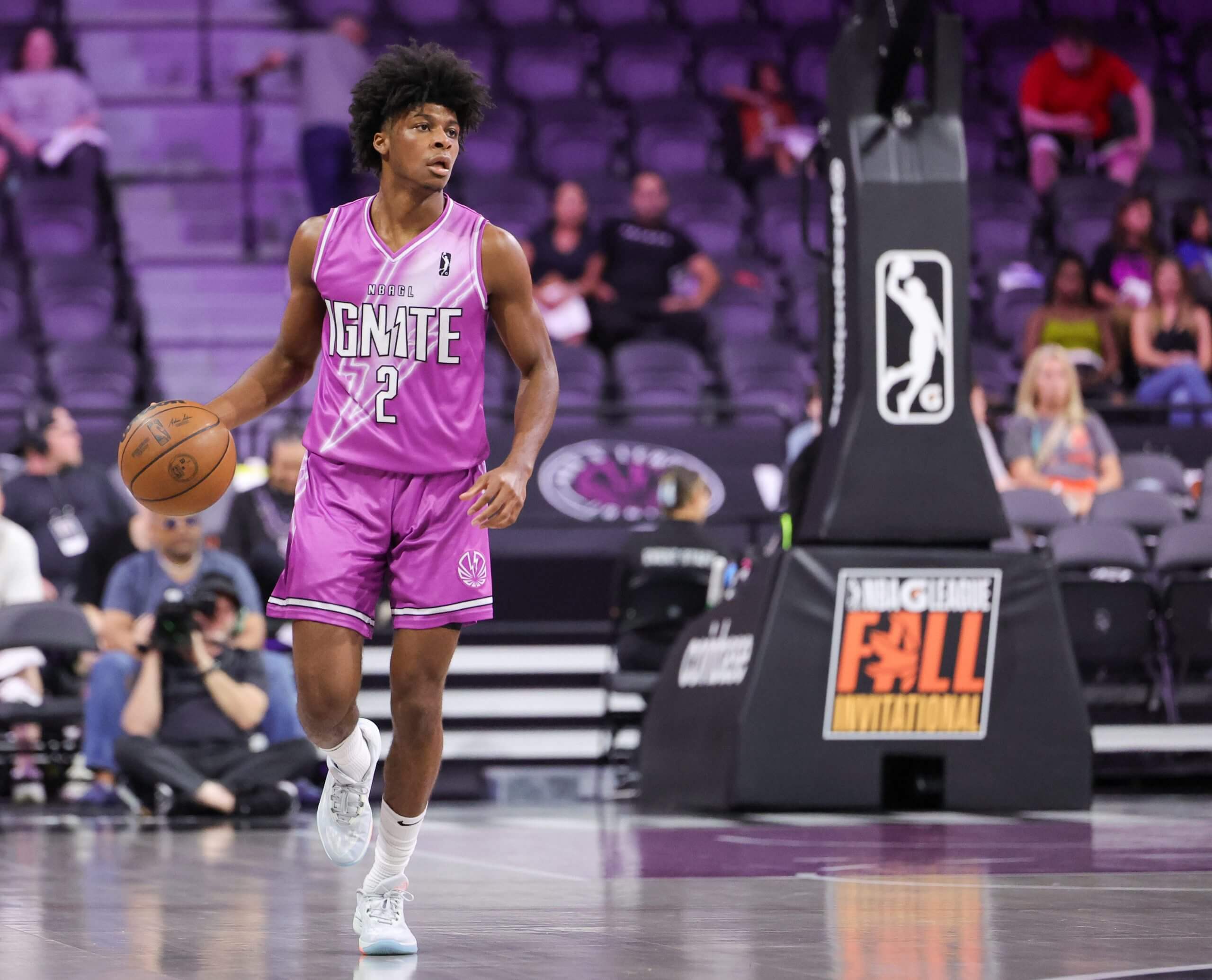
London Johnson will join Louisville for the 2026-27 season after a three-year G League career. (Ethan Miller / Getty Images)
And in November, 6-foot-10 center Abdullah Ahmed, who played with the G League’s Westchester Knicks, announced his commitment to BYU, picking the Cougars over Houston. Like Johnson, Ahmed is expected to play next season. BYU inked Ahmed during the early signing period as part of its otherwise traditional recruiting haul, which featured a junior college player and two high school athletes.
NCAA is ‘afraid they’re going to get sued’
The NCAA doesn’t comment on individual eligibility issues, but a spokesperson said the organization looks at each case individually instead of painting with a broad brush. Regardless of the specific reasons each of the three players listed above were deemed eligible, various stakeholders in the sport have not welcomed the news.
“So let me get this straight, we can now recruit G league players? Is the NBA next?” St. John’s coach Rick Pitino posted on social media, joking that he had “first dibs” on two-time league MVP Giannis Antetokounmpo of the Milwaukee Bucks.
So let me get this straight, we can now recruit G league players? Is the NBA next? I have first dibs on @Giannis_An34 😂
— Rick Pitino (@RealPitino) September 24, 2025
Izzo was more blunt, saying the governing body is allowing G League players into college only because “they’re afraid they’re going to get sued.”
In the wake of college athletes being able to profit off their NIL, which became legal in 2021, the NCAA has faced numerous lawsuits involving eligibility, centered on claims its rules are restricting athletes’ earning potential.
“More schools are recruiting and enrolling individuals who have competed professionally — including many with experience in international and domestic leagues who may find college sports more appealing given the financial benefits now available,” an Oct. 24 email from the NCAA to its membership read. “Each player’s situation is unique, and these issues arise at a time when NCAA eligibility rules are facing repeated lawsuits … in making its eligibility decisions, the NCAA endeavors to treat prospective student-athletes, whether domestic or international, as consistently as possible.
“These cases,” the email read, “are likely to continue.”
In other words: Welcome to the new world.
Other coaches aren’t necessarily outwardly in favor of said new world, but they understand college sports are an “adapt or die” environment.
“It’s a waste of time to complain about it,” said first-year Auburn coach Steven Pearl. “If there’s a loophole that you can expose and exploit to help make your team better, that’s what you have to do. I think what Louisville (did) is brilliant. Those guys are creative thinkers and they’re trying to find ways to be ahead of the curve.
“If you’re allowed to do it, I don’t see what the problem is. I get that it’s different than it used to be.”
He shrugged.
“Every day, every week, (the rules) are changing. So you gotta roll with it.”
NIL pays more than G League contracts
The way Todd Ramasar sees it, Darlan “should have always been in college.”
Ramasar, who owns Life Sports Agency, brought Darlan on as a client in April 2024. When they talked about Darlan’s NBA dreams, Ramasar saw a path to the pros, just not through the G League.
Ramasar understood why Darlan picked the G League over college basketball, including an offer from Santa Clara, in 2023. It offered him money, a way to “take care of his family” back in Africa, Ramasar said. But because of NIL, college players can do that now, too.
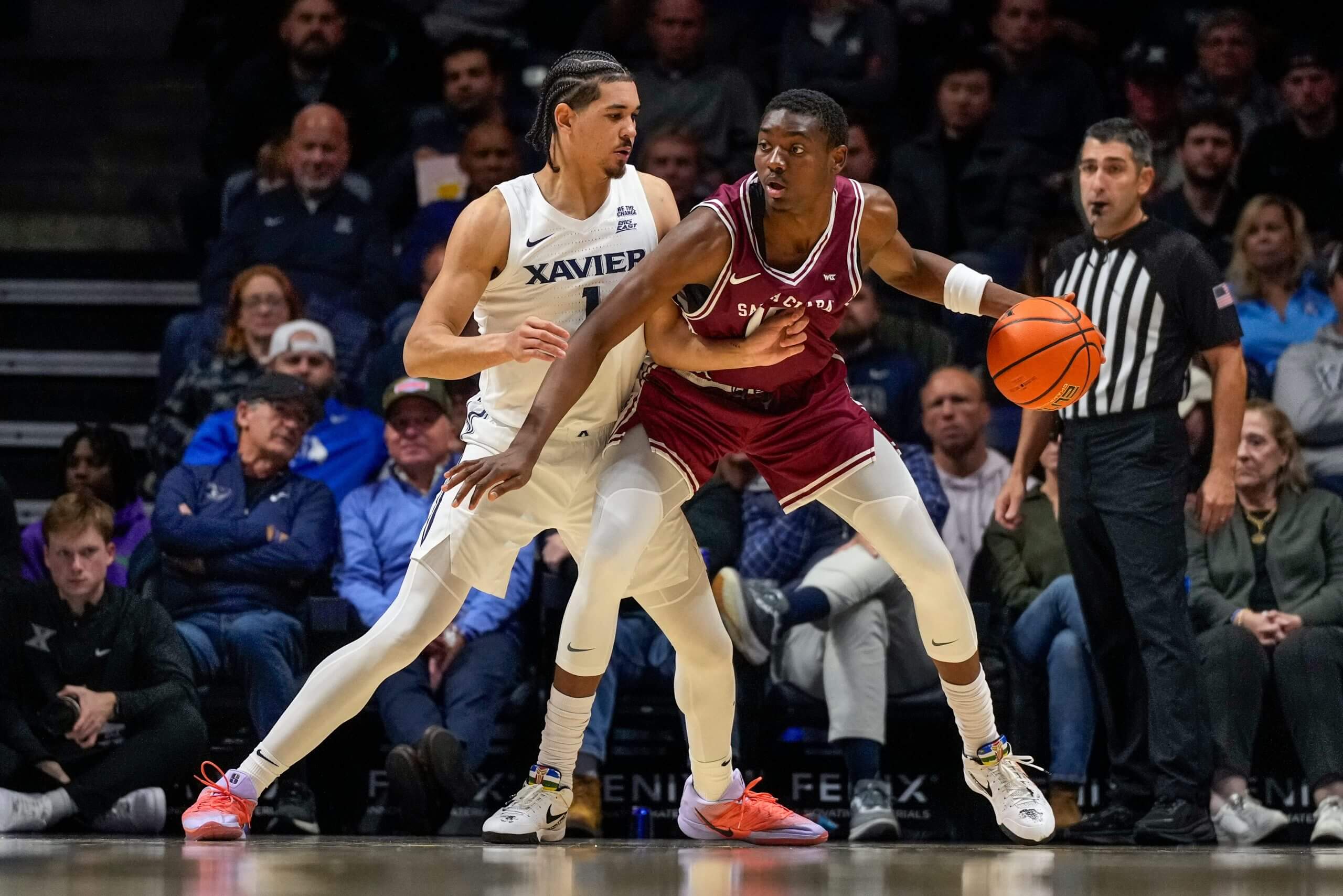
Thierry Darlan sees the college route as a better path to the NBA then the G League. (Sam Greene / USA Today Network)
The stark financial contrast is noteworthy. In the G League, players often sign contracts for less than $50,000. In college, a combination of NIL and rev-share has led athletes to regularly make more than six figures. Consider that Texas Tech’s JT Toppin got $4 million to return to Lubbock while top recruit AJ Dybantsa got more than $5 million to go to BYU.
To Ramasar, college eligibility for Darlan was a no-brainer, even if the player had to adjust to a more regimented school schedule.
“Thierry was never offered an NBA contract, and he wasn’t paid at an NBA level,” Ramasar said. “I didn’t think it was going to be that difficult to argue for (Darlan’s eligibility). I just knew it was going to be bigger news because of the G League.”
Ramasar pointed out that Darlan was an NCAA qualifier in 2023, which would have been his freshman year of college. Had the NCAA not ruled in Darlan’s favor, Ramasar planned to encourage Darlan to sign with a pro club overseas. (The NCAA granted Darlan two years of college eligibility.) Darlan still has NBA ambitions, and Ramasar has told him college basketball and pro clubs overseas offer him a better chance to realize those dreams.
The G League, Ramasar argues, isn’t actually about development. Essentially, he said, it exists for players who have already been anointed — not guys like Darlan, who are trying to play their way into an NBA contract.
“The G League is there for players who have been drafted by NBA teams, are under NBA contracts who need minutes and reps,” he said. “The reality is, from an NBA perspective, they do not look at G League underclassmen the same way they look at guys in college; they put college at a higher platform. (Outside) people look at the G League as a professional league … but it’s a minor league.”
Darlan said he’s already benefited from the college system. Asked how practices in the G League compared to those at Santa Clara, he chuckled loudly.
“You practice in the G League, but not crazy like you do in college,” he said. “In college, every practice is like a game — you’re going to sweat, even if it’s a walk-through. Practice is really intense in college, we go really hard at each other.”
Former pro hockey players can join NCAA, too
Darlan’s journey to college sports might be unconventional, but it’s not entirely unheard of. There’s precedent for the move in a different sport.
In November 2024, the NCAA voted to allow former Canadian Hockey League players to compete in NCAA Division I, starting in 2025. Players will maintain eligibility so long as they aren’t “paid more than actual and necessary expenses” as part of their CHL participation. (CHL players remain ineligible for Division III hockey.)
The change is expected to alter the landscape of college hockey, and its effects were felt immediately. In July, Gavin McKenna, one of the best players in the CHL and the projected No. 1 pick in the 2026 NHL Draft, announced he’d attend Penn State, bucking the traditional path for elite players.
As for Darlan, he isn’t worried that he’s coming off the bench or that he’s averaging only 5.6 points and 4.9 rebounds per game for the 7-1 Broncos.
“The college game is way, way different,” he said. “There’s not as much (spacing), the pace is different, but I’m getting used to it. Coming off the bench doesn’t mean nothing for me. If I’m helping the team win, if I can do little things, that’s what matters to me. The coaching staff is helping me a lot, I’m getting better every day.”
Ramasar isn’t convinced the recent rulings on former G League players mean it’ll become commonplace in college hoops. The incentives of NIL, he thinks, will funnel even more players to college, skipping the G League — or overseas professional leagues — entirely.
Since Darlan became eligible, Ramasar said he’s gotten calls from numerous schools curious to hear which, if any, loopholes he exploited. He said that attitude misses the point of Darlan’s individual story. He didn’t make a case for Darlan’s eligibility to “open the floodgates of new business.”
Coaches don’t necessarily anticipate blanket eligibility for former G League players either. But they’re preparing for all scenarios.
“At the end of the day, we’re not the ones making decisions,” Baylor coach Scott Drew said. “We either adapt to the rules or we get left behind.
“So until something changes, I guess all of us are watching G League games now.”