
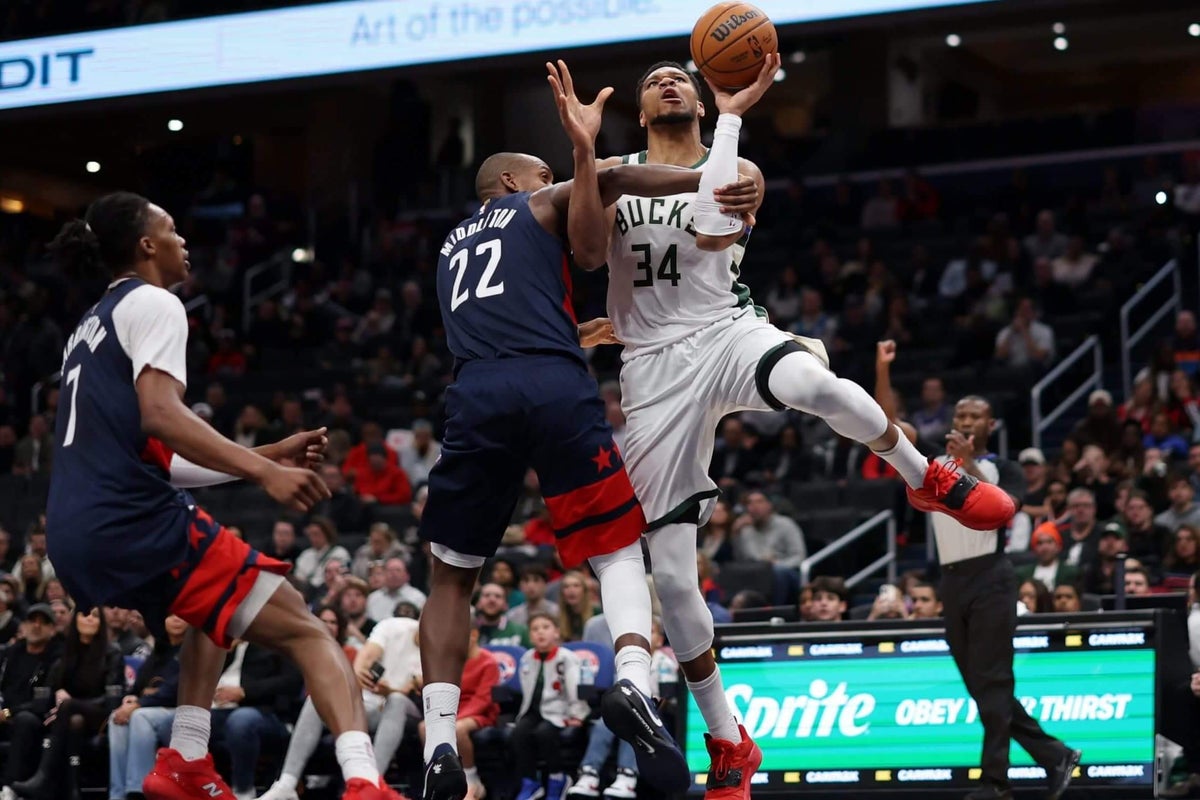
Following the Milwaukee Bucks’ shocking 129-126 loss to the Washington Wizards on Monday night, head coach Doc Rivers laid out the defeat in simple terms in one of his first postgame statements.
“They had 18 more shots than us,” Rivers said. “You know how hard it is to win a game when you spot a team (18 shots)? … I always tell people, ‘Just imagine saying, you get the first 18 shots and then we’ll start the game, right?’ ”
He made a nearly identical statement following the Bucks’ 118-109 loss to the New York Knicks on Nov. 28.
“The bottom line is they had 13 more shots than us, they had eight more free throws,” Rivers said. “We’re outshooting teams (in accuracy), shooting 52 percent. But it’s the turnovers, it’s the offensive rebounds, it’s the fouls.
“It’s a numbers game, and we have to win that game. Especially with Giannis (Antetokounmpo), if we win that game, we’re going to win the game.”
Taking fewer shots (and often fewer free throws) than their opponents has been an issue that Rivers has noted after multiple losses this season. Because fouls and free-throw attempts can play a role in how many shots a team takes on a given night, shot attempts can be a bit rudimentary. However, they still serve a useful purpose as a quick and rough snapshot of how a game played out shortly after it finished.
The Bucks have now lost 13 games this season. Giannis Antetokounmpo has played in eight of those losing efforts. Opponents have taken more shots than Milwaukee in six of those eight losses with Antetokounmpo on the floor.
With a little more than one quarter of the season complete, the Bucks have a possession problem. They desperately need to find a way to fix it if they want to discover a winning formula that will turn their season around and put them in a playoff position by the end of the season.
So, how can they fix it?
Let’s take a look at each category that affects how many shots a team (and their opponent) takes in a game and how likely it will be for the Bucks to make a change in that category moving forward.
Offensive rebounds
According to Cleaning the Glass, the Bucks are 30th in offensive rebounding rate, grabbing only 23.3 percent of their misses. The Bucks have been last in the category for nearly the entire season and were last in the 2024-25 season as well, grabbing only 21.7 percent of their misses. That aligns with precedent, as a team coached by Rivers has finished 20th or lower in the category in seven of the last 10 seasons.
After discussing the possession problem following Friday’s loss in New York, The Athletic asked Rivers whether a desire to flip that number might lead the Bucks to pursue offensive rebounds more aggressively before Saturday’s game against the Brooklyn Nets. He made it clear that Milwaukee’s offensive rebounding figure was unlikely to change moving forward.
“We can tell our guys, all of them, to go offensive rebound every time, the numbers aren’t going to change,” Rivers said. “I really do believe this and every coach that I’ve talked to in the NBA feels like if you have a group of guys that can offensive rebound, you should offensive rebound. If we can’t defensive rebound very well, what makes you think we can offensive rebound very well?
“So I’m more concerned about defensive rebounds — far more — than I am about offensive rebounds because if we defensive rebound better and take the other team’s offensive rebounds away, then the numbers game will start going on our side.”
Defensive rebounds
As Rivers stated, the Bucks have not been a good defensive rebounding team this season either. They are currently 18th in the category, but that figure is misleading because of the time Antetokounmpo missed due to his left adductor strain.
After ranking 25th in defensive rebounding rate through their first 12 games, the Bucks have posted the fourth-best defensive rebounding rate among teams over their last 10 games and grabbed 73.4 percent of available rebounds, per Cleaning the Glass.
While this figure suggests the Bucks have done a much better job of grabbing defensive rebounds, opponents have posted the third-best effective field-goal percentage against the Bucks over the last 10 games. So it may be tough to say the Bucks have improved on the defensive glass; they might just be forcing fewer misses.
However, when asked by The Athletic about the possession battle over the last few weeks, players throughout the roster have consistently cited defensive rebounding as the issue they expect to be easiest to fix moving forward.
“Rebounding is one thing everybody can do well,” Bucks big man Bobby Portis told The Athletic following shootaround before the Bucks’ 106-103 loss to the Miami Heat. “Everybody leaves the game with like four rebounds, that would clean up a lot.
“I feel like teams get a lot of offensive rebounds against us, a lot of second-chance opportunities. If everybody finishes the game with four, five rebounds, that will definitely help our defense out. You finish the possession with a rebound.”
While it might seem simple, the Bucks have struggled to get the job done on the glass, and at least part of that is due to their roster construction.
With Taurean Prince indefinitely sidelined following neck surgery, the Bucks don’t have any wings left in their rotation. That rotation consists of guards — Ryan Rollins, Kevin Porter Jr., AJ Green, Gary Trent Jr. — and bigs — Antetokounmpo, Kyle Kuzma, Portis, Myles Turner — right now with no one in between.
With few options on the wing, Rivers has often opted to start three-guard lineups and lean into undersized units, and the Bucks have struggled to be a strong defensive rebounding team.
Committing turnovers
As of Tuesday morning, the Bucks are 15th in offensive rating, scoring 116 points per 100 possessions. Here is where they rank in the four factors offensively:
Effective field goal percentage: 2nd
Turnover percentage: 12th
Offensive rebounding: 30th
Free throw rate: 30th
While there is a discussion to be had regarding how many free throws Antetokounmpo should be awarded on any given night, there is little argument about how many players on the roster consistently put pressure on the rim for the Bucks to earn free throws consistently.
Outside of the Bucks’ superstar forward, Rollins and Kuzma have done it at times, and Porter can be added to the conversation now that he is back from injury. However, that is about it.
With an offense built around Antetokounmpo and great 3-point shooting, the Bucks don’t appear to have the personnel to climb much higher in free-throw rate. And that brings the conversation to turnovers.
Suppose the Bucks are not going to get extra offensive opportunities through offensive rebounding, as Rivers has made clear, and get fewer points at the free-throw line, as their roster and tactics suggest. In that case, they have to be nearly perfect with the ball and commit as few turnovers as possible each night.
Creating turnovers
Following Saturday’s win over the Nets, Rivers discussed how the Bucks could potentially change with Porter back in the fold after he missed 19 of the first 20 games. That included a few notes about how the Bucks might now be able to apply the pressure on opposing offenses he envisioned before the season with Porter and Rollins on the floor, a sentiment the Bucks’ best player echoed after the game.
“(Porter)’s incredible, especially when you have Ryan and Scoot out there, they just make it tough,” Antetokounmpo said after Saturday’s game. “Sometimes, I get a hand on the ball and I might not be able to get it and then all of a sudden you see a guy just — pew — come in from the backside and get the ball. And sometimes, it’s Ryan and sometimes, it’s Scoot.
“Just having both guys on the court, you just make it tough for the other guard. They both can guard, and I think Scoot is deceiving. He’s like 6-7 … he’s big. He can use his hands and get deflections; he can get rebounds. He’s able to guard. So just having him out there defensively, it’s big.”
To this point, the Bucks’ stated preseason goal of being a more physical defensive team has only led to a minimal amount of turnovers (20th in turnover percentage) and regular foul trouble (fifth worst in free-throw rate).
Porter’s presence should help in both categories. Still, through two games, those efforts have been inconsistent, and it doesn’t appear as though his reintroduction to the roster will transform Milwaukee’s defense into one of the league leaders in turnovers.
Summary
Whether it is due to roster construction issues or tactical decisions, the Bucks appear to have clear structural limits on what they can do to fix their possession problem.
With offensive rebounds off the board and free-throw opportunities limited, the Bucks will need to do a better job of focusing on what they can control on the offensive end and further limiting their turnovers. Because of their lack of size defensively, the Bucks will only be able to do so much on the defensive glass, which means they may need to find ways to create havoc for opposing offenses to force more turnovers.
No matter what the Bucks do, the possession battle will play an essential role in every game, and their focus on the parts of the game that dictate that number needs to improve moving forward.