
Want more ways to catch up on the latest in Bay Area sports? Sign up for the Section 415 email newsletter here and subscribe to the Section 415 podcast wherever you listen.
The Warriors are past the quarter-mark of their season, and there are a lot of balls in the air.
Reinforcements are either here or on the way. Both the end of Golden State’s roster and its bench are in a state of flux.
At long last, Seth Curry is here
In the far-left corner of the far-left court at the Warriors’ practice facility, Seth Curry was doing what he’s done for 11 years: rip the net.
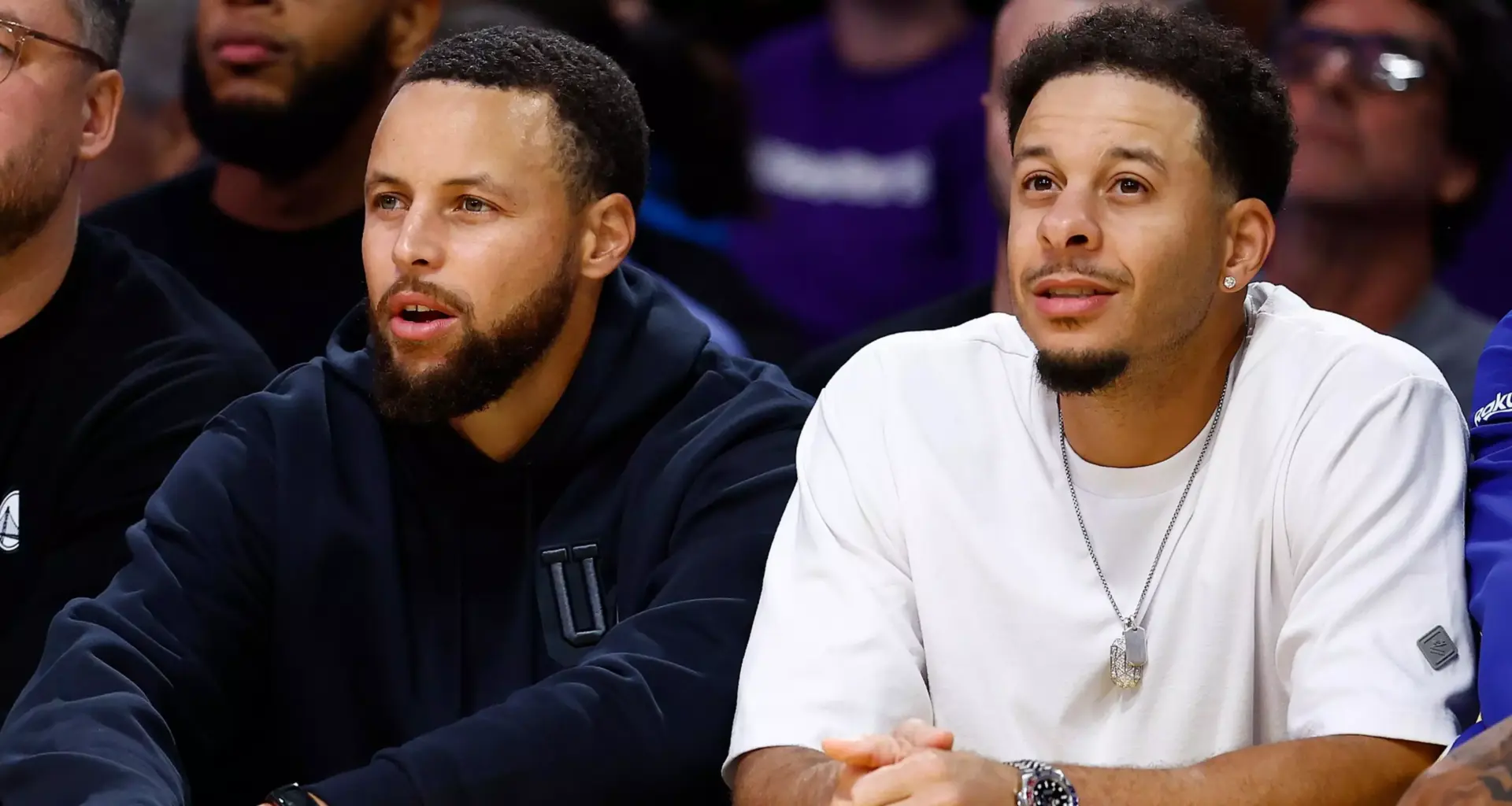
Curry joined the Warriors on Monday after officially signing his contract, a prorated veteran minimum deal worth roughly $1.7 million that unites him with his older brother. He’ll be active on Tuesday against the defending champion Oklahoma City Thunder, head coach Steve Kerr said.
After leading the league in 3-point percentage last year, Curry joins a team that’s first in 3-point attempt rate, second in total attempts per game, and just 15th in accuracy.
Curry has been around the team for large portions of this season — including the Warriors’ long road trip in mid November — as both he and the Warriors expected this to be the outcome all along. But because he wasn’t on the roster, he had to find trainers and other players to scrimmage with in order to keep sharp.
Why did the Warriors wait so long to sign Curry? Well, because they’re hard-capped at the second apron, every passing day before signing Curry gave them a tad extra buffer between that ceiling.
That leeway could come in handy in the event of a trade. If the Warriors send out four players for one, like they did last year to acquire Jimmy Butler, they’ll have to fill out the roster with minimum salaries; every team needs at least 14 rostered players (with a few rare exceptions).
Last year, the Mavericks ran into trouble after the Luka Doncic-Anthony Davis blockbuster trade. Dallas was just a few thousand dollars shy of their first-apron hard-cap, and couldn’t fulfill the hardship contract exemptions they were eligible for because they would’ve pushed them over the limit. So the Mavs completed a game with just seven healthy players. That’s a break-glass-in-case-of-emergency scenario the Warriors were trying to avoid by waiting a couple weeks to sign Curry.
Curry didn’t seem to mind.
Chris DeMarco’s offramp
DeMarco, the longest-tenured coach on the Warriors’ staff, has accepted the head coach position for the New York Liberty of the WNBA. He recently spent quality time catching up with Liberty star Sabrina Ionescu, the Walnut Creek native, at last Monday’s Jazz game.
“Oh so you’re taking our coach?” one onlooking Warrior joked to Ionescu in the Chase Center bowels.
The Liberty have yet to announce DeMarco’s hiring, but that’s just a formality.
Plans are subject to change for a number of reasons, but DeMarco is expected to stay on with the Warriors through December, per sources. Given the state of WNBA collective bargaining negotiations (opens in new tab), an early January start for DeMarco is likely at the moment.
 Chris DeMarco will remain with the Warriors through the end of December. | Source: Jeff Chiu/Associated PressDe’Anthony Melton is nearing a return, and the backcourt is even more crowded
The last time Melton was on the court, he had a folk-hero’s six-game stint with the Warriors.
Then he tore his ACL. The Warriors traded him to Brooklyn for Dennis Schroder, and Melton did the early stages of his rehabilitation on the East Coast.
About a year from going under the knife, Melton is set to return. He’s expected to play at some point during Golden State’s upcoming three-game road trip to Philadelphia, Cleveland, and Chicago.
A two-way threat, Melton is sure to help the Warriors’ perimeter defense if he can stay on the court. He also represents an additional weapon with the ball in his hands, something that’s in short order after Steph Curry and Butler.
Melton, and Seth Curry, are joining an increasingly crowded Warriors backcourt. It’s not inherently a terrible problem to have, though Golden State does have a scarcity of wings sized between Draymond Green (6-foot-6) and Quinten Post (7-foot).
 De’Anthony Melton only appeared in six games for the Warriors last season before tearing his ACL. | Source: Thearon W. Henderson/Getty Images
Here are the Warriors guard options and how it could make sense to ration out their minutes in a full-strength situation:
Steph Curry: 32 minutes
6 days ago

Friday, Nov. 21

Tuesday, Nov. 18

Moses Moody: 25
Brandin Podziemski: 25
De’Anthony Melton: 20
Will Richard: 15
Gary Payton II: 10
Buddy Hield: 8
Seth Curry: 8
Pat Spencer (two-way): 0
Even that breakdown probably features too many players. Kerr can only realistically play six of those guards meaningful minutes in a given game, excluding Payton — who’s practically a power forward.
Podziemski can be frustrating for his indecision with the ball, but he does too many productive things to not play at least 25 minutes. He rebounds, takes charges, and handles the ball. He had a slow start to last season, too, and with a more eager trigger from 3-point range, there’s a good chance he turns it around again.
Melton takes some minutes from Hield and some from Richard, who has started to show signs of offensive regression. The Warriors can only afford to play one of Hield or Seth Curry at the same time because of defensive concerns, and Kerr should ride with whoever’s hot. The issue with that is shooters need playing time to figure out if they’re in rhythm or not; it’s tough to find your stroke in quick bursts.
The key, as always, will be to put as many players who make an impact on both ends of the court together as possible. Melton qualifies. He’s also historically a low-turnover player, which addresses Golden State’s biggest early-season bugaboo.
And another guard!
The Warriors signed LJ Cryer signed to a two-way contract, and he joins Spencer and draft pick Alex Toohey.
Cryer impressed in Summer League and during preseason camp before averaging 24.3 points in seven G League games. He shot 41.4% from deep on 12.4 attempts per game for Santa Cruz.
To make room for Cryer, the Warriors waived Jackson Rowe, who couldn’t crack the rotation despite Golden State’s need for rangy forwards. As buried on the depth chart as Rowe was, Cryer might have an even harder path to playing time given the above guard glutton.
 LJ Cryer impressed Warriors evaluators in a Summer League stint with the team. | Source: Thearon W. Henderson/Getty ImagesBlind Taste Test
A quick thought exercise.
Player A (Age 29, 6-foot-8 wing):
18 games
11.2 points per game
3.4 rebounds per game
2.2 assists per game
0.9 stocks per game
47.3 FG%
40.8 3pt%
85.3 FT%
-1.8 box plus-minus
15.3 usage rate
Player B (Age 23, 6-foot-5 wing):
19 games
12.2 points per game
3.4 rebounds per game
1.4 assists per game
1.8 stocks per game
40.3 FG%
39.2 3pt%
85.7 FT%
-0.9 box plus-minus
19.1 usage rate
Any guesses? Player A was a purported steal of the offseason and Player B, as you might’ve surmised given the publication of this notebook, is a Warrior.
Would you believe me if I told you Player A is Denver’s Cam Johnson and B is Moses Moody?
Moody makes about $10 million less than Johnson annually. Johnson is bigger, but doesn’t really use his size functionally as a driver or rebounder. Moody is arguably a better defender. Johnson is a more pure shooter, but they’re both streaky.
Moody has never enjoyed the offensive freedom Johnson had in Brooklyn (or, frankly, in Phoenix before that). To be fair, he hasn’t forced the issue on that front with his play.
Last year, Johnson was a rumored trade target for the Warriors. They might’ve already had Cam Johnson at home.