
Editor’s Note: Read more NBA coverage from The Athletic here. The views on this page do not necessarily reflect the views of the NBA or its teams.
***
In his first full season at the helm, San Antonio Spurs coach Mitch Johnson finds himself in a quandary. He’s missing his franchise cornerstone, Victor Wembanyama, and his lightning rod guard, Stephon Castle. Yet his offense is finally taking off.
After Wednesday’s 114-112 win over the Orlando Magic, the Spurs have the NBA’s eighth-best offensive rating at 119.4. They have the league’s ninth-best assist-to-turnover ratio at 2.0 since Wembanyama went out with a strained calf, after ranking 23rd in the 12 games with Wembanyama before that.
It’s a notable enough improvement that Johnson received a Western Conference coach of the month nomination. That wasn’t because the Spurs offense is better without Wembanyama. It’s that the team has finally jelled under De’Aaron Fox’s leadership.
Johnson’s next task will be to mesh the open flow Fox has brought to the offense with Wenbanyama’s occasionally static power game.
Wembanyama slowing down the half-court offense isn’t inherently problematic. He’s early in his development and, with enough reps, he’ll be passing and scoring around double teams so easily that having him hammer away in the post will be efficient and effective.
Until then, Fox is showing Johnson another path forward, one that provides Fox the room to get deep into the paint and then open things up for Wembanyama and others from there.
Fox consistently gets deep into the paint and makes kickout passes easily from there. With him on the floor, the Spurs are getting more one-pass open 3s and easy swings to an open shooter in the corner. The defensive rotations are different than with Wembanyama in the post because help defenders aren’t as ready to recover out to the shooters against the flow of Fox’s action than they would be after double-teaming a Wembanyama post-up.
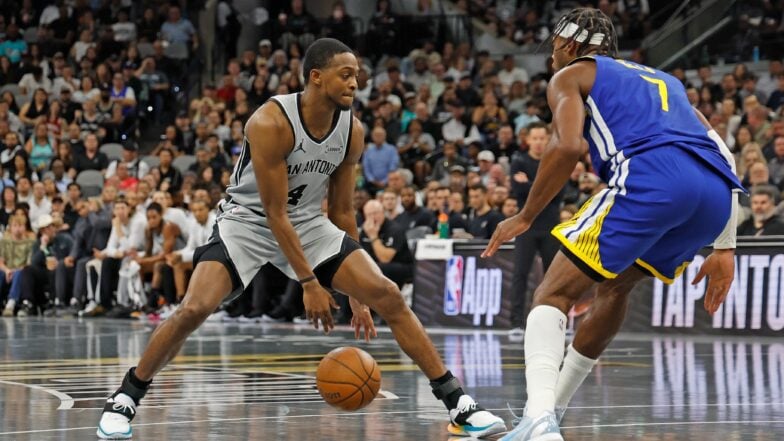
Fox is proud of his speed, but what makes him impactful is how he hits the brakes. He is strong enough to drive right into a big man in the paint and then spin off of him to hit a pull-up. But when he’s really disruptive is when he starts decelerating through the lane and luring in extra help defenders to create open 3s.
Wembanyama slowing the game down makes things a little easier for the defense to prepare its escape plan. On the bright side, he’s so hard to contain and is getting a lot better at manipulating those double-teams. The Spurs’ offensive upside is higher with their big man out there, even if it may function a little more smoothly without him holding down post position. On the other hand, the pick-and-roll between Fox and Luke Kornet — who is starting with Wembanyama injured — is working well now that Fox has his rhythm.
When Wembanyama is out there, Johnson’s offense includes a lot of Horns plays, where two bigs start the action on the free throw line. These classic sets are ideal for players whose screening draws a lot of attention, or when setting up a secondary wing creator for an angled pick-and-roll. But there’s not a lot of mystery to them, and offenses crave mystery these days. Running Horns for Wembanyama makes the Spurs’ half-court offense predictable.
That’s fine in the long run. The franchise is trying to develop Wembanyama into a transcendent player, and that means plenty of growing pains and a need for some structure. But now that Fox is in control of his game and able to create valuable offense with his driving ability in space, Johnson has another way to play.
When he returns from injury, Wembanyama could take Fox and the Spurs’ offense to the next level by studying Kornet. The former Celtics big man makes smart reads on how and when to screen. He’s mastered the art of not getting in the way until it actually helps his team.
Notice on this play how Kornet never even comes close to screening Timberwolves wing defender Jaden McDaniels, who takes a high pick-up point on Fox coming across half court.
This may seem counterintuitive, but Kornet knows Fox is quick enough to get by McDaniels without a screen and realizes his primary responsibility is to roll early and deep into the paint to wall off Wolves center Rudy Gobert so he can’t help at the rim. If Kornet had gone all the way up to set the screen, it would’ve taken him too long to roll all the way back down and Fox would already be ahead of him. Because Kornet gave Fox the space early and rolled quickly, Fox was able to hit the brakes, get McDaniels on his back, then take off again to surge to the rim once Kornet was in position to seal off Gobert.
As Wembanyama’s court awareness develops, Johnson can design more actions that put Wembanyama in better positions off the ball to benefit from his teammates creating easy looks for him. Watch how precise the execution is on this sequence that starts and ends with Kornet.
Fox brings up the ball, while Keldon Johnson runs to the right corner. As soon as Fox crosses the half-court line, Kornet turns to set a down screen for Harrison Barnes. But Kornet doesn’t actually set the screen, because the Spurs want Jaren Jackson Jr. to chase Barnes out to the perimeter instead of hanging out in front of the rim.
Barnes times his screen for Fox well and decides to slip it, knowing that Jackson’s instinct is to blitz Fox. Fox swings the pass early to Barnes and leads him into the catch, making it easy for Barnes to get to the basket. Meanwhile, Kornet shifts from one side of the baseline to the other to be in the perfect position to receive Barnes’ drop-off pass and go for a reverse layup that Jackson can’t block.
It’s a simple play with a myriad of technical precision, something the team didn’t have consistently at the start of the season. Fox’s experience and patience is making it take hold. And if Wembanyama is occupying Kornet’s role, chances are it wouldn’t end with a reverse layup.
Since Fox returned to the lineup, the Spurs’ execution has steadily improved. Their spacing was messy early in the season, which made Wembanyama’s post-ups more risky and led to plenty of turnovers. Players didn’t seem to know how to stay aligned with his passing outlets, and there weren’t enough well-orchestrated cuts from the backside for him to pass over the top of doubles. Now, Johnson’s team is playing with a better sense of tempo and alignment in the offense. They get into their actions earlier in the clock and with better coordination.
It will have to change when Wembanyama returns in the near future, as the team has to make use of his remarkable skill set. You don’t have to run a beautiful offense just for the sake of aesthetics. A more sticky system through Wembanyama can be effective, especially now that Fox has his rhythm.
Still, this Wemby-less period has been a good exercise for Johnson’s coaching development and the rest of the team. It’s helped Johnson establish another offensive identity so the Spurs can be more flexible against different defenses. It’s established that Fox can get back to All-Star form. Most of all, it’s been a reminder that this team is more than Wembanyama, even if he is their leader.
The Spurs have a singular talent that may soon define the NBA but they can’t be entirely defined by him. The best part of this recent run is they’ve proven they can be more than just Wemby’s team.
***
Jared Weiss is a staff writer covering the San Antonio Spurs and Victor Wembanyama for The Athletic. He has covered the Celtics since 2011, co-founding CLNS Media Network while in college before covering the team for SB Nation’s CelticsBlog and USA Today. Before coming to The Athletic, Weiss spent a decade working for the government, primarily as a compliance bank regulator. Follow Jared on Twitter @JaredWeissNBA