
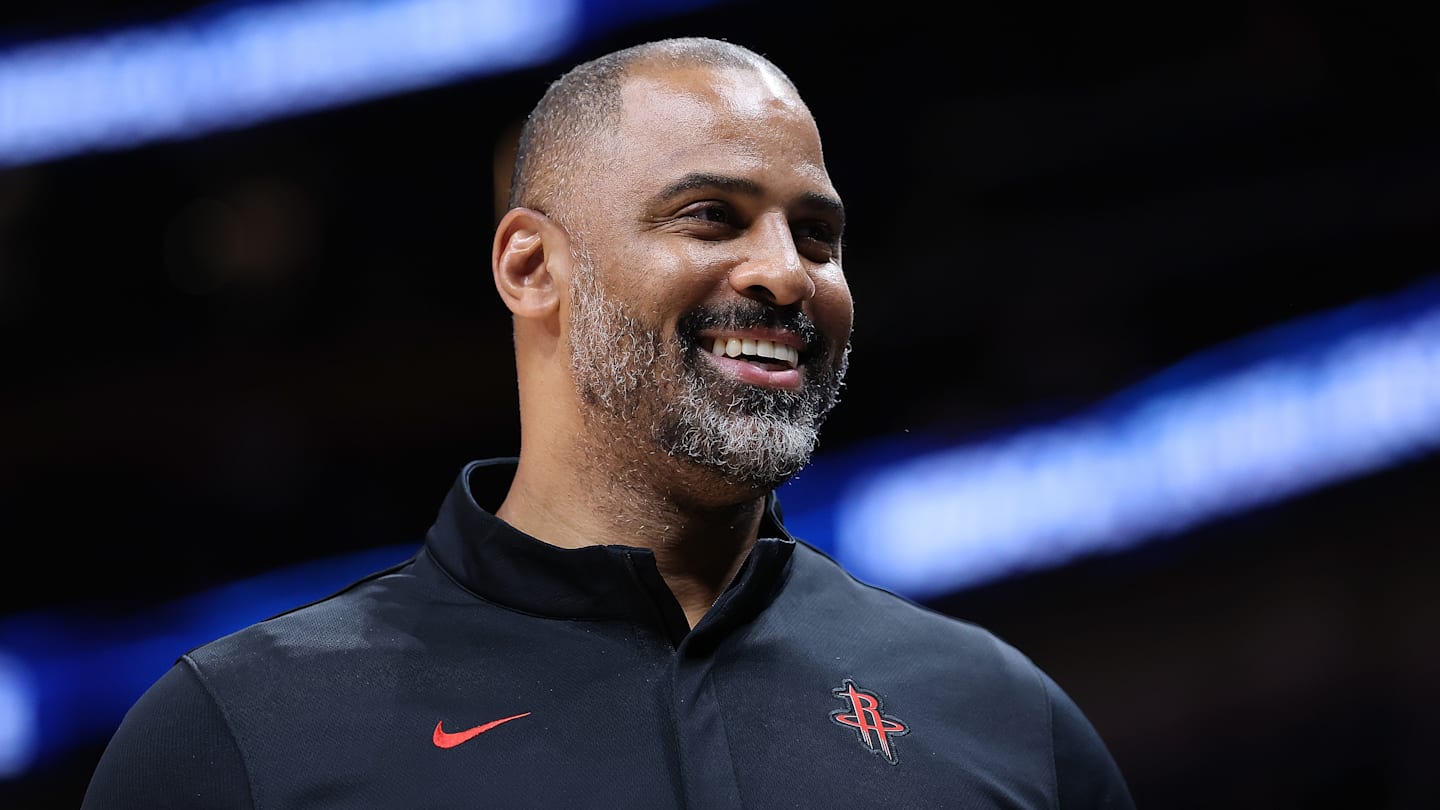
The Houston Rockets, so far this season, have been defined by their versatility, finding ways to win games on a night-to-night basis even in spite of major injuries and the, at times, lackluster production of their star scorers.
Yet, it is head coach Ime Udoka’s willingness to keep the rotation, and the starting lineup, fluid throughout the course of the season that has truly made the difference. Accordingly, his decision to place Josh Okogie back in the starting lineup against the Sacramento Kings on Wednesday was yet another indication of why he is the perfect coach for this team.
Starting Okogie against the Kings was the correct decision
Although Okogie has certainly had his offensive struggles recently, he was +23 in the 26 minutes he played against Sacramento, totaling three points, six rebounds, one assist and two steals in that span. While it might not have been the orthodox decision to pull ascending guard Reed Sheppard out of the starting lineup, therefore, it was evidently the correct one.
Sheppard had started four games in a row prior to last night’s matchup, beginning in Kevin Durant’s absence and continuing even after his return. In that span, he had averaged 14 points, 4.5 rebounds and four assists while shooting a slightly slower 33.3% from beyond the arc.
Okogie, meanwhile, had seen a sharp drop-off in the hot shooting he saw at the start of the season and had largely become an offensive non-factor through his last stretch of games.
Yet, Udoka knew that the team needed a defensive boost against a faster (and more well-rested) Kings squad. His decision to start Okogie, therefore, represented an acute response to what he had seen out of his team in their confusing loss to the Utah Jazz. It paid off as the Rockets came away with a blowout victory, 121-95.
Udoka’s willingness to toy with the rotation is what will bring this team into championship contention
When Udoka said that the starting lineup would be “fluid” this season (even prior to the devastating injury to Fred VanVleet), he truly meant it. For many coaches, this could come to represent a disastrous trend of throwing various combinations on the court to see what sticks. Yet, for Udoka, the changes he has made have shown an increasing understanding of the sheer depth of Houston’s toolbox.
He has employed the double-big lineup relatively sparingly and has only started Adams and Sengun together four times this season. Yet, the team has +7 net rating in the 207 minutes the pair have played together.
Moreover, he has constructed the offense in such a way that the team is not necessarily dependent on having a bona-fide point guard on the floor, making it easier for him to move Sheppard to the bench when his defensive limitations become a concern.
When Tari Eason and Dorian Finney-Smith ultimately return from their injuries, Udoka will have even more pieces with which to strategize.
It’s cliche at this point to say that the NBA playoffs are “matchup-dependent”, but it’s true. The best teams, and the most successful coaches, in those settings are those who know how to leverage their unique strengths while hiding their weaknesses through personnel and strategy.
As Udoka continues to feel out the limits of what this Rockets team is capable of, therefore, they could be well on their way to becoming one of the most dangerous teams in the NBA by the time the regular season comes to its conclusion.