
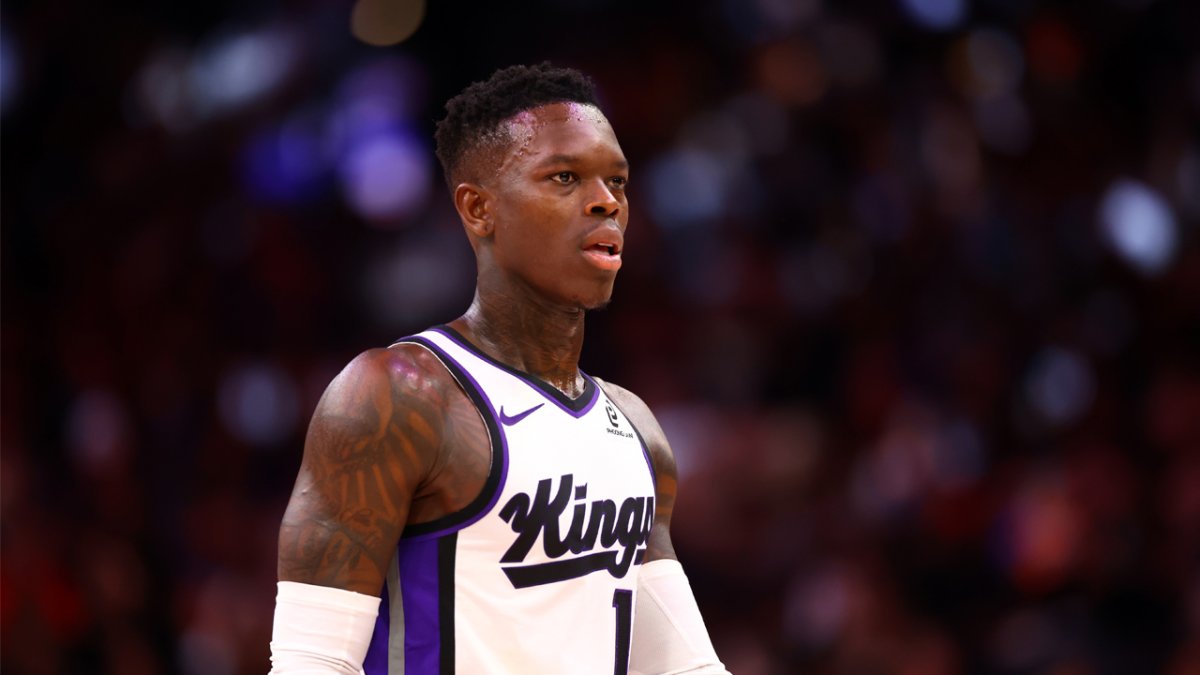
Kings point guard Dennis Schröder will miss his fifth consecutive game Saturday night as he continues to deal with a mild right hip flexor strain.
Stanford Medicine’s Marc Safran, M.D., spoke to NBC Sports California more in depth about Schröder’s injury, detailing the final box that must be checked before he’s given full clearance to return to the court for Sacramento.
“He’s got to be pain-free,” Dr. Safran said. “He’s got to have good strength — not full strength, but close to full strength. And he’s got to be able to go through the drills on the court without contact and pain-free before he can go into a full practice. They’re going to make sure he’s pain-free in the practice before putting him out there in a game.”
Schröder has been listed as questionable for the past couple of games but ultimately ruled out as the Kings continue to be cautious with his return.
He still is considered day-to-day as Sacramento enters Game 2 of a three-game road trip.
Dr. Safran explained how a hip flexor, the muscle that helps bend your hip up or bring your knee up toward your chest, is “incredibly critical” to any athlete — but especially for a speedy, explosive guard such as Schröder.
“There’s several muscles that flex the hip and help the hip bend, but the one that is most important and we talk most about is called the iliopsoas, which is really two muscles that come together as one. They are the main hip flexors. They are the ones when you try to get into bed, lift your leg up from sitting, you use that muscle. But that muscle has more functions than that. Even when you’re laying flat and you want to sit up, you’re using the iliopsoas for that.
“You use that muscle just to maintain your posture. It has a lot of functions.”
So, because the muscle is so important for even the average individual, it’s quite significant for an NBA player. Which also means the likelihood of an NBA player — particularly a guard or wing with explosive movements — is “probably most at risk” and “particularly susceptible” of injuring the muscle, Dr. Safran explained.
Schröder started the first 12 games for Sacramento but later was moved to a reserve role that, in a small sample size, proved to work better for the Kings. In six games off the bench, Schröder averaged 14.5 points on 42.3-percent shooting from the field and 38.7 percent from 3-point range, with 4.5 rebounds, 6.0 assists and 1.5 turnovers in 27 minutes.
The Kings, 5-17, certainly could use his services on both ends of the floor, but they won’t rush it.
Finally, Dr. Safran detailed what Schröder can do once he’s cleared to return to help prevent the injury from recurring.
“It’s listening to the body. If he has some pain, don’t try to push through that,” Dr. Safran said. “The way to prevent recurrence is to continue, even when he gets back to play, is to make sure you stretch that muscle, keep it nice and flexible, make sure you’re warming up adequately before you actually get out there and play and need the explosiveness.
“And continue to strengthen not just that muscle but the muscles around it.”
Download and follow The Deuce & Mo Podcast