
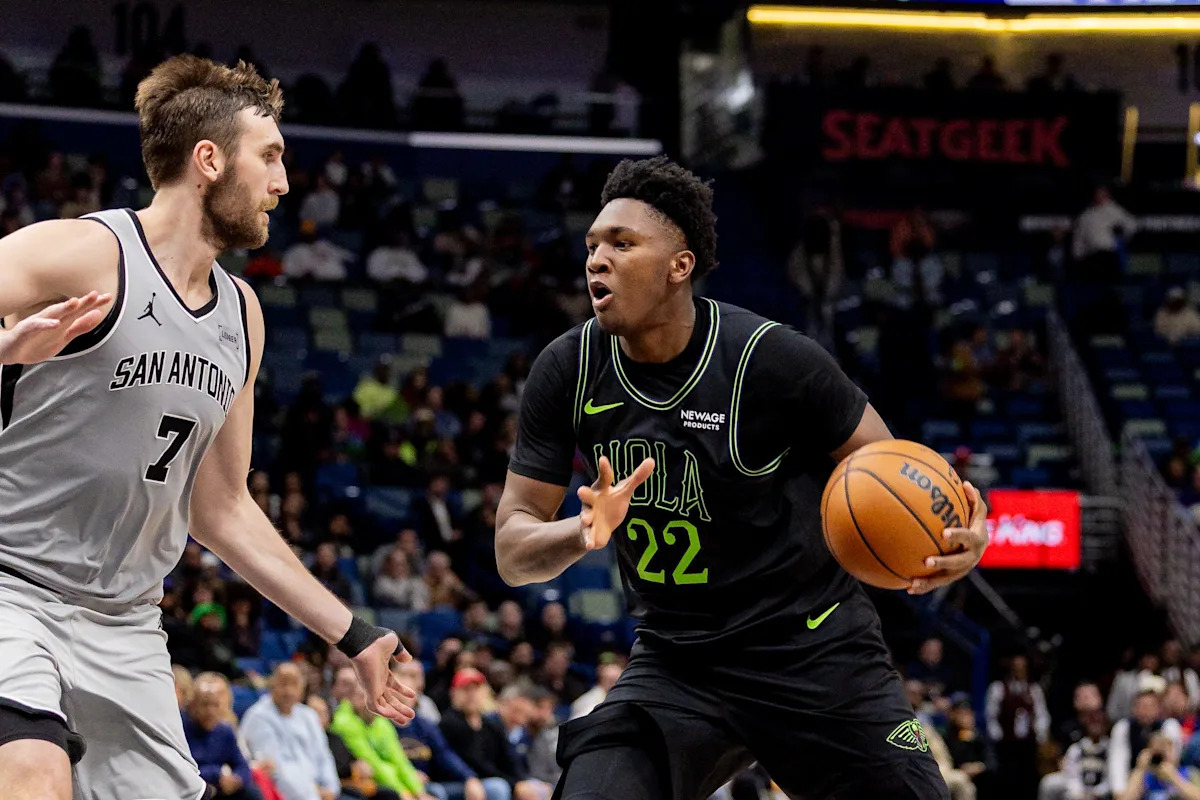
New Orleans Pelicans big man Derik Queen already looks like the best steal in the 2025 NBA Draft and is now a frontrunner to win Rookie of the Year.
Queen is accomplishing genuinely absurd achievements on the court during his first professional season. But it was still malpractice for the Pelicans to give up as much as they did to acquire him on draft night, even if he turns into a legitimate long-term superstar. He is unlike any other player that any of his teammates have played alongside.
Advertisement
There was nothing wrong with trading up for Queen, especially if the Pelicans felt that he is the player that he is showing that he is capable of becoming. But the assets they gave up to acquire him simply make no sense.
Earlier this year, the Pelicans used the No. 7 overall pick on promising young guard Jeremiah Fears.
They then traded up with the Atlanta Hawks to use the No. 13 overall pick on Queen. There was nothing wrong with either of these gambles, especially considering Pelicans executive Joe Dumars was long rumored to have an infatuation with the former Maryland standout.
If the Pelicans liked Queen enough and were confident that he was their guy, of course, they could have just picked him at No. 7 when they were on the clock. The Portland Trail Blazers did something far more surprising when they picked Yang Hansen at No. 16 overall.
Advertisement
However, it was no secret that Queen’s draft stock was sliding after a poor performance at the 2025 NBA Draft Combine even if he looked like a star during March Madness.
Reporting around the time of the draft suggested the Hawks wanted former Georgia forward Asa Newell and likely would not have needed to use the No. 13 pick to select him, so New Orleans and Atlanta were a natural fit as trade partners.
But under literally no circumstances should the Pelicans have included an unprotected pick in the 2026 NBA Draft in order to move up from No. 23 overall to No. 13 to secure the rights to Queen.
ESPN’s Kevin Pelton uses a draft pick trade value chart to determine the value of each draft range. Pelton determined No. 13 is worth 1570 points while No. 23 overall is worth 900 points. So that means to make up the difference, the team getting No. 13 would need to give up an additional 670 points in draft capital.
Advertisement
That is the equivalent of somewhere between the No. 27 or No. 28 overall pick in fair value to make an even compensation, per Pelton.
Maybe the Pelicans thought they were giving up a late future first-round pick to move up ten spots, and that is a no-brainer, especially they thought Queen is worth more than just a typical No. 13 pick.
But instead, the Pelicans gave up an unprotected pick. As of right now, meanwhile, the Pelicans, have the worst record in the NBA and that means the Hawks have traded for the best odds (14.0 percent) at No. 1 overall.
In fact, if the season ended today, the Hawks (via the Pelicans) would have a 40.1 percent chance of landing a top-3 pick in the 2026 NBA Draft and 100 percent chance of having a top-5 pick.
Advertisement
There is no reason the Pelicans shouldn’t have demanded a top-3 protection on their pick in a draft loaded with three potential superstars: Darryn Peterson, Cameron Boozer and AJ Dybantsa. Even a top-5 protection would have probably made sense and the Hawks may have still agreed to the deal.
It was obvious the Pelicans were not in a position to win during the 2025-26 campaign and never should have given up the opportunity to snag another young player to play alongside Queen and Fears.
Queen is an unbelievably talented player and was worth trading up for and probably even worth considering at No. 7 instead of Fears. But this trade was still a bad decision, even if they got a future superstar.
This article originally appeared on For The Win: Why the Derik Queen trade was bad for Pelicans even if he is a star