
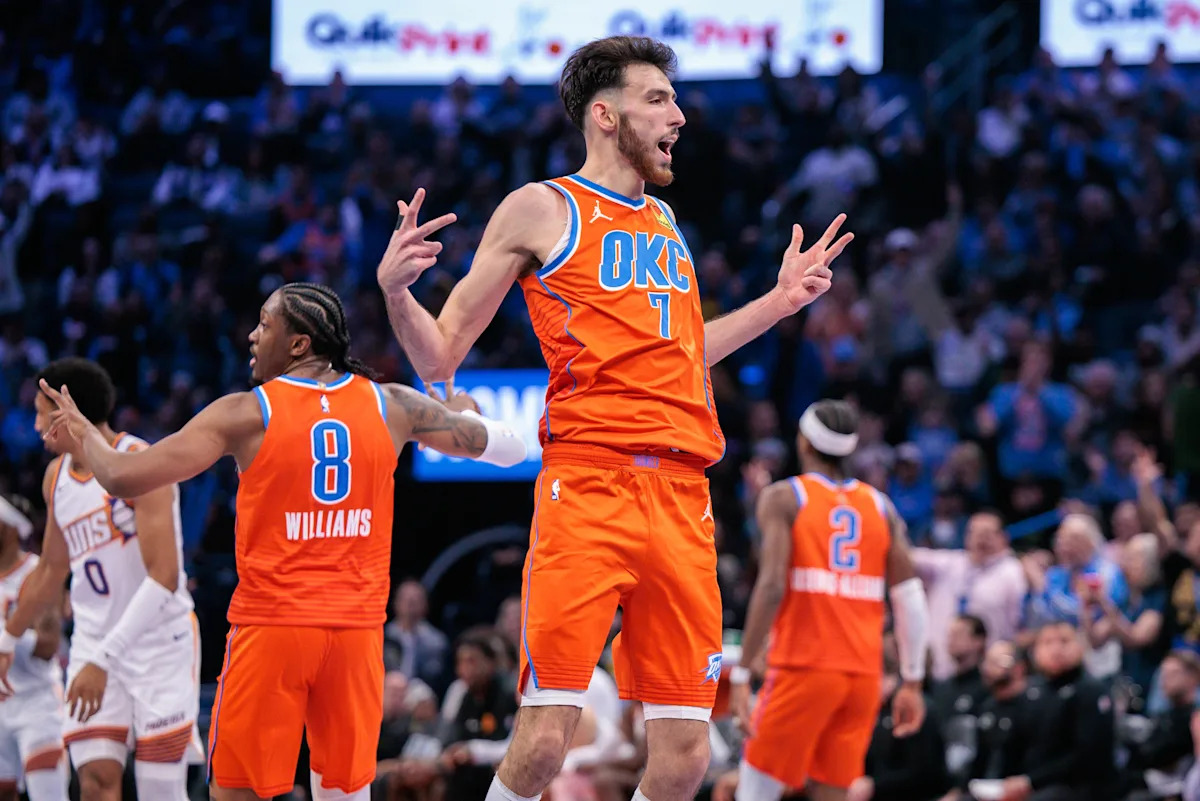
We are down to just four teams in this year’s edition of the NBA Cup, where the true fun of the tournament comes from the ability to tap into the competitive nature at the start of the season.
What’s also fun is we’re getting matchups between teams — the Thunder, Spurs, Knicks and Magic — that are playing some good basketball at the moment. All four semifinalists heading to Las Vegas have won at least seven of their last 10 games (and, well, the Thunder have won 16 straight). And each team has found different ways — and a common belief — to succeed this season. Let’s take a look at what has taken them to the desert in December.
How they got here: Dominance on both ends of the floor
Advertisement
The Thunder are the second team in NBA history to start a season 24-1. There are an assortment of eye-popping stats to highlight the historic nature of their run, but I go back to two quotes from head coach Mark Daigneault.
In the lead-up to Game 7 of the 2025 NBA Finals, Daigneault said, “We have to understand the work is done and we have to trust the work. … The muscle is built. We have to flex that muscle.” Fast forward to the Thunder sitting at 24-1 when Daigneault said: “You have to understand anything in the past takes you out of the present moment. Anything in the future takes you out of the present moment. And the competition happens in the present moment.”
The Thunder have taken every opportunity to flex that muscle during the present moment.
Advertisement
The difficulty in playing the Thunder is how they impose their will on both ends of the floor. Defensively, they are engineered to deliver consistent chaos, speeding offenses up on a regular basis. Their strength lies in their personnel; being able to throw Cason Wallace, Lu Dort, Jalen Williams and Alex Caruso at opposing offenses is a luxury. Not only does OKC have switchability on defense, but it has players who can guard top talent.
This is a physical, active defense constantly working to take away space and take away reads. Have you ever driven during rush hour where you’re stuck in a lane, pressing on the brakes, but briefly see an opening to switch lanes? You hesitate, stay in your lane and see that lane flooded. That’s how the Thunder wipe out opportunities for offenses: you have a window for an advantage and it closes quickly. That defense allows the Thunder to flow offensively, pushing in transition and going on runs to shift games.
The Thunder have also made offensive improvements. Shai Gilgeous-Alexander has gotten even better, blending his straight-line drives with an ability to get to his spots whenever he wants. He’s been able to attack teams that put size or speed on him. Pick-and-roll can also open up a reject to get to his spot. The improved playmaking when defenses send two on the ball has allowed him to read the floor and come closer to bending defenses.
Advertisement
On top of that, OKC keeps everyone involved offensively. Anyone can initiate, anyone can be a screener, and together the Thunder work to keep the ball moving and going side to side. Drive-and-kick, pick-and-roll, the Thunder work to stay out of the box. Opposing teams have traditionally tried to get physical, get them deeper in the clock, and slow their movement, but OKC has responded by advancing in punishing a defensive breakdown.
How they got here: Brilliant guard play without Wemby
Victor Wembanyama sent a message to the entire NBA with his start: 26.2 points, 12.9 rebounds, 4 assists and 3.6 blocks to help lead the Spurs to an 8-2 start. Two straight losses to the Warriors and an injury to Wemby gave some the feeling that the Spurs were destined to plummet down the Western Conference standings. But since Wemby went down, the Spurs are 9-3 and have stayed near the (non-OKC) top of the West.
Advertisement
How? There has clearly been a culture reset within the Spurs.
“The way we want to play is how we want to play,” head coach Mitch Johnson said on Dec. 2. “And it’s quite demanding physically, mentally and emotionally what we ask of them. We’re not going to compromise that.”
The absence of Wembanyama’s offensive growth and defensive impact has forced the Spurs to dive into the little things to find success. It’s also opened a path for their guard play to stand out. Whatever time there was to debate between De’Aaron Fox, Stephon Castle and Dylan Harper has come and gone. This trio has unlocked a different version of the Spurs and given them 48 minutes of consistent guard play.
Advertisement
Fox’s talent speaks for itself, but his ability to play on- and off-ball, to start and finish possessions, has given the Spurs a boost. He is at his best when he’s able to blend the speed of his drives with the smooth ability to pull up when given space. Castle has continued to grow as a talent. There is a shiftiness to what he brings to the table on-ball, as he changes speeds and finds cracks in the defense to expose. The real growth comes from seeing the next play before it happens, understanding when he can score and when a pass is open. Harper plays with a poise and composure that is beyond his years, a patient driver who can turn the corner at any point in time.
The Spurs have layered off-ball movement around their guard play — high-wide pindowns, staggers, guard/guard screens before they can flow offensively — allowing them to find success when playing with each other. Luke Kornet as a trailer has also found a way to screen anyone. It may be a flare at the top of the key, it might be a pick-and-roll, but it gets defenses moving and the Spurs read and react from there.
How they got here: A belief in their new identity
Advertisement
“We’re starting to figure out who we are,” Knicks coach Mike Brown said after their win over Toronto to advance to the NBA Cup semifinals. It’s a meaningful quote if you look at how the Knicks have won eight of their last nine games.
The Knicks play with more tempo in the half-court. For some teams that might mean shooting the ball quicker, but for the Knicks it’s about making quicker decisions. Within their spacing everyone is empowered to attack, move the ball, cut. When defenses try to deny Jalen Brunson the ball in the backcourt, it’s a quick pass to Mikal Bridges, who can initiate offense.
The Knicks get the ball past half-court early, work to play outside of the initial set and get into a second or third action to keep pressure on the defense. Whether from the wing or the corner, they stay in motion, cutting to clear space and open opportunities for each other.
You can see the consistency in that mindset with Josh Hart’s move into the starting lineup. His ability to defend multiple positions and his effort as a weakside defender has helped the Knicks on one end of the floor, but it helps that he’s shooting 44.8% from 3 as a starter. Behind that is the fact that Hart has become more involved: initiating offense, pushing the ball up the court, being a connector. Random screens and random cuts enhance the Knicks’ flow.
Advertisement
In the starting lineup, if Hart’s able to drive, look at who is receiving those kickouts to the perimeter. It allows for Bridges and OG Anunoby to remain involved, mixing in drives, cuts and 3s to be offensive threats. It allows for Brunson to be more sudden both on and off the ball. His evasive footwork opens up drives, his craft and shotmaking pokes at defenses, and you now have to deal with an attack before the ball gets into his hands. When teams want to put a wing on Karl-Anthony Towns and a big on Hart, it also opens Hart up as a screener to keep the Knicks moving. When you combine the offensive growth with the defensive potential, you can see how the Knicks have risen back toward the top of the East.
How they got here: Offensive improvement
The Magic have scored 120 or more points in 12 of their first 25 games. They reached that threshold a total of 10 times last season. The franchise record for that mark is 19, set all the way back in 1994-95.
Advertisement
A team whose success has largely been built on its defensive identity has worked to evolve and improve on the offensive end. There is an emphasis on getting the ball up the floor and looking to attack early in the clock. On a miss or made basket, you see the Magic throw the ball ahead to the wing to try and get to a defense while it’s off-balance. On any given night you can see Desmond Bane, Jalen Suggs or Anthony Black advance it to each other to try and get a paint touch.
There’s a commitment to working to find more flow in the half-court, too. The Magic’s best offensive possessions come when they make quick decisions, quick reads of the defense and get downhill.
The key to that for Orlando has been their guard play. With both Paolo Banchero and Franz Wagner in and out of the lineup, Bane has found a consistency to fill the void. The Magic can use him in movement sets off screens that go beyond a simple pindown. Using him in dribble handoffs or pass-and-catch actions allows him different ways to turn the corner and get downhill. In pick-and-roll, the threat of the jump shot grabs a defense’s attention, but the drives are when things really open up.
Advertisement
The commitment to what the Magic are trying to do on offense can allow them to stay in a game like the quarterfinals matchup against the Heat, who refused to miss shots to start the game (15-0 run, 30-17 lead at the end of the first quarter). And the Magic’s defense still operates at a high level, using physicality, size and length to disrupt. The more stops they can get, the more they can get out and run. That combination continues to create a wave for the Magic that turns each game into a different type of fight.