
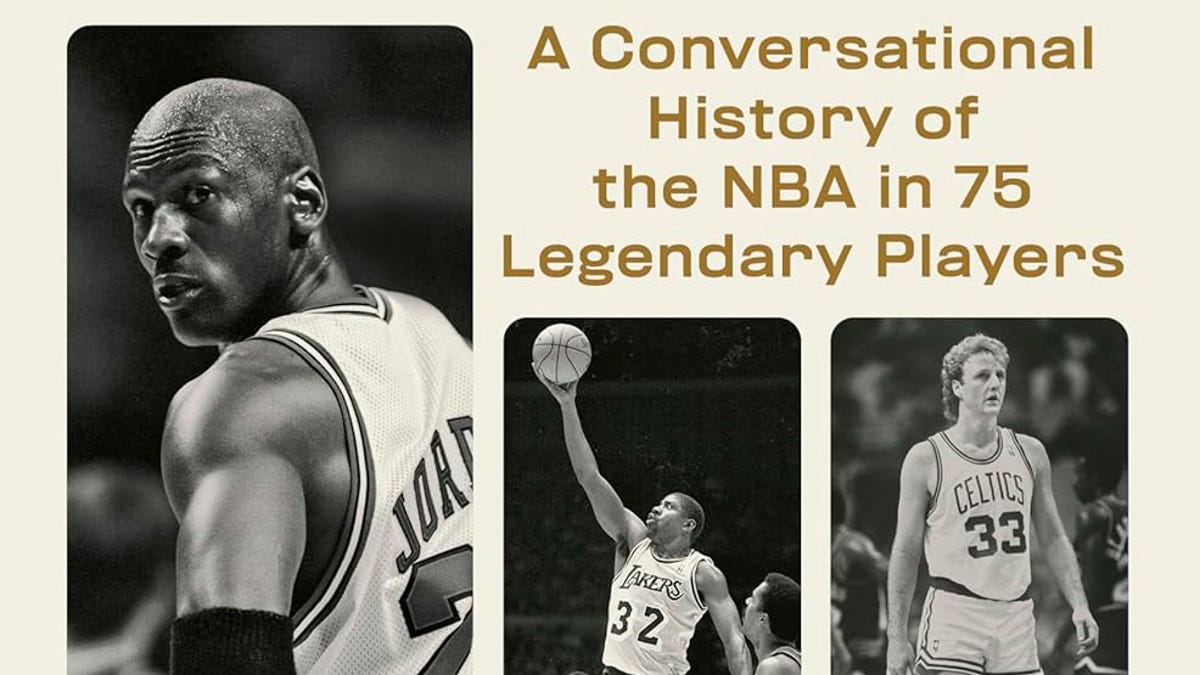
Sam Smith wrote The Jordan Rules, one of the most impactful sports books of all time. But that was just the tip of the iceberg of a long journalism career that began in the heart of politics during the Watergate scandal in Washington, D.C., and later took root in Chicago, where he covered the Bulls’ NBA championship era led by Michael Jordan.
Smith recently sat down with HoopsHype to discuss his new book, Masters of the Game: A Conversational History of the NBA in 75 Legendary Players, his relationship with co-author Phil Jackson, Jordan, Kobe Bryant, and more.
You can buy Sam Smith’s new book Masters of the Game: A Conversational History of the NBA in 75 Legendary Players at Amazon and Barnes & Noble online stores.
Reading this book, it felt exactly as you intended it to be – like the 1981 film My Dinner with Andre. Felt like sitting in a restaurant with you and Phil Jackson, listening to a conversation that guided me through the lives of many great characters in NBA history
Sam Smith: I realized that, having grown up in New York City and going to games as a kid, I’ve literally seen every one of these players play in person, except George Mikan. Wilt Chamberlain, Bill Russell, Oscar Robertson, and Elgin Baylor, all these historic figures that basketball fans have heard of, and they’re legends, but they have only seen them on grainy tape. And so I got to talking with Phil, and when I was telling him about the book, we realized he had literally played against them or coached. He played against Wilt, and he had stories about Wilt, Russell, and Robertson up close. So it’s sort of this combination of how many people in the world are still involved in basketball on some level, seeing everybody in the history of the game.
We felt we had this unique perspective to talk about these guys, but in the context of just… I didn’t want to do another book about who’s the greatest, best of all time, those debates, who’s the best point guard, who’s the best scorer, this and that. We wanted to make it just sort of a reflection of two people, a coach and a player, and a journalist, the observer, who literally knew all these people. I had done a book with Oscar Robertson six or seven years ago, Hard Labor: The Battle That Birthed the Billion-Dollar NBA, and this was just sort of a unique inside perspective about these people. Anybody could look at the numbers, but not many knew these players as we did.
Do you remember the first time you met Jackson? When did you feel you had formed a connection that would last for decades?
SM: I saw Phil play. I used to go to Madison Square Garden when I was growing up in New York City. Every Tuesday in Madison Square Garden, there was a doubleheader. The NBA was not particularly popular at that time. So literally, almost half the NBA was in Madison Square Garden every Tuesday. There were 12 teams, and four of them were playing. And Phil was among them. So I got to watch Phil. But then, when I got to the Chicago Tribune in 1979, I was a government political news reporter, and I switched over to sports in 1983.
Around that time, before you made a switch in departments, you had a sabbatical where you could work on a magazine and write long pieces. So I decided to do a kind of diary story on winter league basketball. I went with a CBA player from the Chicago area on a van trip. We drove out, and they played the Albany Patroons, which happened to be coached by Phil Jackson. I was doing this story on this player, Carl Nicks, actually, who was Larry Bird’s top teammate with Indiana State. Bird played in that great Indiana State team, which met Magic Johnson in the 1979 NCAA Final. And Nicks was the second leading scorer on the team. And actually, I’ve run into him; he’s a scout for the Pacers now. I went, I was doing the story, and met Phil, and then I switched to sports. And so when I did NBA stories, I would give Phil a call, sort of background. And then serendipity, he ends up on the Bulls staff as an assistant coach.
So I had known him already, not only from watching him play. I’d met him, and I kind of used him as an expert source when I wrote NBA stories. We got to talking, hung around, had some lunches, that kind of thing. Phil is just a really interesting guy, kind of offbeat. I worked in Washington, D.C. as a political writer. I covered Congress mostly, but the White House sometimes. And before I left there, I was a press secretary for U.S. Senator Lowell Weicker, who was on the Watergate Committee. And so I mentioned that I’ve met a lot of famous people in my life, but not that many interesting people. And Phil was really interesting. It became a thing: Phil would raise a point, and you think it was off-beat, but then you think about it and say, ‘Oh, yeah, I can see that.’ And so he sort of had, like, a way of looking at things, and it made you think about things. So I really enjoyed spending time with him. And then he happened to become the Bulls coach, and I was covering the team.
I remember a John Paxson story. Part of your job as a reporter is to develop relationships. The way the NBA worked back then, the locker rooms would be open, like literally for hours. I mean, I remember sitting around talking to Michael Jordan, two, three hours before every day, things that don’t exist anymore. By then, the locker room rule is that it would close 45 minutes before the game. So usually toward the end, I would stop in the coaches’ room when Phil would come, and I would talk to him, and we would kind of get carried away talking. I remember John said to me just a couple of years ago that it used to drive him crazy. ‘We were sitting around waiting for our meeting. And then you come strolling out of Phil’s office. You know, we’re all sitting around, where’s Phil? Where’s Phil?’, he said.
When he left Chicago, I was still covering the NBA when he went to the Lakers, so I found reasons to go to L.A. and covered Kobe Bryant and Shaquille O’Neal. That was the story of the league. And then when he left, actually, that was sort of the genesis of the book. When I was talking about it with Phil, I hadn’t sought him out about doing the book. I was collecting these stories, and I was telling him about it, and I just happened to ask him offhand when we were having lunch. I told him, ‘Do you want to do it with me?’, and he said, ‘Yeah.’ I really didn’t have a book at the time. I was just thinking about these stories and starting to collect them. I thought, well, that’d be a good excuse to go up to Montana and hang out with Phil. Even if it’s not a book in the end, it would just be a fun thing to do. And so that’s sort of how it came about.
There are many examples – such as when you’re discussing Allen Iverson and, all of a sudden, the conversation shifts to a locker-room faceoff between Kobe Bryant and David Stern. Did you have a preconceived idea of how fluid the conversations needed to be, and the risks involved?
SM: Yes, and no, really, no [laughs]. Because the idea started to develop as we talked. Initially, I said, ‘Okay, we’ll sit down, and I’ll get out the list, and we’ll just go through it one by one.’ It’s sort of the definition of having a conversation. When you sit around and talk with somebody about a subject, how often do you kind of end up only talking about that subject? You get reminded about something else. Especially with Phil, and I think that’s always the case, I always noticed with Phil that every discussion would be filled with all these digressions. I remember when I wrote my first book, The Jordan Rules, and the first time I sent it to the publisher, they said, ‘It’s not linear, too many digressions.’ And I said, ‘That’s what the book is, it’s a behind-the-scenes look. And nothing in life is that linear.’ And so it’s not a biography that’s going to be chapter one, two, three.
To me, part of the gem of the book is that you’re not giving away anything. But it was like when we talked about Moses Malone; everyone knew a great offensive rebounder and the championships. Then it reminded Phil that that was the only time his mother ever saw him play a game of basketball in his life! When someone like Phil Jackson says that to you, you know, a player in college, an All-American champion, part of the legendary New York Knicks championship team… And his mother had never seen him play other than his one ABA game when they played the Utah Stars and Mose Malone. So we started talking about his family, and so that’s sort of part of the Moses Malone story.
That’s the appeal of the book, subjects that you don’t expect kind of come up, and then you learn about Phil’s life, and maybe a little bit about me if you care, but also about our reactions to these people, and how these people crossed across our lives, and what our views were when we saw them, not so much the numbers that everybody can look up online, but these unique perspectives that don’t exist otherwise. They’re in our background, in the back of our memories. We kind of bring them out. That’s the essence, to me, of conversation. People always say, ‘What’s it really like?’ That’s what we tried to do with this book. ‘Hey, if you want to hang out with Sam Smith and Phil Jackson, whether you did or not, this is what it would be like, exactly.’
The 75 players are not the only characters in the book; celebrities and filmmakers also appear, adding another layer that helps capture what the era was like for those older players
SM: When Phil was talking about things, when he brought up, for example, Woody Allen, in a story about the Knicks… Allen is now sort of persona non grata in the United States because of some of the things that happened in his personal life. But he was a fixture at Knicks games. He was at every Knicks game; he was just a regular connected with the Knicks. Phil ended up in his movie [Manhattan, 1979]. I was a big Allen fan; he grew up in my neighborhood. Not that I know him, but he had the same experience growing up as I did. He’s a little more successful and a little smarter, but we came from the same high school areas. Another example is when Phil mentions the story about living in the building with actor and singer Zero Mostel. He was famous with the Fiddler on the Roof play on Broadway. Mostel told Phil that they kept asking him to do the show, that it was going to kill him… and it kind of did.
There were so many kinds of offbeat stories that just interested me. I’ve always felt that’s always going to be my guide in writing. If something interests me, and I assume it’s going to interest somebody else, I write it down. Those stories became part of the conversations, and I thought, ‘Oh yeah, that’s interesting.’ It’s sort of just a natural flow. We would start in the morning with somebody, and then end up veering all over the place, and then I would have to go back to the list. I’d say, ‘Okay, Phil, let’s do this guy, because we’ve ended up talking for 45 minutes on something else.’ But that gave me an excuse to come back to Montana, catch up with him in Los Angeles in the winter.
Did these dialogues with Jackson allow you to reflect on your career and find a sense of closure on issues left open in the past?
SM: I’m glad you brought that up. I always considered myself sort of a basic journalist. I’m just going to tell you what I see and let you make a judgment about it. I’m not going to inject myself into that story. And that independence was always important to me. I’ve sort of been like that movie Zelig, where Allen sort of ends up in the middle of all of it, he’s standing next to Franklin D. Roosevelt or Adolf Hitler, or whatever the case might be. Just so I’ve kind of been this witness to a lot of history because of being in the right place at the right time, and that’s not because of anything I did, just because I happened to be around the Bulls and Bird and Magic and all these incredible things that were going on in sports. I happen to be out of just good fortune to be there. And so I felt that it would be revealing on some level if I talked a little about it, because I’ve always been, as I said, not wanting to put myself in the story; I was a big believer in that. It’s not about me, it’s about them. This would be an opportunity when we would talk a little bit about Phil’s life. And Phil’s really a regular basketball guy. And I think it comes through the book.
This is his personality: good sense of humor, likes wordplay, just fun and thoughtful. That’s why it’s comfortable to be with him. People always think that Phil is sitting around, smoking a pipe and chanting or something. If he were doing that, I wouldn’t be spending time with him. He’s kind of a regular basketball guy. When I did the Jordan Rules book, I told the players nobody’s going to lose their job, nobody’s going to be in trouble with their families, it’s going to be basketball behind the scenes. And I always felt bad about the way the media interpreted the ‘Republicans buy sneakers, too’ comment by Michael Jordan. Michael would sit and talk for hours on end before every game. He loved the give and take. And so me having a political background, after a couple of hours of talking basketball, you end up bringing up some other stuff.
That was a time when Harvey Gantt, the mayor of Charlotte, was running against Jesse Helms, who was a terrible segregationist racist senator from North Carolina. Michael actually had suffered bias. He mentioned growing up in North Carolina, where he was subject to racism in school, and he’s sensitive to it. But that was a time in the NBA when there were financial problems. The league was on the players, telling them, ‘Stay out of politics.’ Even if you go back, you’ll find Kareem Abdul-Jabbar never talked about politics then. Everybody, they were told, basically, the league’s not doing great. They were on the verge of losing five teams, like 100 jobs. And so it’s like, let’s keep it to basketball. And so I bring this up, and I didn’t realize it at the time, but I can see Jordan’s like, ‘Get away, I don’t want to talk about that.’ So Jordan, that’s sort of one of his superpowers. He’s really funny, clever. He’s not like, well-read guy, but he’s really a smart guy. His nature, his life, is having the last word. I realized later he’s just trying to get rid of me. So he kind of came up with a quip to get rid of me.
Unfortunately, a lot of my colleagues, the media used it as a way to take shots at him, especially in the New York Times. I thought they used it a lot to say, well, this is his political philosophy, unlike these players today. And it was a lot different when LeBron James, Carmelo Anthony, and Chris Paul were making these stands about, and it was fine. I’m glad they were doing it. But doing it in 2010 was a lot different than saying something like that in 1988 or something. That got sort of smoothed over, and I always felt Michael was made a victim, and that I wanted to clear that up, that that was a joke that had nothing to do with political philosophy, and that was a classic out-of-context gotcha. We don’t care what he meant, but it’s a good story, so we’re going to use it as a good story.
What’s your take on the ongoing feud between Michael and Scottie Pippen?
SM: Phil mentioned that in the book, because a lot of his teammates have died. Dick Barnett recently, Willis Reed, who Phil was close to. They used to get together, not so much for events. They did, actually, one, at a big business conference out in Idaho a few years back. And Phil kind of made the joke that the ’70s Knicks used to get together, and that ‘I don’t think there’s going to be many get-togethers with the ’96 Bulls.’ He was sort of joking about it, that there are not going to be many reunions after all the things that have been said. Scottie Pippen called Phil a racist. Scottie has been an angry guy. He’s been angry at everybody and doesn’t have a relationship with the Bulls anymore. I was pretty close to him; we were going to write a book together, I still got the contract for it, but we finally didn’t do it. He doesn’t talk to me anymore either.
Phil was very sympathetic toward him, despite whatever things he said about him. We talked about that in the book. He said, ‘I feel like Scottie’s had bad advice.’ And the touching thing, though, was that when I asked him about how Michael reacted, he said Michael was really hurt by it, and not angry. He regrets losing this relationship. I wouldn’t have seen that from Michael, that Michael would feel the things that Scottie has said about him that have been critical or interpreted as really negative; instead of getting angry, he just felt a sense of loss. Phil tells in the book how Michael felt that this 20-year relationship, not that they were really close, but Michael really appreciated Scottie. In his Hall of Fame speech, he credited one player. He didn’t bring up any of the other teammates as much as he liked him. He liked John Paxson and other players, but he brought up Scottie specifically. It’s kind of a tender moment where it shows Michael’s sort of soft side, and that really his reaction toward Pippen was a feeling of loss.
Do you think Jackson developed a deeper bond with Kobe Bryant than with Michael?
SM: Yeah, actually, I do. Michael was more independent, and his interests were golf, competing, and gambling. And actually, one of the things we talked about a lot, and I said to Phil a lot of times, ‘How did you ever develop a relationship again with Kobe, after the first three titles, and then you wrote a book saying, basically, he was uncoachable?! Not only that, first of all, how’d you come back to coach him?’ But Kobe had so many interests beyond basketball that I think drew him close to Phil. In fact, Phil mentions in the book that he said that the film Kobe did, getting an Academy Award, meant more to him than the titles he won. In the beginning, Kobe really wasn’t a reader, but after a while, not only did he enjoy Phil’s books, he’d ask him, and they would talk about literature.
Some of the discussions Phil and I had about Kobe with Shaq were some of the most interesting. Because there’s a lot of stuff with Shaq that people wouldn’t realize, like when Phil gave Shaq books, and Shaq’s summary of one of the books was just hysterical. And then also their relationship, like Phil’s trying to keep it together when the Lakers are trying to choose between Shaq and Kobe. And I never heard the story that Jerry Buss basically gifted Pat Riley, trading Shaq to him, giving him a chance to win one more title with Shaq as basically a payoff. Not that he owed him anything, but it was sort of regretting having to fire him at the time when he was the Lakers’ head coach. I never heard that. So I thought there were some really unique kinds of inside stories. Phil was literally at Kobe’s house just days before the horrible accident; he had gone down to Orange County and spent some time with him, and they were literally talking about Kobe traveling on helicopters back and forth all the time. Obviously, no one knew what was coming. It was just such a kind of dramatic, dramatic moment.
Is the Jordan Rules book still selling?
SM: Yes, when they did the Last Dance documentary, it kind of revived things a little bit. There’s a whole new generation that kind of found it then, so yes, a little bit, but I’m still working. I’m still doing the same thing, writing, and he’s a billionaire. So we’ve kind of veered off a little bit.
Have you shared Michael Jordan memories from the book with younger generations?
SM: There’s some. You don’t want to be the person sort of always saying, ‘In my time…’ It’s hard for any current generation to get a sense of it, and that’s kind of why I write these books, I appreciate the history of the league, and I want to keep the legacies of these players, get people a sense of who they are and what they went through, and how it sort of relates to modern era, but it’s hard for people to visualize something they didn’t see. I get that with younger generations. You see Jordan on video, and that’s why I try to tell the personal stories, a little bit about spending time with them. What he was like, and all that kind of stuff. But it’s like any history, the American Revolution, George Washington, and Thomas Jefferson. You just don’t know what it was really like. And the same thing goes with Wilt and Baylor; you haven’t seen them, you can’t get that sense.
You tell the stories and mention them at times when people bring them up, but the nature is that people are mostly involved in their own lives each day. And that’s why I hear a lot that ‘A lot of those players couldn’t play in today’s game.’ Well, of course they could! They would fit in fine. If you look at who the best players in the NBA today are, they’re players who fit in that generation better. Nikola Jokic is not athletic; fundamentals, passes, moves, even though those players there were great athletes at the time. They didn’t shoot like Stephen Curry, but because you got one, two points for it, not three. Luka Doncic is more of an ’80s player than he is a modern player: he dominates the ball, moves slowly, and he’s not a jumper, not a great athlete. I think the eras have come together more than people would like to admit.
Who was the most charismatic player you had the chance to cover during your career?
SM: Well, I was around the most charismatic player ever, Michael Jordan. And that’s one of the appeals that Kobe always had for me. When the Bulls dynasty broke up in ’98, it really wasn’t management who did it. It was Michael, Michael basically said, ‘I’m done.’ He needed a break. And without Michael, the Bulls did the classic: We’re going to get draft picks. Salary cap room, whatever. Nobody wanted to come. They made offers: Kevin Garnett, Tim Duncan, Eddie Jones, Grant Hill, Tracy McGrady, Vince Carter, literally every single one. And they ran away, fast. They just ran away from playing after Jordan. Kobe wanted to be traded to Chicago. I think it was the summer of 2007, before the Lakers made the Pau Gasol trade. He wanted to be traded, and he came up with Chicago. And then why would he want to come to Chicago? They haven’t had any success, basically, since 1998, but he wants to be on the United Center floor, winning a championship to show he can do what Jordan did.
Kobe was the only one in history who wanted to do it; while all these other great players ran away from the Jordan shadow, he ran to it. He was like the firefighter running to the fire. He was the policeman who ran toward the 9/11 terrorist attack. Everybody else was running away for safety, and he was running toward it. I really always respected and appreciated that about him, that he was unique, and he was the closest player to Jordan. Not LeBron James. Not to take anything away from LeBron, but LeBron is nothing like Jordan. He’s just a great physical talent, a great basketball player, but not near the mentality. Kobe is the only one I’ve ever seen with that mentality. Bird had it, but he just didn’t have the athletic ability that those guys did. But he had the toughness and the verve famously remembered; he basically fought the entire Pistons team one time. They had to drag him off the court.
You can buy Sam Smith’s new book Masters of the Game: A Conversational History of the NBA in 75 Legendary Players at Amazon and Barnes & Noble online stores.
We highly recommend you add HoopsHype as a preferred source on Google. You just have to click here.