
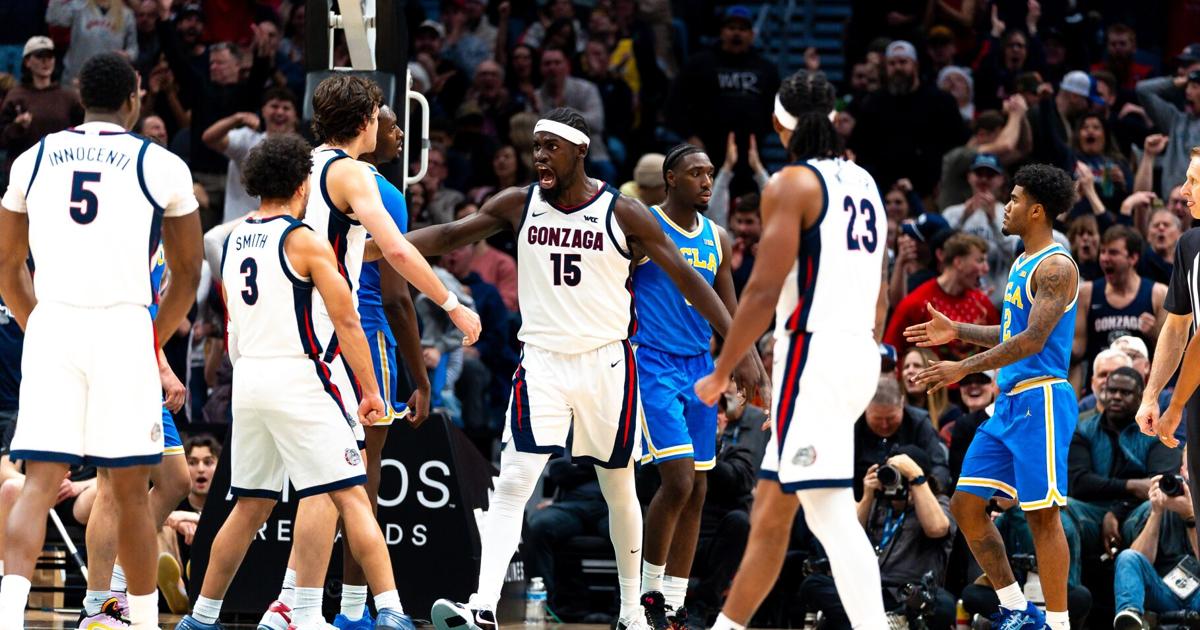
Almost exactly a year ago, the Gonzaga University men’s basketball team dropped to 7-3 on the young season after two backbreaking losses to No. 4 Kentucky by one and No. 18 UConn by six. Two weeks later, GU failed to capitalize on another big game opportunity, falling by three points to No. 22 UCLA at the Intuit Dome, flailing to 9-4 and damaging its tournament resume by leaving key ranked wins on the board prior to West Coast Conference play.
Fast forward to Monday, and the 2025-26 Zags are 9-1 with (then) ranked wins over No. 23 Creighton, No. 8 Alabama, No. 18 Kentucky and No. 25 UCLA on Saturday at Climate Pledge Arena in Seattle. GU’s only loss remains to No. 2 Michigan in a 40-point drubbing on its third game in three days at the Players Era Championship in Las Vegas. It’s a very different setting for GU compared to a year ago, and currently sitting at No. 7 after Monday’s AP Poll, the Zags’ success in pre-WCC play could translate to a return to a high seed in the NCAA tournament.
Now 10 games into the 30-game regular season, here are two main takeaways from GU’s hot start, and what to look out for in the next two-thirds of the season as the Zags seek to continue its success.
The post tandem and tenacious defense create a high floor, but the shooting determines this team’s ceiling.
Ike and Huff showcased another dazzling performance in Saturday’s 82-72 win over UCLA, as Ike poured in 25 points along with Huff’s 21 in the duo’s second-highest scoring output this season (48 points combined against Kentucky). When GU’s shooting started slow, Ike and Huff carried the workload in the first half, combining for 29 of GU’s 45 points. Ike would also finish the game with a season-high five assists, most of which came on post dump-offs to Huff.
Huff (17.4 ppg) and Ike (17.3 ppg) cement one of college basketball’s highest scoring duos, giving opposing defenses nightmares as both have the ability to completely take over games, a signature mark of teams that make deep runs in the NCAA tournament. Having a dominant post tandem has also been a signature of past Mark Few-led GU teams, and the veterans Huff and Ike create a strong floor for this team night in and night out.
However, the next step for this team is its continued shooting improvement. Last year, the Zags shot 34.4% from three, the worst mark in a Few era that has seen its teams consistently hover around the 40% mark. Through ten games, GU is up to 35.7% from a mark that was around 30% at the beginning of the season thanks to newfound success in the past few games. And when the Zags hit threes, they don’t just beat teams — they embarrass them.
GU hit 14 threes in its 39-point blowout versus Maryland, knocked down nine in its embarrassment of Kentucky and another nine in its 27-point runaway win versus Creighton.
However, GU has been able to pull out victories on poor 3-point shooting nights (27% against Oklahoma, 29% against ASU, 27% against Alabama) largely in part because of the efforts of Huff and Ike (and credit to GU’s sixth-ranked defense in the country according to KenPom). With improved shooting, it would be extremely hard to stop an improved defensive team with a multitude of offensive threats.
The guard play has been fantastic, fitting GU’s needs perfectly.
They may not put up the flashiest numbers on a game-to-game basis, but GU’s two main ball handlers — Mario Saint-Supery and Braeden Smith — have been flying under-the-radar as sensational ball handlers. Questions surrounded this year’s GU team in terms of the guard play following Ryan Nembhard’s departure, as the two-year Zag’s absence left way for a little-known freshman and a redshirt who sat on the sidelines for a year.
Yet, both Saint-Supery and Smith have been balling for the Zags. Saint-Supery has taken control of the starting role, averaging 9.1 points and 4.6 assists per game, while Smith is averaging 3.6 points and 4.3 assists per game in 16.5 minutes. These stats won’t jump out at the average viewer, but Saint-Supery and Smith’s role on this squad cannot be overstated.
Both Saint-Supery and Smith boast an elite assist-to-turnover ratio (3.06 and 3.9, respectively), which has helped the Zags commit a WCC-low 10.3 turnovers per game, leading to a 4.91 average turnover margin, by far the best mark in the WCC. What has helped the turnover margin? Along with taking care of the ball, both guards can flat-out defend, with both averaging over a steal per contest.
Last season, Nembhard averaged over 35 minutes per game. This season, Few has the luxury of having two guards who can both control the ball and stop it on the other end. When one is having a down game, the other can pick them up. Smith played 27 minutes in the win over ASU, recording nine assists after Saint-Supery failed to record a field goal and dished out just one assist. Two games later against Alabama, Smith recorded a season-low eight minutes, while Saint-Supery balled out with 10 points, six rebounds and five assists. On a game-by-game basis, the services of both guards will become a necessity.
Against UCLA, Smith was a +12 in just 13 minutes, including hitting an enormous 3-pointer with 10:37 left to retake the lead and stop a huge momentum swing from the Bruins. Both Saint-Supery and Smith are more than capable of swinging a game, and each provide vital winning tendencies to a team whose storylines are dominated by its big men. As the season marches on, don’t expect both Saint-Supery and Smith to play the same number of minutes every single game, as each and every game provides a different challenge for this new-look backcourt. Yet, both guards are more than capable of providing for this year’s team.
GU has two more games remaining before its final WCC regular season campaign, with matchups against Campbell and Oregon on the horizon. Despite being just one-third of the way into the season, GU has put up an impressive resume and holds all the tools to earn a high seed in the NCAA tournament.