
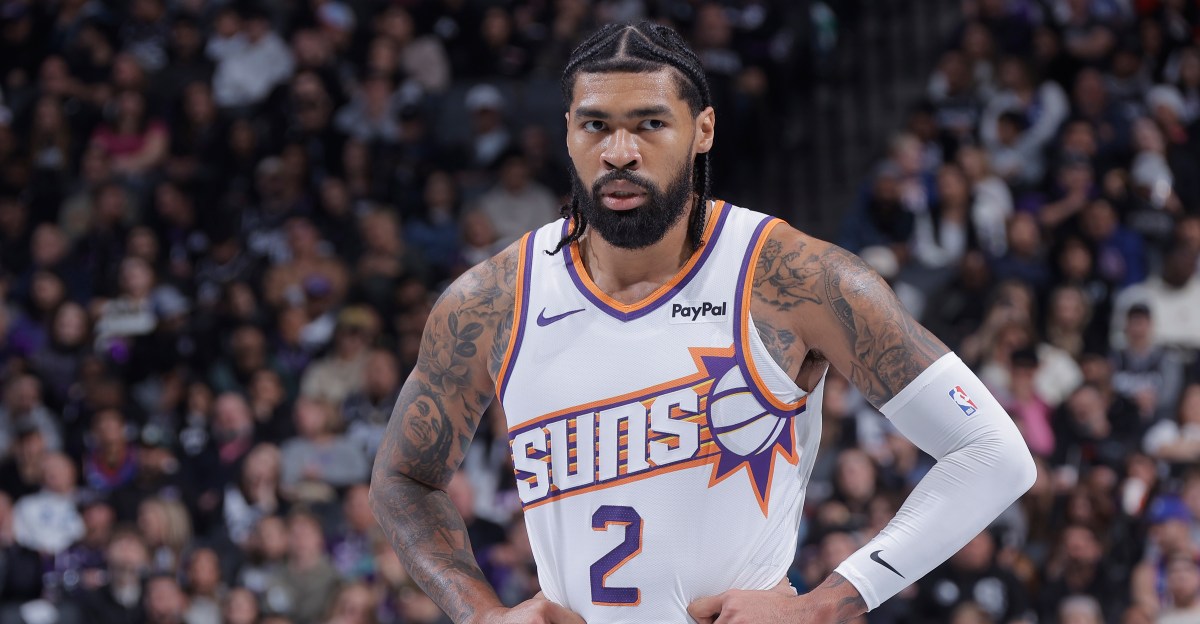
Losses like the one against Golden State last night are frustrating because they shine a bright light on a real Suns issue. Phoenix has grit. They play connected basketball. Even with some loose effort showing up on Saturday night, this matchup exposed a problem that has been sitting there all along.
The Suns lack switchable size.
That has been clear in these last two games against the Warriors. It is why we saw far more Oso Ighodaro than Mark Williams. Ighodaro averaged 29.0 minutes across the two matchups. Williams averaged 18.5. That was not accidental.
Golden State plays five out because they do not have much size themselves. Once Draymond Green was ejected early, they became even smaller. It worked to their advantage. When the greatest shooter of all time can launch from deep whenever he wants, you have to respect that gravity. Mark Williams does a lot of good things, but switching on the perimeter is not his strength. Oso is not perfect there either, but he brings more athleticism, more lateral quickness, and a better ability to survive on the perimeter.
That is the choice teams like Golden State force Phoenix to make. Open up the perimeter for someone like Steph Curry, or protect the interior and try to control the glass. Jordan Ott chose to prioritize the perimeter. The Suns paid for it on Saturday night.
When you are starting Dillon Brooks, Ryan Dunn, or Royce O’Neale at power forward, you are a team that does not have what anyone would call “size”. Because of that, the results of this week’s Suns Reacts Survey were not surprising. Knowing the team is open to moving Nick Richards, the community leaned toward second round draft compensation rather than bringing back another player.

The logic tracks. If there is not much on the market that feels worth taking back for Richards, then stockpiling assets makes more sense. Put something in the cupboard. Save it for a deal that actually moves the needle later.
Richards does bring size. It simply is not the kind of size this roster needs.
Richards is making $5 million this season, and he becomes an unrestricted free agent once it ends. The Suns do hold his Bird rights, so if they wanted to bring him back, they could offer more than most teams. That part almost does not matter, because he feels like a square peg in a round hole on this roster.
There is a reason he ends up with DNPs against teams like Golden State. He is not the rebounder Mark Williams is. He is not the defender or connective piece that Oso brings. What Richards does have is size, and that is something the Suns lack. Size alone is not enough. It has to come with a level of athleticism that always feels slightly out of reach for him.
That is where the frustration sets in. He feels close. The size is there. The length is there. Then the game speeds up and the cracks show. Reads come late. Passes miss their mark. Moving screens become the norm. Opportunities slip by. It adds up, and it is why he never quite settles into being the consistent center this team needs.
It would be great if the Suns could move him and bring back someone who actually fits what this team needs, a real power forward who checks the right boxes. The problem is the math. Unless you bundle his contract with someone like Royce O’Neale and his $10.1 million deal, you are not getting back anything that truly moves the needle.
The list of players who fit what Phoenix is looking for in a Richards trade is short. Very short. The Suns are under the first apron, which means they can take back 125% of the outgoing salary plus $250K. In Richards’ case, that puts the incoming number at $6.5 million.
Once you start filtering power forwards by that salary range, removing rookies recently drafted who are still projects on their teams and removing players who make less than Richards (seeing as so many teams have apron restrictions as it pertains to taking back salary), the options thin out quickly. And when you factor in fit, impact, and actual availability, it becomes clear why this is not as simple as trading Richards for help and calling it a day.
Saddiq Bey (NOP) — $6.1 millionTari Eason (HOU) — $5.7 millionGuerschon Yabusele (NYK) — $5.5 million
The next question becomes, what is in it for the other team? Half a season of Nick Richards on an expiring deal? How valuable is that? We have items being auctioned off for Dave King’s Bright Side Night that are more valuable than that.
That is why I line up with where 61% the community landed. If you are going to move Nick Richards, you do it for draft compensation. Find a team that needs a big, Toronto comes to mind, and flip the expiring contract for second round picks. If you can pull two seconds out of that, it is a big win. Not because those picks are guaranteed to turn into rotation players, but because they become currency. They are the sweetener in a larger deal down the road.
Not this season. Maybe next year. After another year of development, patience, and culture building really takes hold. After the team gets a clearer picture of what Jalen Green is becoming and how Khaman Maluach is progressing.
Until then, when the Suns face teams that play a quality five-out style, it is going to hurt in one way or another. Either the perimeter defense suffers, or they get worked on the glass. That is exactly what happened last night. Phoenix held Golden State to 34.7% from three. Playing Oso on the perimeter worked to a point. Pulling him out of the paint opened the door for rebounding chances, and the Warriors took advantage every time they could.
Nick Richards does not solve that problem. He has not shown he can help in multiple lineup contexts or different styles of games. Because of that, he has become the odd man out. An expiring contract who has not consistently executed the vision of this version of the Suns.
Get what you can for him by February 5 and move on.