
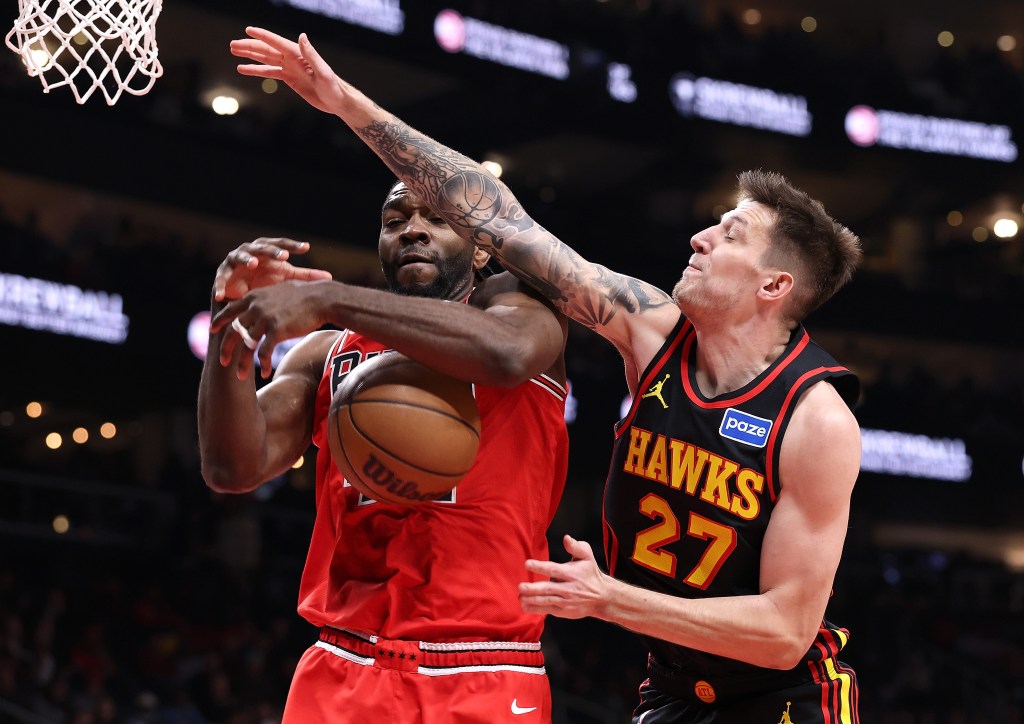
ATLANTA — Nearly 15 minutes after the opening tip of Sunday’s win over the Hawks in Atlanta, Patrick Williams strode to the scorers table and began to tug off his black warmup.
Only five minutes and nine seconds remained in the first quarter. Williams was set to become the fifth player to come off the bench for the Chicago Bulls.
For a minute, Williams seemed confident. Self-possessed. In his first offensive possession, he grabbed a pass at the top of the key and barrelled downhill for a layup, rolling the ball off his fingers and over the rim. This isn’t new. The play looked easy. Basketball often looks easy when things are going right for Williams.
But Williams faded in and out of focus during the game. He clung to the perimeter, grabbed a few offensive boards, rimmed out on a shot from behind the arc. Then he sat on the bench for the entire second quarter. Williams earned two more rotations in the second half — less than three minutes apiece — and finished with only four points, all of which were scored in the first quarter.
This isn’t new either. Williams averages 19.8 minutes per game, the ninth-most on the Bulls roster. In the last four games, he fell to the 11th man on the roster, playing only 12.1 minutes per game.
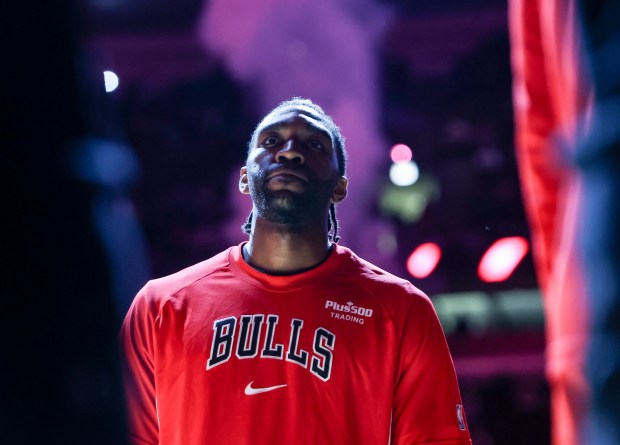 Bulls’ Patrick Williams stands during player introductions before a game against the Warriors on Dec. 7, 2025, at the United Center. (Dominic Di Palermo/Chicago Tribune)
Coach Billy Donovan says this isn’t necessarily the end game for Williams. The Bulls are still figuring out how — and when — to employ a double-big lineup, which often pushes backup forwards to the edge of the rotation. But as the Bulls recalibrate around the return of injured players, it’s clear Williams is losing priority in the team’s depth chart.
“At some point, there’s going to have to be a level of sacrifice by everybody,” Donovan said. “I wouldn’t sit there and say that in my mind, okay, he’s just the 11th guy and that’s it. I don’t know what’s going to happen with our team going forward. But I do think Patrick can help.”
And that doesn’t change the reality for the Bulls — that the team’s highest-drafted player in the last 17 years is confined to a minimal role off the bench.
Donovan knows that when assessing a player’s potential, most fans look to the same place: where a guy was picked. That has never worked in Williams’ favor. The forward has carried the weight of the No. 4 pick ever since he was drafted in 2020. For most of that time, that weight has been too heavy.
The 2020 draft wasn’t the splashiest in league history. (Three of that year’s top 10 picks are actually now on the Bulls roster.) Still, a top-five pick is meant to be a caliber of player that can shift the trajectory of an organization’s future. Instead, Williams continues to be a non-factor.
If anything, this season has been a step backward for Williams. He lost his touch from close range, shooting a confounding 44.4% at the rim. His 3-point shooting is still a lone strength, shooting 40.7% from deep to make more shots from behind the arc than at the rim. Otherwise, Williams is a quiet presence waiting in the wings for the Bulls.
“I’ve got to accept Patrick for what he does and how he contributes as a player,” Donovan said. “There’s been moments where he’s really, really, really been effective and then there’s maybe some other moments he hasn’t.”
It’s easy to get your hopes up about Williams. Donovan even says this himself — just looking at his 6-foot-6 frame and his evident strength, it’s hard not to project the image of a future All-Star onto the forward.
But his output has always been more modest. Williams has never averaged more than 10.2 points per game. His best rebounding season is still his rookie year, when he averaged 4.6 per game. His two-point shooting has only degraded with time.
And after years of attempting to coax, cajole and command a better version of Williams into existence, Donovan wants to embrace the forward for what he can do for the Bulls right now.
“It’s not like I’ve just resigned myself to the fact that he can’t get better,” Donovan said. “I resigned myself to the fact of, here are the things he does well that can impact our team, and I’m going to count on those things and demand those things out of him. But if I want him to put the ball on the floor and create, make a play and go finish and step through and do all this, that may not be him.”
In the short-term, Donovan wants Williams to focus on simple tangibles that fit into the overall ethos of the new Bulls system.
Most of these requests are fundamentals: take open 3-pointers, contest physically on defense, hit the boards hard, shore up his finishing at the rim.
“If he does those things at a high level, he’s a really, really good contributing factor for us,” Donovan said.
Williams did not choose this. He didn’t ask to be drafted fourth overall. He did not set expectations that he’s never been able to fulfill. And five years removed from his draft, the fault in his growth — or lack thereof — still lies first and foremost with the front office that used a rare top-5 pick on an untested role player.
But blame and regret can’t help the Bulls. For now, the only answer for Williams is to perform his role on the Bulls roster, however big or small.