
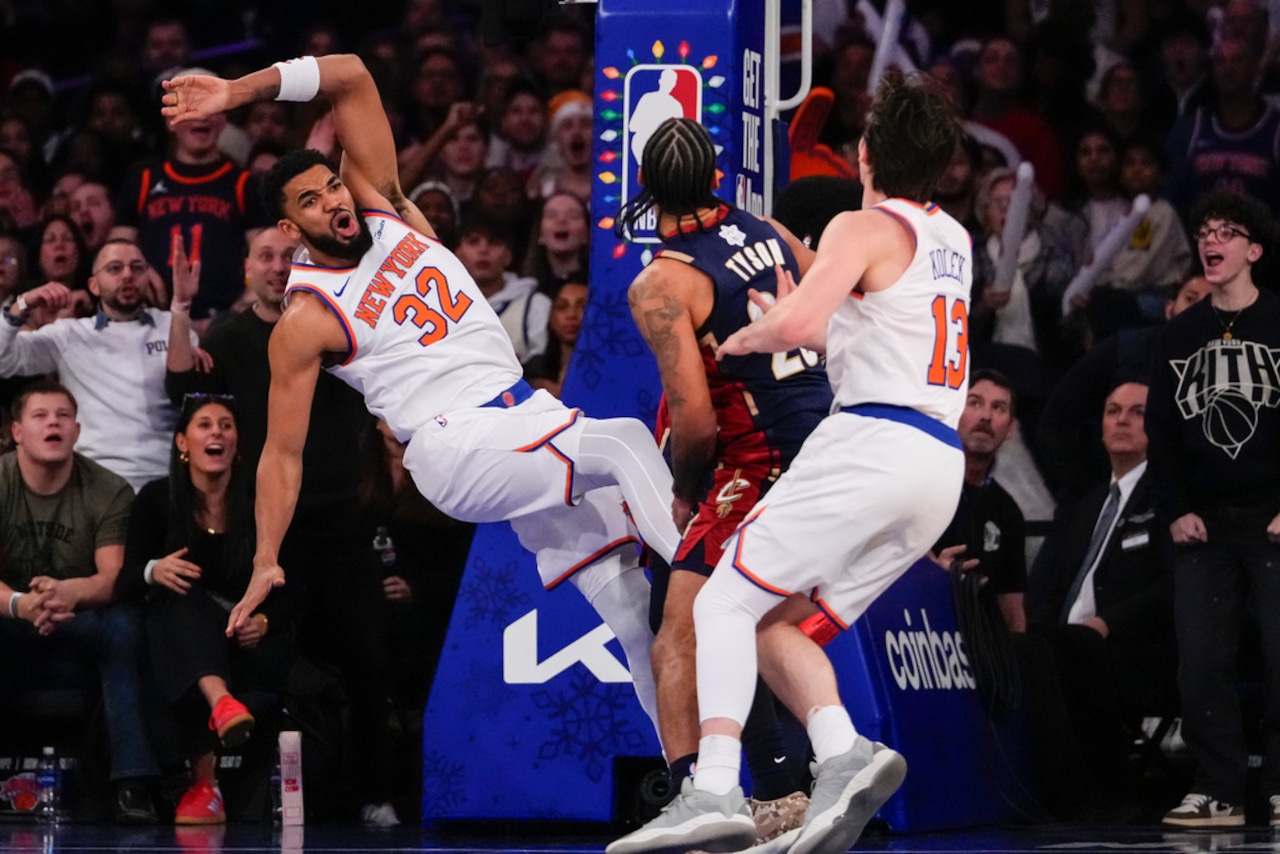
CLEVELAND, Ohio — The Cavs haven’t been focused on the wins and losses early in the season. They’ve concerned themselves more with the process and finding combinations that could be useful in a playoff series.
Even in a 126-124 loss to the Knicks on Christmas Day, Cleveland may have found just that, and it might be necessary with the evolution of the Cavs’ defense.
Cleveland no longer survives by escorting drivers into the waiting arms of its two big men. The team’s defensive identity is now focused on disrupting the trip before it ever begins.
Against New York on Thursday, that philosophy crystallized around a five-man group that deserves real consideration moving forward.
Donovan Mitchell, Evan Mobley, Lonzo Ball, De’Andre Hunter and Jaylon Tyson.
This wasn’t just a regular-season wrinkle found at Madison Square Garden in December. It’s a lineup that could answer questions in April, particularly in late-game moments designed to remove attackable defenders from the floor.
That only works if Kenny Atkinson is willing to make the call.
A changing defensive identity
The Cavs’ old identity was to protect the paint-first by funneling everything inside. Trust Jarrett Allen and Mobley to clean up the mess. Against finesse teams, it worked. Against teams like the Knicks, who weaponize force and second chances, it bent.
This new group flips the logic.
Ball, Hunter and Tyson form a defensive spine that allows Cleveland to defend outward instead of inward. Length across all three positions. Quick hands. Strong chests. And most importantly, interchangeable responsibilities.
The head of this snake is Ball. His anticipation and ability to stunt without fully committing shrink the floor horizontally. He is rarely guarding to contain. He is guarding to disrupt timing, giving him time to chase in rotations.
Hunter handles the hardest assignment. He absorbs contact without giving ground, something Cleveland has sorely needed against downhill wings and guards. His ability to switch onto bigger players without immediately requiring help keeps Mobley out of constant motion.
Tyson is the connective tissue. He toggles between on-ball pressure and nail help seamlessly. When he digs down, he recovers with urgency. When he switches, he does not panic. That calm is crucial.
Together, the trio makes life easier for the Cavs’ two stars.
Mitchell’s help is nearby when teams attack him in switches. But off the ball, he can shade passing lanes, load up early and gamble selectively — like he did to strip away a steal against Mitchell Robinson at the top of the key on Thursday.
This allows Mobley to be at his best: a roaming problem solver, always active and always connected to the play — rather than standing in place and risking disengagement.
This is where the lineup works.
Mobley is not stationed under the basket waiting to deter. He is hovering. Tagging rollers. Showing at the level and peeling back. Sliding into gaps that should not exist. His length becomes multiplicative when he is not tethered to the rim.
Switchability is the enabling factor. One through four can exchange assignments without triggering a scramble. That matters against a team like New York, which lives on forcing extra rotations and punishing them with offensive rebounds or Brunson isolations.
In five games together, this group has posted a defensive rating of 103.2 per 100 possessions. That would lead the league. The net rating sits at a staggering plus-43.6.
Small sample caveat acknowledged. Structural logic still applies.
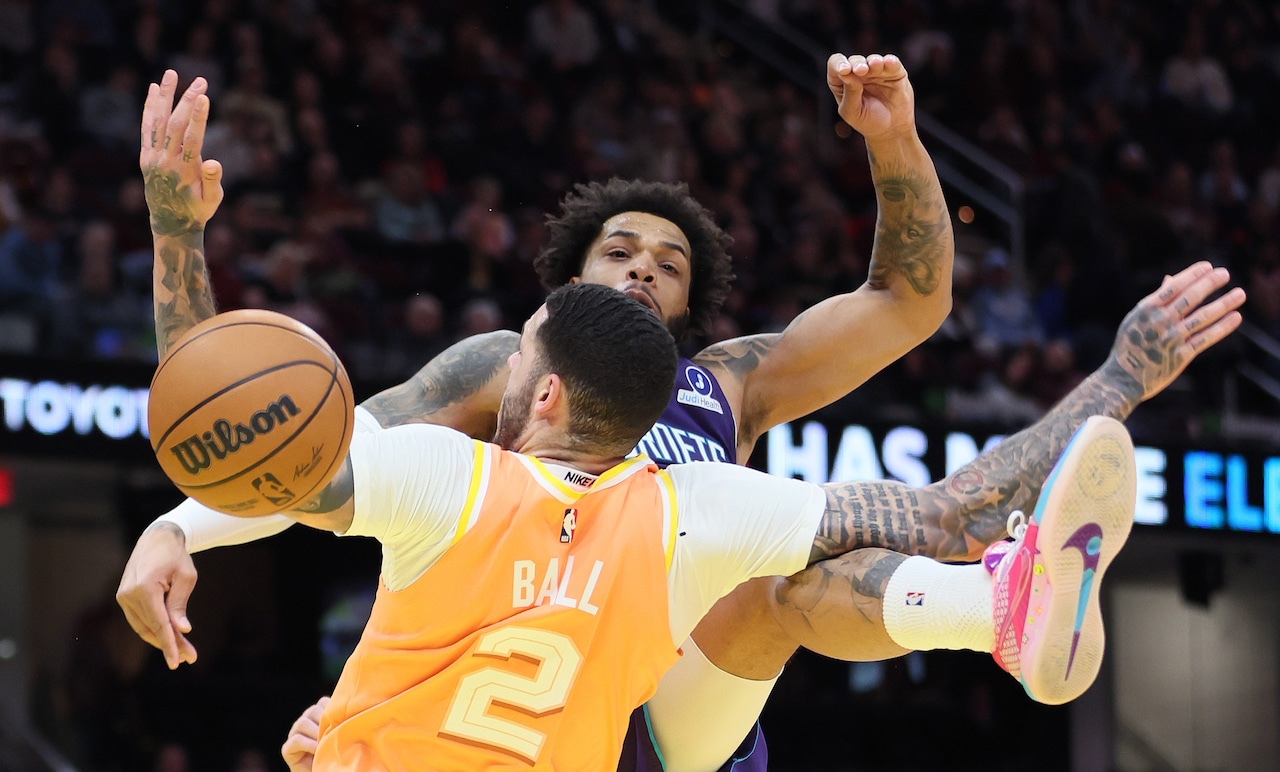 Charlotte Hornets forward Miles Bridges blocks the shot attempt of Cleveland Cavaliers guard Lonzo Ball in the second half at Rocket Arena.John Kuntz, cleveland.comOffense by committee, not hierarchy
On the other end, the lineup works because it does not ask anyone to be something they are not.
Ball is the organizer. His scoring struggles are real and glaring — shooting 30.3% from the field and 26.1% from deep — but his value is not shot creation. It is shot sequencing.
In transition, he turns chaos into advantage. Early hit-aheads. Dragging defenders with his eyes. Forcing cross-matches before the defense can settle. Cleveland needs those easy points, especially with lineups that trade size for mobility.
In the halfcourt, there are questions. Legitimate ones.
Ball’s scoring gravity is minimal. Defenders duck under screens without consequence. Weakside defenders will stunt off him entirely to clog Mitchell’s driving lanes or sit on short rolls. When the ball sticks, Ball becomes the easiest release valve for a defense already comfortable living with the results.
But the Cavs have quietly found ways to insulate those limitations rather than fight them head-on.
That’s why running matters to them.
Ball is rarely asked to initiate against a set defense. But when the defense is settled, Cleveland flows quickly into secondary actions — shallow cuts, guard-to-guard exchanges. That repositions Ball as a connector instead of a creator. That trims down the number of possessions in which his defender can simply park and wait.
Hunter and Tyson do the dirty work. Straight-line drives. Attacking closeouts. Forcing rotations. Neither needs to dominate the ball. Both move with purpose off it, opening space and allowing the offense room to develop. They understand when the advantage is theirs and when it belongs to the next pass.
That is how Mitchell and Mobley feast.
Mitchell attacks a tilted defense. Mobley catches on the move, not in traffic.
The offense hums not because of shooting brilliance, but because of decision clarity.
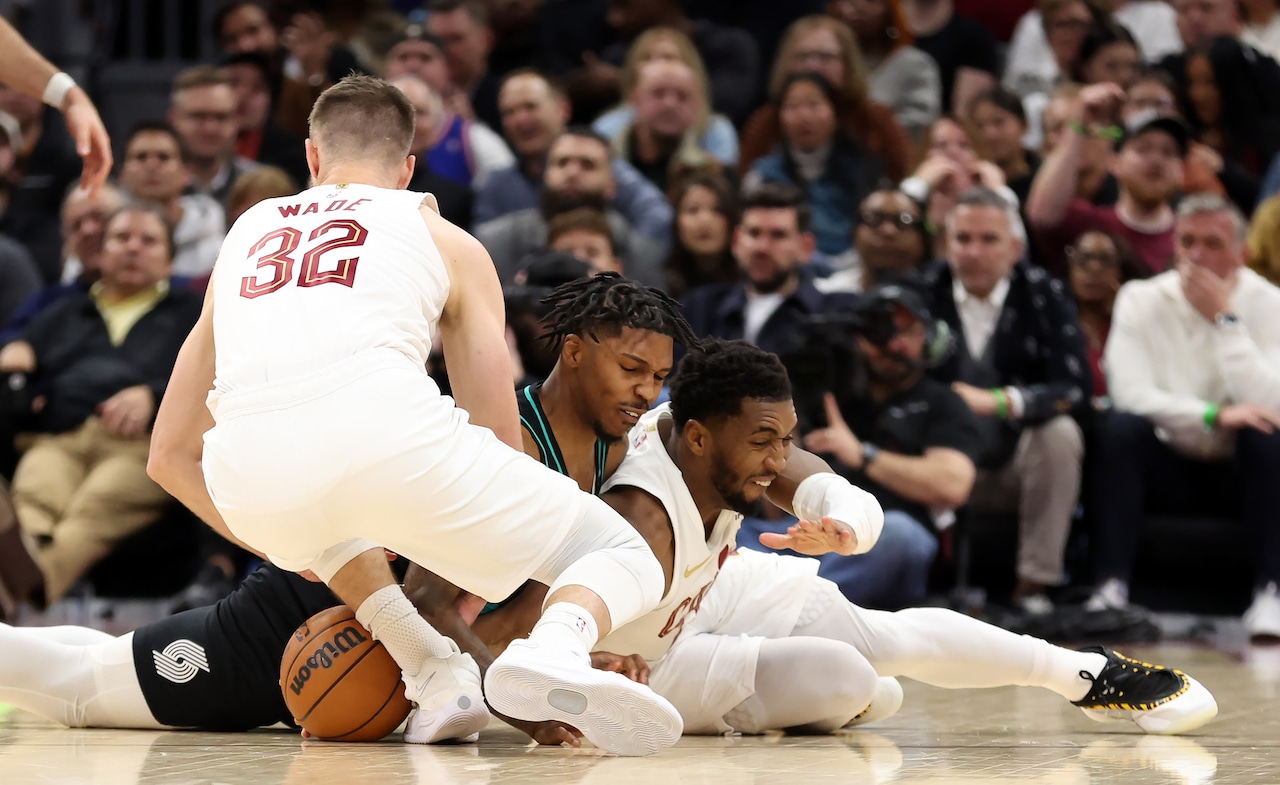 Cleveland Cavaliers forward Dean Wade, Cleveland Cavaliers guard Donovan Mitchell and Portland Trail Blazers guard Caleb Love battle for a loose ball in the second half of play. Joshua Gunter, cleveland.comThe Wade counter
There is, however, a necessary contingency.
Ball’s offensive limitations cap the ceiling of this group in certain matchups. That is where Dean Wade enters the conversation.
Subbing Wade for Ball preserves the defensive thesis while adjusting the offensive math.
The Wade-Mitchell-Mobley-Tyson-Hunter lineup has played 31 minutes across eight games. The net rating is plus-30.0. The defensive rating rises to 108.8 per 100 possessions, which would be second in the league behind the Oklahoma City Thunder.
Wade adds spacing and a 3-point threat that his current shooting numbers don’t fully reflect, but teams still have to respect his track record. Defensively, he is another body that can absorb contact against bigger guards or wings. And his foot speed at 6-foot-10 may be Wade’s most necessary skill.
This version becomes particularly valuable against teams with size at the guard spot or bigger initiators who want to bully their way into switches. Or against Brunson himself — who Wade has held scoreless (0-of-10) in roughly six minutes of matchup data over two games per NBA.com — when the Cavs want to throw waves of physicality without overcommitting help.
The beauty is optionality.
Atkinson can toggle between Ball and Wade without abandoning the core idea. Length. Switchability. Aggression at the point of attack. Mobley as the roaming eraser rather than the stationary wall.
This is not an indictment of Jarrett Allen, whose value remains against opposing two-big lineups, even as Atkinson becomes more comfortable going away from him in fourth quarters. Nor is it one of Darius Garland, who is the engine of Cleveland’s offense but is routinely targeted late in games. It is an acknowledgment of matchup reality and situational necessity.
Most importantly, it aligns with where the Cavs are headed philosophically. Defense as prevention, not reaction.
Christmas Day may not have ended with a win, but it revealed a tool.
And the Cavs would be wise to keep it close at hand.