
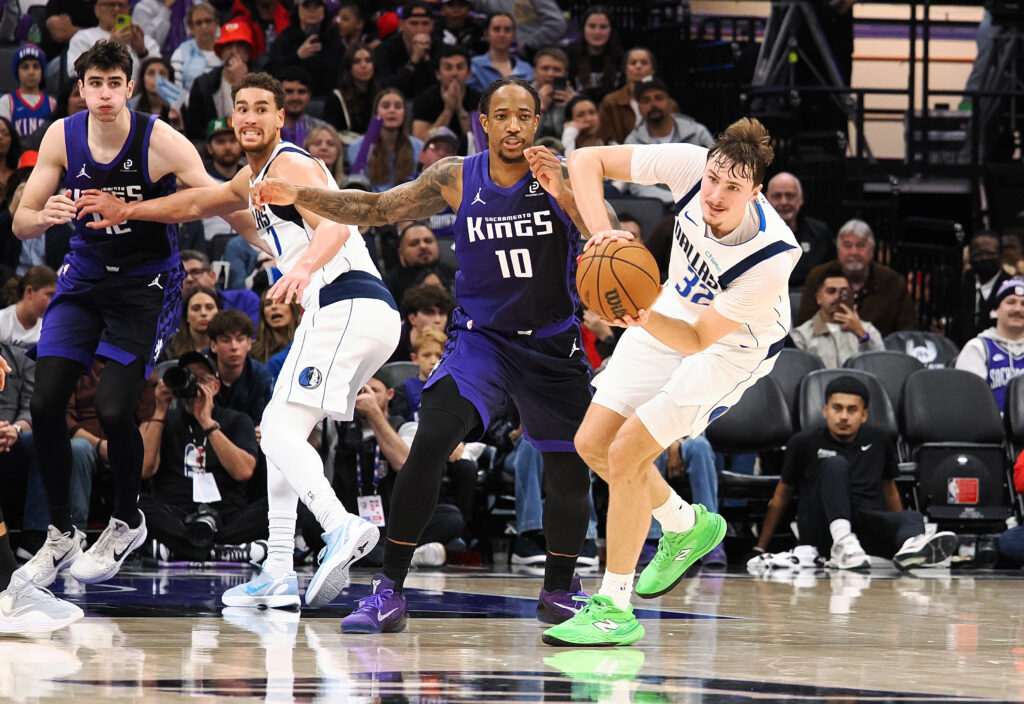
The Dallas Mavericks walked into Sacramento needing a clean performance. What they delivered instead was another night where flashes of promise were drowned out by turnovers, defensive lapses, and missed opportunities in winning time. Despite a strong showing from Cooper Flagg, Dallas never truly controlled the game and watched the Kings dictate terms for most of the night in a 107-113 loss.
While the Mavericks searched for answers, the Kings celebrated a milestone. Russell Westbrook, now wearing Sacramento colors, passed Magic Johnson for seventh place on the NBA’s all-time assists list, a moment that underscored how comfortable he looked running the show. Westbrook’s poise, paired with Sacramento’s ball movement and pressure defense, highlighted the contrast between a Kings team playing with purpose and a Dallas squad still struggling to close gaps.
Cooper Flagg Was Impressive But Can’t Do It Alone
Cooper Flagg was once again Dallas’ most reliable source of offense. The rookie poured in 23 points on 7-of-13 shooting, knocked down 3-of-4 from deep, and went a perfect 6-for-6 at the free-throw line. He added six rebounds and five assists in 34 minutes, consistently attacking mismatches and keeping Dallas afloat when the offense stalled. When the Mavericks needed a bucket, Flagg was often the one creating it.
The problem was the weight he carried. Flagg also committed five turnovers, a reflection of how much responsibility he was forced to shoulder. Dallas finished with 21 turnovers as a team, many coming from forced reads and rushed possessions late in the shot clock. For all of Flagg’s growth, this was another reminder that Dallas is leaning too heavily on a rookie to solve structural issues that run deeper than individual production.
Turnovers And Steals Gave Sacramento An Advantage
The box score tells a blunt story. Dallas committed 21 turnovers. Sacramento committed just 11. That imbalance led to a 28-11 advantage for the Kings in points off turnovers; the single biggest statistical separator in the game. Sacramento recorded 16 steals, repeatedly jumping passing lanes and turning broken possessions into easy offense before Dallas could set its defense.
Even when the Mavericks shot well, 46.0% from the field and a scorching 48.1% from three, they couldn’t capitalize because possessions kept evaporating. Ryan Nembhard, Cooper Flagg, and Max Christie combined for 10 turnovers, and Dallas never recovered from the momentum swings those miscues created. Against a Kings team that thrives on chaos, Dallas played right into their hands.
Sacramento’s Backcourt Controlled Tempo
Russell Westbrook looked fully at ease orchestrating Sacramento’s offense. He finished with 21 points on 8-of-16 shooting, drilled 5-of-9 from beyond the arc, and handed out nine assists. His ability to push pace selectively, attacking when lanes opened, pulling the ball back when needed, kept Dallas off balance all night. Passing Magic Johnson on the all-time assists list felt fitting on a night where his fingerprints were everywhere.
Westbrook wasn’t alone. Keon Ellis added 21 points while hitting 5-of-10 from three, and DeMar DeRozan chipped in nine points and six assists without forcing shots. Sacramento totaled 32 assists on 45 made field goals, a sign of how clean their offense was compared to Dallas’ stop-start rhythm. The Kings didn’t overwhelm with size or pace; they overwhelmed with decision-making.
Dallas Competed On The Glass But Lost The Margins
Rebounding wasn’t the issue for Dallas. The Mavericks edged Sacramento 51-50 on the boards, pulled down 40 defensive rebounds, and got solid interior work from Daniel Gafford, who posted 11 points, seven rebounds, and a block in 23 minutes. Dwight Powell grabbed 11 rebounds off the bench, giving Dallas second-chance opportunities that should have mattered more.
But those efforts were undermined by execution elsewhere. Dallas allowed 14 offensive rebounds, failed to convert consistently at the free-throw line (14-of-20), and spent most of the game playing from behind – leading for just 5% of the contest. Even with strong shooting and competitive rebounding, the Mavericks never found the discipline needed to turn small advantages into sustained runs.