
The NBA season is about 40% complete, but 2025 is over, or nearly over, everywhere around the world. I hope you’re doing something more fun than writing a year end article, but worse things than year end articles happen at sea.
Without further ado, let’s talk about this basketball year in general. By that I mean, off season to now, rather than the remains of the 2024-25 season. We’ll count down in New Year’s fashion instead of counting up. I know I can count on you all to understand. Almost all of you, anyway.
FIVE! – Off Season Signing Number One – Demonstrably Factual Signing
The Rockets signed two players, really, in the off season – the big get was Dorian Finney-Smith who was expected to sign with the Lakers, but allegedly (by me) Rob Pelinka sprained both shoulders trying to get out of his famously tight leather jacket, and was unable to call, text or email Dorian Finney-Smith or his representatives. So the Rockets were able to swoop in and sign him.
As for the player previously known around here (again, by me) as Definitely Fictional Signing, there is proof of his existence now. Some have suggested he’s like the Loch Ness monster, but I believe he could be more present in everyday basketball, and life, like Bigfoot. DFS has played a couple of games for the Rockets, and looks a lot like a guy who hasn’t played since last season, and didn’t participate in training camp. That said, there’s plenty of time for him to round into form.
I think it’s worthwhile to be clear on who Dorian Finney Smith is as a player. First off, he’s going to be 33 years old in early May, 2026. That means that what you see is pretty much what you get, unless things are getting worse with age related decline. He’s a solid defender at forward, and can in some cases play up or down a little bit. He’s a good, but not great, rebounder. He can definitely do the “three” part of 3&D, with a career percentage of 36% that has hovered at or very near 40% over the past two seasons.
That said, he’s not a volume shooter. Even on a per36 basis (and he’s averaged 28mpg for his career) he shoots around 6 threes per game. He’s been on a number of offensively challenged teams and has broken five attempts per game twice in his long career. The reason I mention this is, for the most part players settle into the usage level that works best for them over a longish career. Occasionally you’ll see huge efficient usage spikes like James Harden or SGA, but that’s the exception. So expect DFS to be more in the vein of Second Stint Trevor Ariza as a shooter – shoots it well, but rarely at high volume. If DFS can play at early 30s Ariza level for the Rockets, he’s a steal.
The Rockets also signed The Baby Deer of fond memory, or officially, Clint Capela. Clint is no longer a young buck, leaping over trees, brush and other players with impunity. He’s no longer the player that literally made KAT abandon the paint and run and hide in the corner in the playoffs. He’s now a stag, and may be somewhat weighed down by his mighty rack of antlers, to torment this metaphor still further. In any case, if DFS needs to round into form, Clint may need to round down to be more effective. That springy, quick, first and second jump from a standstill you remember? Gone. Running the lane to smash down lobs? Also largely gone.
But guess what? One of the NBA’s top five ALL TIME rebounders by rebounding rate is still good at rebounding. He’s averaging around his career norm for total rebounds per36. What do you think that is? 8? 10? Nope, it’s 15 boards per36 (I told you he was an all time great rebounder: Clint’s 7th all time on the offensive glass, and 3rd all time in rebounding percentage. Third.). He’s at a career high for offensive boards per36 as well, at 8. So while it hasn’t looked pretty, Capela just has that special knack for rebounding.
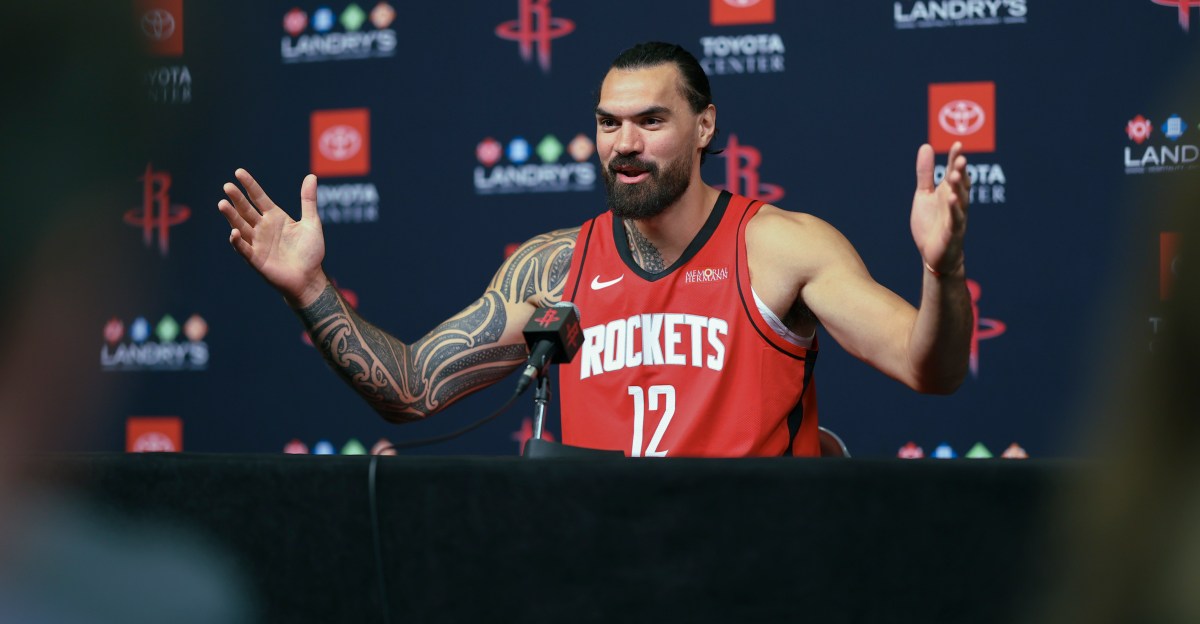
If the Rockets can work the same magic on Clint’s health they did on Steven Adams, who looked like a shell of the player he had been when he first played for the Rockets, the mighty deer may yet leap again. For now, Adams is questionable for the New Year’s Day game against the Nets, so maybe Clint will get more minutes, and look better soon. Hopefully the toll of nagging injuries over his career hasn’t stolen his hops for good.
THREE! – Kevin Durant – Not A Point Guard. Or is he? He isn’t.
We always have to argue about something around here, and this year’s big winner so far is “Who should be the Rockets Point Guard”. To be more accurate, who should be the Rockets primary initiator and bring the ball up. Whether you side with Amen Thompson’s case, Reed Sheppard’s, Alperen Sengun’s or a combination of three, I think we can perhaps all agree that the initiator, and main dribbler of Right Now, and The Future, should not be Kevin Durant.
Or should it? You might think that Durant’s assist rate, and turnover rate would be higher than usual, given that he seems to be initiating the offense from Old Arky (the top of the 3pt arc, the only spot Ime Udoka clearly believes offense should ever start). Only, neither Durant’s assist totals, nor his turnovers have risen from his career norms, especially those of the past few seasons. So while it might look bad, well, it’s about the same as it ever was for KD. So far, anyway.
TWO! – High Performance Garbage Truck
Only Ime Udoka could coach an offense that looks clumsy, clunky, and dreadfully boring, yet is second in the NBA in offensive rating at 121.5 (second to Denver, so number one is possible fairly soon), with a net rating of +8.6, also second, behind OKC’s absurd +13.8. ( You might not have noticed, but OKC looks a lot more vincible without a steady diet of Kings, Jazz , Hornets, and assorted NBA teams we’ll call Flotsam and Jetsam. What the Rocket’s excuse regarding Flotsam and/or Jetsam is, I couldn’t tell you. They just like losing to F&J, I guess.)
So the offense scores points. It’s second overall, and could be first soon. And yet. They shoot a great percentage from three, among the best, but also shoot fewer of them than almost any team. Part of this is the mid range dominance of their highest usage player, Kevin Durant. And let’s be clear, making threes is better than taking a ton and bricking them (SILAS!). Perhaps the Rockets Official Shooting Committee has worked its magic, or very young players have just gotten better, as you’d expect (and Jalen Green isn’t shooting threes for the Rockets (or anyone) these days).
The offense score points. A lot of them. This despite their pace being 28th overall. And yet.
In terms of pace and scheme, it often seems the Rockets leave points on the table with their turgid, often motionless offensive sets. Well, sets might be generous. Set, with some variants. The results are good, but could there be more, could the Rockets reach an absurd level of dominance on both ends of the court, with a faster, less predictable offense?
I see two main ways of looking at this. One is, the Rockets sort of ISO dominant, brute force, low motion, crash attack is something that should hold up in the playoffs. All sorts of clever, motion-y, basketball beauty often wilts in the playoffs (ask Cleveland over the past couple of seasons). This One True Set of the Rockets could accustom the players to gouging out points, without any help in the form of basketball plays, motion, or the hard work of outsmarting opponents.
Two, on the other hand, it could be that if you stop the first Rockets action, you more or less stop the offense. Playoff intensity defense, and the weird second version of the NBA rules found in the playoffs might lead to another offensive collapse in the post season. It certainly wasn’t the Rockets defense that doomed them against Golden State.
I guess we’re going to find out. (But would it kill the coaching staff to have something, anything, to run ATO, SLOB or BLOB? I hear Mike D’Antoni is available for consulting.)
Of course all this might matter a lot less because the Rockets are…
ONE! – Gods of The Offensive Glass
Right now the Houston Rockets are very best offensive rebounding team, by percentage of their own misses rebounded. Of all time. The highest whole season offensive rebounding percentage is the 1991-92 New Jersey Nets at 39.1%. The Rockets currently stand at 41.3%. That’s two percent higher than the best of all time (since the stat was first tracked in 1973). Number two in the NBA is currently Detroit at 36.9%.
In terms of total rebounds, and rebounding rate, the Rockets are first in the NBA. Their rebounding rate is 55.9%. Detroit, again, is second at 52.7%.
The Rockets rank merely 13th in terms of defensive rebounds, but due to being the Gods of The Offensive Glass, they’re still number one in total rebounds. I think those medicore defensive rebound numbers might be schematic in some way, in terms of the switchy pressure and high levels of help the Rockets employ. They might also just be bad at caroms off terrible three point attempts.
The highest number of total offensive boards per game all come from the early 1990s. The best season offensive rebounding average ever is 18.5 boards per game, with three teams being with 0.1 offensive rebound per game of one another over the three top seasons. The Rockets currently stand at 16.3.
I don’t think they’ll catch the early 1990s teams in raw total rebounds couple of reasons. One is, far fewer paint shots that aren’t dunks or layups are attempted. Far more three pointers are attempted, and the carom off missed 3pt shots are longer, and generally harder to track down from the paint that the mid range and paint shots of the 1990s.
Two, the game was far more focused on big men, dominating the paint back then. Generally shots taken then were simply less efficient overall – the majority being post ups, and mid range attempts. Three pointers were fairly rare, especially compared to now. So even though today’s game pace is much higher, with many more shots being attempted made, team shot profiles are far different, and generally far more efficient. Pace was slow in the 1990s, and defense was rugged. Serious hand checking and hard fouls were the norm (and not reviewed). Even though there were fewer shots taken, there were more close in misses to rebound.
No one will ever catch the utterly, shockingly clanky, largely not integrated, rebounding raw numbers of NBA basketball (more like Completely Celtics Owned and Operated NBA) of the 1950s. 71.5 per game – 1969-60 Boston Celtics. Seventy One Point Five Rebounds Per Game.
If you enjoy real NBA history being made, the Rockets are making it. On the glass.
ZERO! – Happy, Healthy and Prosperous New Year to all! May 2026 be better than 2025.