
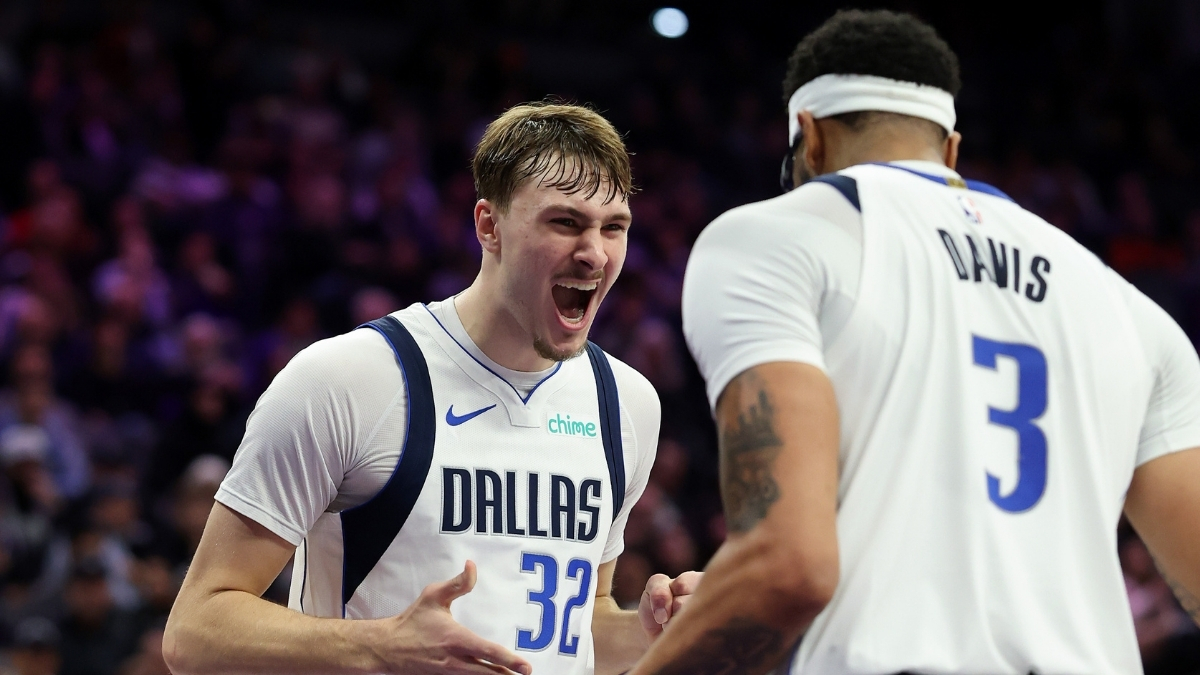
For weeks, the Dallas Mavericks have been searching for proof that their work — often undone by missed shots, turnovers, or late-game execution — could translate into tangible results away from home. Tuesday night offered that evidence, delivered not through shooting brilliance, but through persistence, physicality, and a single moment of trust when the game demanded it.
Brandon Williams knocked down a go-ahead three-pointer with 33.9 seconds remaining, Cooper Flagg led a steady response after an early deficit, and the Dallas Mavericks survived a rugged night offensively to earn a 100–98 victory over the Sacramento Kings at Golden 1 Center. The win snapped a seven-game road losing streak and marked Dallas’ second straight victory overall.
A Difficult Opening Puts Dallas in Early Hole
The tone of the game was set early, and it favored Sacramento. The Kings pushed the pace from the opening tip, capitalizing on Dallas turnovers and forcing the Mavericks to defend in transition before they could organize their half-court coverages.
Sacramento methodically built a double-digit lead in the first quarter, exploiting rushed decisions and loose ball security from Dallas. The Mavericks struggled to generate clean perimeter looks, while several live-ball turnovers fueled Kings possessions that stretched the defense and tilted the floor. By the end of the opening frame, Dallas found itself trailing 35–25.
The deficit reflected more than cold shooting. It was rooted in execution lapses — something Anthony Davis openly acknowledged afterward.
“We were turning the ball over — bad plays — and it started with me in the first quarter,” Davis said. “I had two turnovers. They were getting out in transition because of our turnovers.”
Cooper Flagg Sparks a Second-Quarter Response
Facing the possibility of the game slipping further away, Dallas steadied itself early in the second quarter behind Cooper Flagg. The rookie provided composure and intent, attacking gaps rather than forcing shots and helping the Mavericks regain structure offensively.
Flagg scored or assisted on multiple early baskets in the period, mixing decisive drives with timely passes to keep Sacramento from settling into a rhythm. His energy helped Dallas chip away at the margin and briefly shift momentum, even as perimeter shots continued to misfire.
The Mavericks were not flawless during the stretch, but they began to look more connected — a point Flagg emphasized when reflecting on the first half.
“In the first half, at times, we got caught standing around and watching each other,” Flagg said. “We missed some easy passes that we usually make.”
Sacramento, led by DeMar DeRozan and Zach LaVine, managed to stabilize before halftime. The Kings entered the break with a 58–46 lead, but the game no longer felt as one-sided as it had during the opening quarter.
Strong Halftime Start Signals A Shift
Dallas carried its late-second-quarter footing into the third, opening the half with noticeably sharper defensive rotations and improved ball movement. The Mavericks came out intent on shrinking the floor defensively and winning the possession battle — a shift Jason Kidd said was emphasized directly at halftime.
“At halftime, we talked about what we needed to do better,” Kidd said. “We weren’t playing together in the first half.”
The Kings initially answered each Dallas push, keeping the lead at arm’s length as the Mavericks repeatedly trimmed the deficit to five or six points. But unlike earlier in the night, Dallas no longer looked hurried. Possessions extended, offensive rebounds accumulated, and Sacramento’s margin of comfort steadily eroded.
Midway through the quarter, Dallas absorbed another test when Flagg briefly left the floor after bumping knees. He returned moments later and continued orchestrating the offense, unfazed by the scare.
“In the second half, we did a better job coming out with great energy and playing together,” Flagg said.
By the end of the third quarter, Dallas had cut the deficit to 78–76. The Kings still led, but the game had tilted — the Mavericks had wrestled control of tempo and effort, even if the scoreboard lagged behind the feel of play.
Winning the Possession Battle On a Grueling Shooting Night
Neither team found consistency from the perimeter. Dallas shot 40.6% overall and 29.6% from three-point range, while Sacramento finished at 42.4% from the field and 29.0% from deep. Klay Thompson and Max Christie endured particularly difficult nights, combining to shoot 5-of-22 from the field and 4-of-18 from beyond the arc.
Rather than forcing shots, Dallas leaned into physicality. The Mavericks outrebounded the Kings 55–43 and generated a decisive 15–8 advantage on the offensive glass — a product not only of starting two bigs in Davis and Daniel Gafford, but also aggressive perimeter crashing from Naji Marshall and Flagg.
“I thought we kind of found something new — offensive rebounding,” Kidd said. “Najee, AD, and Gaff, those guys were big for us. We didn’t shoot the ball well tonight, shooting 40 percent, so they gave us opportunities with second-chance points.”
Gafford finished with 13 rebounds, seven on the offensive end, repeatedly extending possessions that kept Dallas within striking distance. Davis added 16 rebounds of his own, anchoring the interior on both ends.
Sacramento countered in the fourth quarter by going small, sliding Precious Achiuwa to center and mixing in zone coverage. The look briefly disrupted Dallas’ flow, but the Mavericks still outscored the Kings 24–20 in the period by continuing to attack the paint and prioritize rebounds.
Trust and Timing Define the Decisive Possession
The game’s defining moment came after DeRozan drilled a step-back jumper with 40.4 seconds remaining, giving Sacramento a 98–97 lead. Out of a timeout, Dallas stayed patient.
Davis set a screen for Flagg near the top of the floor and rolled hard to the basket, drawing help defenders with him. As the defense collapsed, Flagg made the read and fired the ball to Williams on the right wing.
Davis, positioned with his back to the play, did not see the pass develop live.
“My back was turned, so I didn’t see the play develop in real time,” Davis said. “I know the play and what happened, but I didn’t see it live. I thought he was going to drive, and then he kicked it out to B-Will. B-Will laced it with confidence and made the three to put us up two.”
For Williams, the shot was a culmination of preparation and belief.
“Just a shot of confidence,” Williams said. “My teammates have full confidence in me. I kind of saw it in Cooper’s eyes before he passed it — he was going to get it off to me — so I just had to be ready to shoot.”
Closing The Door And Carrying Momentum Forward
The Mavericks still had work to do after Williams’ three. Sacramento missed three potential answers from beyond the arc, including attempts by Dennis Schröder, Russell Westbrook, and DeRozan. Even after Marshall missed two free throws with 8.1 seconds remaining, Dallas secured the offensive rebound and prevented the Kings from generating a clean final look.
Williams said the closing sequence demanded focus across multiple areas.
“Rebounding, hitting free throws, everything honestly,” he said. “All the little things. Don’t foul. There was a lot that played into it for sure.”
Davis finished with 19 points and 16 rebounds, Flagg added 20 points, eight rebounds, and six assists, and Williams scored 18 points — 14 after halftime — including the biggest shot of his NBA career.
“It’s always a good feeling to win, especially on the road,” Williams said. “It gives us a lot of confidence going into this trip.”
Kidd viewed the victory as a necessary step for a team that has repeatedly played tight games this season.
“We didn’t play our best, but we found a way to win a close, ugly game,” Kidd said. “Hopefully we’re starting a new streak.”
Dallas improved to 14–23 and will continue its road trip Thursday night at Utah, carrying with it a road win built not on efficiency, but on effort, trust, and resilience — traits that finally translated into a result when the margins were thinnest.
Latest Dallas Mavericks News & NBA Trade Rumors