
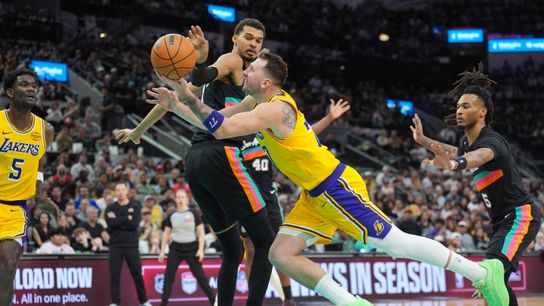
SAN ANTONIO — The third quarter arrived like a judge’s sentence, swift and merciless.
For two quarters, the Lakers had competed, trailing by just four at halftime, and convinced themselves that effort alone might be enough.
Then the Spurs peeled back the facade and revealed the truth that has haunted this team all season: effort without execution is just theater, and theater doesn’t win basketball games.
The Spurs won 107-91, but numbers don’t tell the tale.
The deep dive is far more brutal: Spurs’ points in the paint 66, Lakers 40. The Spurs shot 23 of 28 from the free throw line, the Lakers, 14 of 22. The Lakers’ three-point shooting: nine of 39 for 23%.
San Antonio wasn’t good—the Spurs made just 4 of 25 threes themselves, a paltry 16%.
But the Spurs understood what the Lakers refused to accept: when you cannot shoot, you must score inside. When you cannot score inside, you must be able to shoot. When you can do neither, you have to defend. But when you can do none of the above, you’re the Lakers.
Luka Dončić provided the only oxygen, the only reason the game remained within shouting distance for as long as it did.
Dončić poured in 38 points, 10 rebounds, 10 assists—his 86th regular-season triple-double, seventh-most in NBA history. He played all but four minutes in the first half, orchestrating an offense that moved like a car with three flat wheels, grinding and lurching but somehow still moving.
He found Jaxson Hayes for a reverse dunk that would’ve gone viral on any other night.
He set up Jake LaRavia for 16 points.
He carried the Lakers’ scoring load, their playmaking burden, their emotional weight.
He carried everything. He couldn’t carry enough.
“I still should have done way better than this,” Dončić said. “Miss free throws, turnovers, man. I think we had some great looks, too. We could have knocked ’em down, but we didn’t.”
The “we” is instructive. Dončić took ownership, but the “we” included everyone not named with a Slovenian surname.
Only three Lakers scored in double figures.
LaRavia’s 16 points and Hayes’ 10 were commendable but insufficient.
The Spurs had six players in double figures, led by Keldon Johnson’s 27 points.
They had depth, they had options, they had a young bench that provides damn near a double-double every night.
The Lakers had LeBron James watching from the bench in street clothes, his 41-year-old body refusing to cooperate on the second night of a back-to-back, his arthritis and sciatica a cruel reminder that even legends have expiration dates.
The Lakers had no one else.
“When you are down so many players, this is how we’re going to have to win,” JJ Redick said. “This is how we’re going to have to compete.”
Redick’s voice carried the resignation of a coach who has delivered this sermon too many times.
Compete, they did… for two quarters.
The Spurs’ 66 points in the paint overwhelmed a Lakers interior defense that looked like cardboard cutouts against San Antonio’s athleticism.
The Lakers disrupted alley-oop attempts early, a minor victory that felt like patching a dam with chewing gum.
The Spurs adjusted. The Lakers didn’t.
San Antonio’s youth and depth—Julian Champagnie’s energy, Stephon Castle’s 15 points, De’Aaron Fox’s 14—wore down a short-handed team that had played hard but had nothing left.
“We fought very hard,” Dončić said. “Everybody that left the court today should be feeling proud.”
Pride doesn’t show up in the standings. Pride doesn’t stop penetration. Pride doesn’t make three-pointers fall.
The Lakers shot 23% from the 3-point line. They shot 64% from the free-throw line, missing eight in a game they lost by 16.
They recorded 16 turnovers, resulting in 24 Spurs points.
Los Angeles committed the cardinal sin of modern basketball: they couldn’t score efficiently from anywhere, and they couldn’t stop their opponent from scoring anywhere.
The formula was there. It always is: Play hard, get extra possessions, compete.
The Lakers competed. They just couldn’t complete.
The Lakers needed a secondary offensive player outside of Luka. On a night where shooting 35 to 40 percent from three, perhaps the Lakers win.
But the Lakers didn’t have a secondary offensive weapon.
Austin Reaves is out with a calf strain. Rui Hachimura is sidelined with the same injury. James’ 41-year-old body needs its rest.
The Lakers’ roster construction—built around three stars, supplemented by minimum contracts and hope—crumbles when even one leg of the tripod disappears.
They’re a platoon of soldiers out of ammunition, tasked with holding a ridge.
This is the paradox of the Lakers’ season. They are 23-12 with a healthy roster, a record that suggests championship contention.
But the Lakers have played just three games with everyone healthy.
The sample size is minuscule, the results promising, the reality nonexistent.
“We haven’t seen much of the full team healthy yet this year,” Redick said. “That’s just not many when it comes to 35 games played.”
The Lakers’ most glaring weaknesses have been defense and turnovers.
They turn the ball over less when LeBron and Luka share the floor, but their defense remains suspect.
Wednesday night, it was catastrophic: the interior points surrendered, many of them, countless uncontested layups, a third quarter where the Spurs scored at will and the Lakers watched.
The Lakers needed offense. They needed someone to step up. But when only three guys score in double digits, it will never be enough to win in the modern NBA.
Three guys. One star. Zero answers.
When you cannot shoot, you have to score inside. When you cannot score inside, you must be able to shoot. When you can do neither, you have to play defense.
When you can do none of the above, you’re the Lakers.
The season isn’t over. The Lakers will get healthy—maybe. They’ll get whole—perhaps. They’ll get their secondary weapon back—hopefully.
But Wednesday night in San Antonio, the truth was laid bare: Dončić is a global superstar who leads All-Star voting, a kid from Slovenia who dreamed of the NBA and now carries its most decorated franchise on his back.
He cannot do it alone. No one can.
The Lakers are a riddle without an answer, a safe without a combination.
In San Antonio, they were Dončić, and then they are nothing. And in the long, cold grind of an NBA season, nothing is a hole too deep from which to climb.