
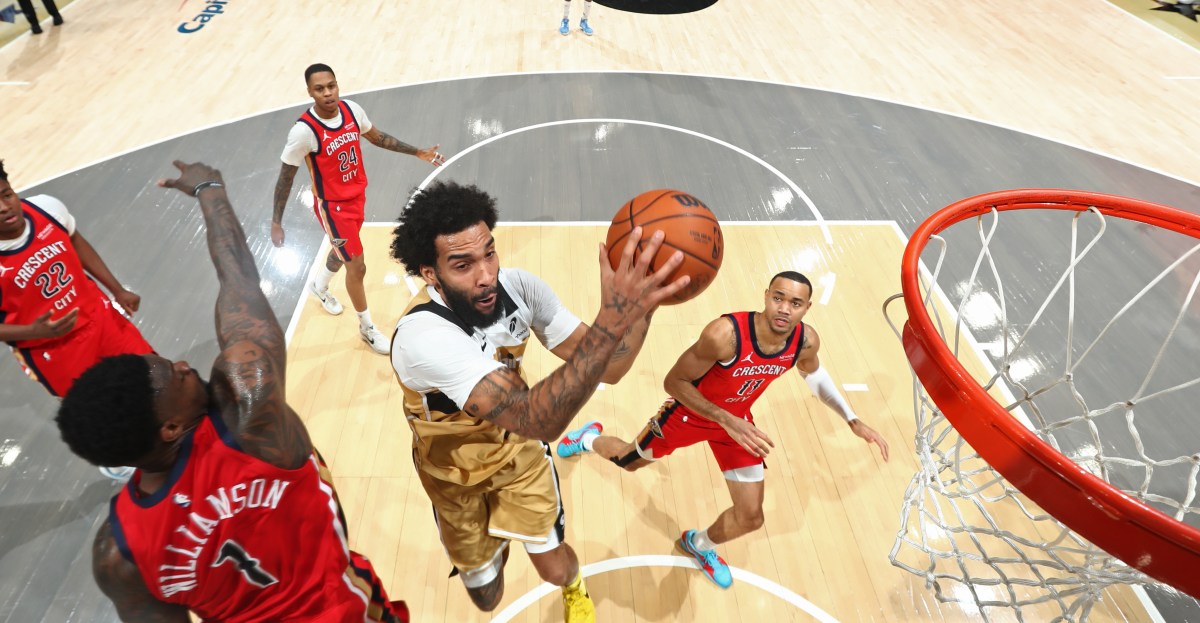
If you found your eyes glazing over and your thoughts wandering to the Stranger Things finale during last nights Pelicans at Wizards matchup, join the crowd. These are two of the worst teams in basketball — the Wizards intentionally, the Pelicans by accident — and they spent much of the night demonstrating why.
The teams combined for 36 turnovers (19 by the Wizards) and probably another dozen bad passes that didn’t become turnovers by sheer luck. New Orleans’ second half offensive surge was more due to Washington’s defensive mishaps. It’s fair to say that in this game, the less incompetent team won.

Wizards forward Justin Champagnie swoops in for a dunk. NBAE via Getty Images
It was an inauspicious beginning to the Trae Young Era, who watched in street clothes from the bench in his first game as a member of the Washington Wizards franchise. The Monumental broadcast was in peak educational form, informing viewers of Young’s absolutely amazing, superlative, colossal leadership skills, and cited things like working on special handshakes with teammates, sitting in the middle of the bench instead of the end, combing his hair, and wearing a beige suit.
I may have made the last two up — I was switching back and forth between the Pelicans and Wizards feeds throughout the game. New Orleans analyst Antonio Daniels is still very good, but Joel Meyers has lost a step or three on the play-by-play.
Both Meyers and Daniels mispronounced Tristan Vukcevich’s name — it’s not VOOK-then a long pause-SEVich, it’s Vooksevich kinda run all together. Like how the Wizards’ public address announcer said the name at least a dozen times during last night’s game. Meyers also misidentified players several times and got names wrong a few more.
It was a rough night to watch.
With CJ McCollum and Corey Kispert departed and Young not ready to play, the Wizards returned to tank mode. Last night, they replaced Marvin Bagley III — who’d been playing well — with Vukcevic, who has not. Somewhat amusingly, it was the starters who contributed most to the tank. The Wizards were +10 in Vukcevic’s minutes.
The Pelicans got big output from their starting front court.
Trey Murhpy III scored 35 points on 24 shots to go with 8 rebounds, 4 assists, and 4 steals.Zion Williamson scored 31 points on 12-14 shooting. The Wizards could do nothing to contend with his size and strength.Rookie Derik Queen posted the second triple-double of his career — 14 points, 16 rebounds, 12 assists.Kyshawn George returned to action after missing a few games with a strained hip flexor. He shot decently but committed three turnovers and four fouls in 24 minutes.As I watched the game, it kinda felt like Khris Middleton was having a quiet but decent performance. I remembered the made shots and the assist. Then I looked at the stat sheet and realized I’d memory-holed the misses and turnovers.Alex Sarr was ineffective on both ends — solidly outplayed by whoever was in the middle for New Orleans. The game underscored some areas where the 20-year-old will need to progress — maintaining mental focus and getting stronger.In the “Weird Comments from Broadcasters” category, there was Meyers noting in the second half that Tre Johnson had made 2-5 from three-point range, “…but I really like his stroke…” as if 2-5 (40%) was somehow bad.The Wizards tried to deploy Coulibaly on Williamson. He’s been able to shut down or chip away at the efficiency of bigger and smaller players alike, but Williamson has a unique blend of speed and power. Once Williamson decided to attack (about 7 minutes into the game), he scored at will. At one point in the first quarter, he had a 9-0 run on the Wizards.Despite blowing a few layups in the first half, Justin Champagnie played well. Again. He had 12 points, 9 rebounds, 4 assists. His night included three third-quarter dunks.By the numbers, AJ Johnson had his best game of the season — 6 points, 6 rebounds. I wouldn’t make too big a deal of it — the rebounds were a lot about the ball just bouncing his way.Malaki Branham hit a couple threes.Former Wizards great Jordan Poole played 12 minutes and got booed every time he touched the ball. The boos didn’t make much sense to me, but the full Poole experience was on display — strange decisions, bizarre shots (and he took only two!), three turnovers, and four fouls. How bad has Poole been for New Orleans? On the Pelicans’ broadcast, Daniels praised Poole for getting out of the way so Williamson would have room to drive.At one point in the third quarter, Sarr drove into the lane, spun on his left shoulder and hit a nifty jump hook. On the Pelicans broadcast, Daniels pointed out that Sarr used that exact move in pre-game warmup work. He said many players do different things in warmups than they do in games, but that Sarr’s pre-game routine focuses on the shots he uses in the game.
Below are the four factors that decide wins and losses in basketball — shooting (efg), rebounding (offensive rebounds), ball handling (turnovers), fouling (free throws made).
The four factors are measured by:
eFG% (effective field goal percentage, which accounts for the three-point shot)OREB% (offensive rebound percentage)TOV% (turnover percentage — turnovers divided by possessions)FTM/FGA (free throws made divided by field goal attempts)FOUR FACTORSPELICANSWIZARDSLGAVGeFG%59.5%48.9%54.4%OREB%25.6%21.2%26.2%TOV%15.6%17.4%12.8%FTM/FGA0.1580.2530.213PACE10999.8ORTG11798115.7
PPA is my overall production metric, which credits players for things they do that help a team win (scoring, rebounding, playmaking, defending) and dings them for things that hurt (missed shots, turnovers, bad defense, fouls).
PPA is a per possession metric designed for larger data sets. In small sample sizes, the numbers can get weird. In PPA, 100 is average, higher is better and replacement level is 45. For a single game, replacement level isn’t much use, and I reiterate the caution about small samples sometimes producing weird results.
POSS is the number of possessions each player was on the floor in this game.
ORTG = offensive rating, which is points produced per individual possessions x 100. League average so far this season is 115.1. Points produced is not the same as points scored. It includes the value of assists and offensive rebounds, as well as sharing credit when receiving an assist.
USG = offensive usage rate. Average is 20%.
ORTG and USG are versions of stats created by former Wizards assistant coach Dean Oliver and modified by me. ORTG is an efficiency measure that accounts for the value of shooting, offensive rebounds, assists and turnovers. USG includes shooting from the floor and free throw line, offensive rebounds, assists and turnovers.
+PTS = “Plus Points” is a measure of the points gained or lost by each player based on their efficiency in this game compared to league average efficiency on the same number of possessions. A player with an offensive rating (points produced per possession x 100) of 100 who uses 20 possessions would produce 20 points. If the league average efficiency is 114, the league — on average — would produced 22.8 points in the same 20 possessions. So, the player in this hypothetical would have a +PTS score of -2.8.
Players are sorted by total production in the game.
WIZARDSMINPOSSORTGUSG+PTSPPA+/-Malaki Branham245417510.4%3.318314Justin Champagnie224912122.1%0.6148-5Tre Johnson255711716.8%0.193-29Bub Carrington296510016.2%-1.673-1AJ Johnson16369917.5%-1.01133Kyshawn George24549825.9%-2.569-15Tristan Vukcevich23528535.1%-5.53210Bilal Coulibaly30679015.3%-2.77-26Alex Sarr25578727.9%-4.6-21-31Khris Middleton21484715.9%-5.2-68-24Anthony Gill360.0%0.00-1PELICANSMINPOSSORTGUSG+PTSPPA+/-Trey Murphy III368214326.2%5.833932Zion Williamson296615427.1%6.827022Derik Queen357911324.2%-0.615818Jeremiah Fears327310526.5%-2.015020Jordan Hawkins204610813.7%-0.5122-2Yves Missis13299119.5%-1.4793Karlo Matkovic51212414.3%0.1154-4Micah Peavy286310811.1%-0.525Bryce McGowens2965998.7%-1.0-1518Jordan Poole12271317.9%-4.9-331-6Trey Alexander240.0%0.00-1