
A look of quiet frustration washed over Julius Randle as he trotted back on defense.
Cason Wallace had just buried his second 3-pointer of the night, capping a blistering 25–6 Thunder run to close the third quarter. As Minnesota scrambled to stop the bleeding, Randle slowly made his way to the bench — and never returned.
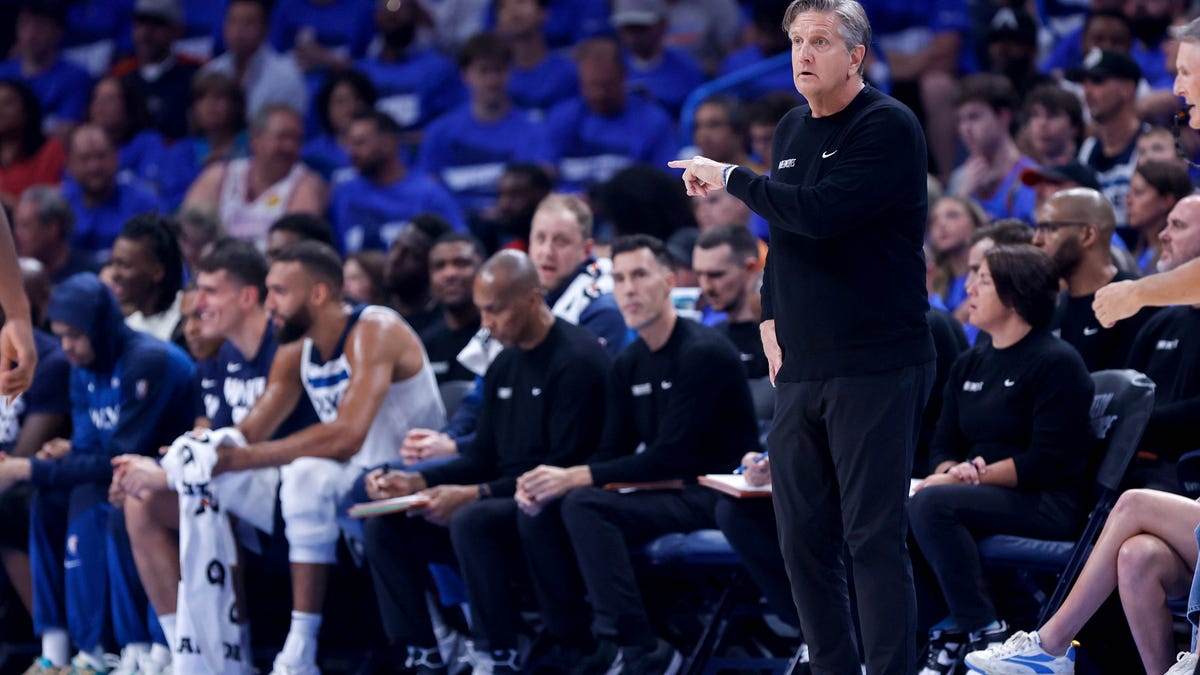
For the first time this postseason, Timberwolves head coach Chris Finch opted to sit Randle for the entire fourth quarter.
“Naz (Reid) had a good game going,” Finch said. “I just wanted to try to see if I can spread the floor and get some quick decision making out here to change the complexion of the game.”
Minnesota dropped Game 2 of its Western Conference finals matchup with the Thunder in a 118-103 loss on Thursday night. After racing through the first two rounds of the playoffs, Minnesota now finds itself in a 2-0 series hole.
Timberwolves star Anthony Edwards led the team with 32 points, nine rebounds and six assists, while Jaden McDaniels chipped in 22 points on 8-of-15 shooting.
But all eyes remained on Randle, whose struggles became the defining story of the night.
The three-time All-Star was nearly invisible in Game 2 after putting up a team-high 28 points in Game 1. He finished the day with just six points and four turnovers on 2-for-11 shooting.
It was his first single-digit scoring outing of the 2025 playoffs.
“I think for the most part I was just standing and spectating a little bit too much.” Randle said. “I’ve got to get myself into action — get myself on the move. You know what type of defense they are, they’re going to swarm me.”
Still, a flicker of hope appeared late.
Trailing by as many as 24, the Timberwolves opened the fourth quarter on a 13–4 run, trimming the deficit to 13. That spark was fueled by Naz Reid and Nickeil Alexander-Walker, both of whom bounced back after shooting a combined 4-of-22 in Game 1. Improved ball movement and better rim pressure led to cleaner looks — and for a brief stretch, Minnesota looked like itself again.
But the momentum didn’t last.
The Thunder answered with another late push, a now-familiar script.
Shai Gilgeous-Alexander, fresh off accepting the league’s MVP award earlier in the day, slammed the door shut. He finished with 38 points, eight assists and three steals while countering each defensive look Minnesota threw his way.
“I think we know what the problem is with certain things, but I also think we found some things that were successful today,” Randle said. “We’ve just got to execute at a higher rate for the full 48 minutes. It can’t be 36 and a little spell, because that’s kind of where they get you.”
That chess match has defined the first eight quarters of this series.
A largely known objective for Minnesota entering the series was limiting the number of 3-pointers in which OKC hoisted up. They did just that in Game 1 to hold the Thunder to a season-low of just 21 3s.
Each tweak has opened new vulnerabilities, however.
I asked Nickeil Alexander-Walker about the tradeoff of limiting OKC’s 3-point shooting, which has led to the Thunder getting further efficient looks in the mid-range: pic.twitter.com/ibrQ2GHI8q
— Jordan Davis (@jdavis34_) May 23, 2025
By running the Thunder off the 3-point line, the Timberwolves have exposed themselves in the interior. Through two games, OKC is shooting 56% on two-point attempts and have scored 112 of their 232 total points in the paint.
“What happens is that you feel us strength together stops,” Gilgeous-Alexander said. “That’s what’s really encouraging. The stops are what gets us going. We can play faster, play confident and we’re out there running and just hooping.”
Game 3 will test Minnesota’s resolve.
The Timberwolves know their strengths. They’re also well aware of their glaring flaws.
But against this Thunder team, none of that is guaranteed to matter unless they can execute for 48 full minutes.
“We won’t get stops if we’re playing defense 90%,” Timberwolves guard Nickeil Alexander-Walker said.
“They’re so disciplined in the small details — like we have to match that. I think in the fourth quarter we matched that. They missed the mid range shots that they were making in that first half. And I think that just boils down to matching that intensity and bringing another level like they did in the third quarter.”
Jordan Davis covers high school sports for The Oklahoman. Have a story idea for Jordan? He can be reached at jdavis@oklahoman.com or on X/Twitter at @jdavis34_. Sign up for The Varsity Club newsletter to access more high school coverage. Support Jordan’s work and that of other Oklahoman journalists by purchasing a digital subscription today at subscribe.oklahoman.com