
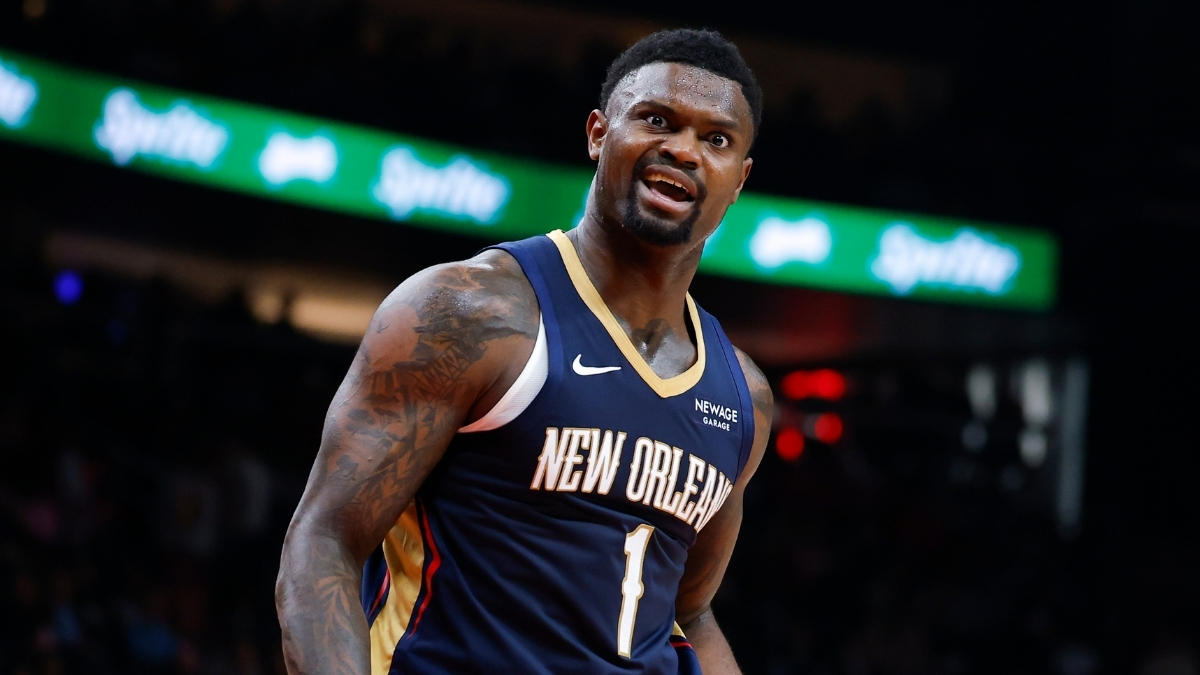
The NBA Draft can be cruel to an NBA franchise. Sometimes, your pick slips in a strong draft. Suddenly, you are rolling the dice on a project instead of selecting a generational prospect. Other times, you land the generational prospect anyway, and it still does not work out.
Take Zion Williamson and the New Orleans Pelicans. Williamson arrived as a franchise-altering talent, a player expected to bend defenses and timelines alike. There have been moments where that vision looked real. Too often, though, his tenure has been defined by missed games, uneven availability, and a roster that has quietly evolved past its original focal point.
Now, with New Orleans drifting toward the bottom of the Western Conference standings and another uneven season unfolding, speculation around Williamson’s long-term fit has resurfaced. One team that could reasonably convince itself to gamble is the Chicago Bulls.
Here is a trade framework that makes that possibility tangible.
Chicago Bulls Land Zion Williamson in NBA Trade Proposal
Chicago Bulls Receive:
New Orleans Pelicans Receive:
Why the New Orleans Pelicans Do the Deal
The draft can be unforgiving, but it can also be generous.
New Orleans learned that again this summer. The Pelicans made a controversial draft-night move to acquire Derik Queen, surrendering a future first-round pick in the process. Early returns suggest the risk may have been justified. Queen is averaging 12.9 points, 7.2 rebounds, and 4.1 assists per game, flashing the type of all-around profile that hints at franchise potential, even if the advanced metrics remain a work in progress.
At the same time, the Pelicans’ position in the West has clarified the stakes. Oklahoma City, San Antonio, and Denver sit comfortably above the rest of the conference, while New Orleans finds itself closer to the bottom than the play-in picture. Their recent 122–116 loss to the Denver Nuggets only reinforced the broader concern: this roster no longer feels dependent on Williamson to function.
That game was telling. With Nikola Jokić and Jonas Valančiūnas both out, Denver started Aaron Gordon at center and leaned on small-ball lineups featuring Peyton Watson. On paper, that is the type of matchup Williamson should dominate. Instead, he finished with 12 points on 12 shots, shooting 41.7 percent from the field, despite taking more than 70 percent of his attempts this season in the paint.
That contrast has become harder to ignore as the year has progressed. Williamson is averaging 22.3 points, 5.7 rebounds, and 3.4 assists in 26 games, and his 3.6 Box Plus/Minus still reflects impact. But New Orleans no longer runs through him by necessity. Trey Murphy III has emerged as the team’s most reliable scorer, posting his seventh 30-point game of the season against Denver. Queen has become a central offensive hub. Even role players such as Saddiq Bey are producing efficiently in complementary roles.
In that context, reallocating resources starts to make sense. White, despite shooting just 31.9 percent from three this season, is a career 36.7 percent shooter who offers secondary creation and positional size at 6-foot-5—useful traits alongside Queen as the Pelicans continue to scheme around defensive limitations. Vucevic functions primarily as salary ballast, but his experience as a floor-spacing, playmaking big could provide short-term stability or be rerouted later. The real prize is the unprotected first-round pick, which restores draft capital after the Queen gamble.
For a franchise increasingly oriented around flexibility and fit, this deal represents a clean pivot.
Why the Chicago Bulls Do the Deal
The market has shifted. The Trae Young trade reset expectations across the league, reinforcing that even star talent comes with discounted pricing when health, fit, or leverage is compromised. Two years ago, this package would have been unthinkably light for Williamson. Now, it reflects the reality of risk-sharing.
From Chicago’s perspective, the upside remains difficult to dismiss. Williamson is still one of the league’s most devastating interior scorers, a constant paint touch when healthy, and he is only 25. His efficiency metrics remain strong relative to team context, even as New Orleans has struggled.
The Bulls, meanwhile, are searching for a ceiling. Pairing Williamson with Josh Giddey and Matas Buzelis would give Chicago a collection of young, high-variance talent rarely assembled by this franchise in recent years. It is a bet on upside rather than incremental improvement—exactly the type of swing Chicago has typically avoided.
If it fails, the Bulls have at least chosen a direction. If it works, they may finally possess a player capable of reshaping their competitive timeline.
The Bigger Picture
Neither franchise walks away with certainty. New Orleans continues a long-running experiment with the draft, this time fully committing to a core built around Queen, Murphy, and younger complementary pieces such as Jeremiah Fears. Chicago, meanwhile, leans into volatility by acquiring a player whose career has been defined as much by “what if” as by production.
That tension is the point. Building an NBA contender is brutally difficult, even when luck appears to smile on you during the draft.
This trade does not crown a champion. What it does is advance each team’s interests. The Pelicans gain clarity and assets to better align their roster with their emerging identity. The Bulls acquire a player who, with better fortune, could still be franchise-defining.
And in the end, doesn’t so much of this still come down to luck anyway?
Latest NBA News & Trade Rumors