
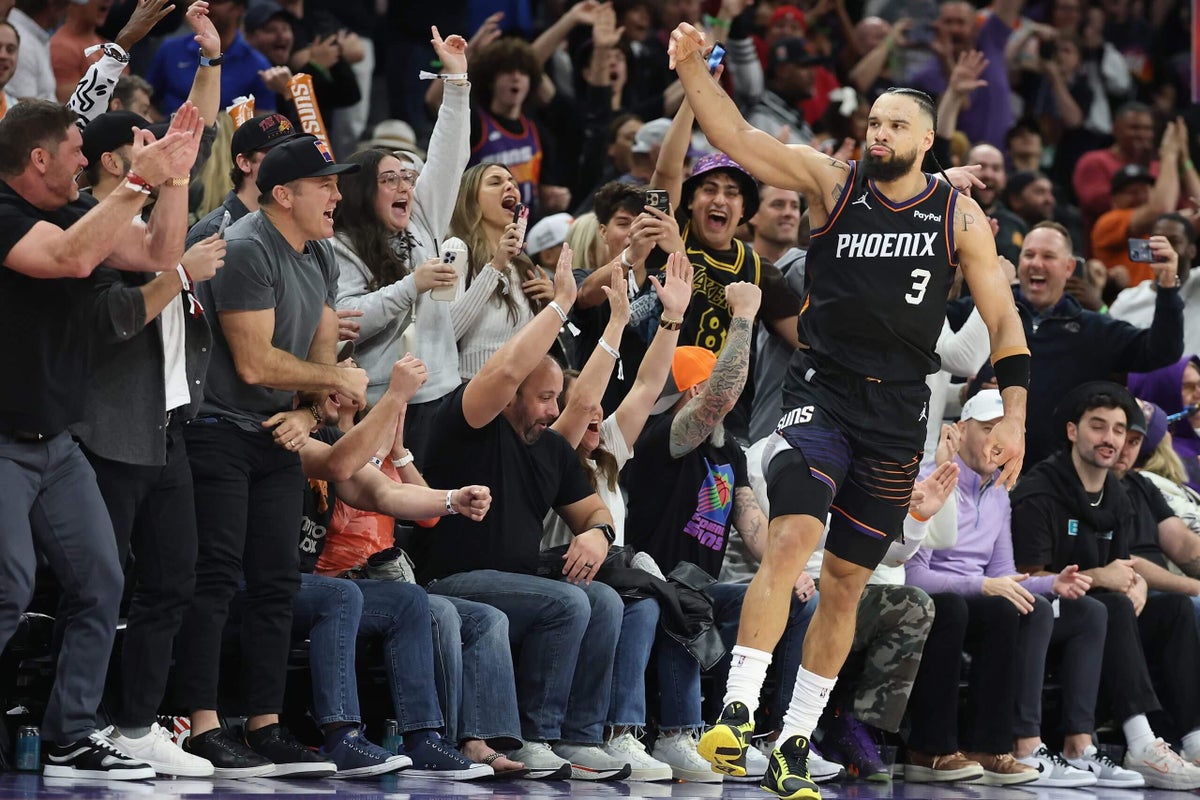
A scorer has no shame. A point guard could use less of it. And a persistent center is sprinting into everyone.
Let’s open the notebook to run through three NBA trends that have caught my eye over the past week.
Brooks was here
No one can claim to know fear until they have tried to stop Dillon Brooks. The defending champs now understand this feeling.
Mired in a close game with the Oklahoma City Thunder, the Phoenix Suns’ pinball began the fourth quarter firing. He took all-defensive wing Jalen Williams off the dribble, spun one way, then the other and drained a turnaround jumper over him.
The bucket (Brooks does not “score” — he “gets buckets”) put the Suns up 3 to begin the period. It was only the beginning.
On the next possession, Brooks squared up Williams once again on the right side of the court. He tried to post up his counterpart. No dice. So, he swung the ball to the other side of the court.
This is rare. Usually, once Brooks chooses to go one-on-one, no one else touches the basketball. He passes out of less than 5 percent of his isolations, the second-lowest rate for any high-volume one-on-one player in the league, according to Second Spectrum. But this cross-court line drive was one of the special dishes.
The moment didn’t last for long. The ball popped around the perimeter and ended up with Brooks again. So he went at Williams another time, a drive to the hoop.
Floater.
Another bucket.
A minute later, he attacked guard Ajay Mitchell in the same spot on the floor, trying the same spin move. A minute after that, he hoisted a stepback 3-pointer over Mitchell.
No coincidence, Devin Booker was nowhere near the court. When Brooks runs without the Suns’ top player, he takes far more midrange shots and ends up creating three out of every four buckets for himself, according to Second Spectrum. Once Booker returned, Brooks re-entered a more passive (but still pretty darn aggressive) role. The Suns held on for a narrow upset victory.
Such has been the Brooks experience this season: a topsy-turvy display of deserved confidence for the NBA’s biggest surprise squad. The Suns are contending to rise above the Play-In Tournament — and Brooks calling his own number is a significant reason why.
Brooks has brushed off jokes about his self-belief for years. But he had never backed up his demeanor as well as he has this season.
The ball might stick in his hands when he goes one-on-one, but once it unglues, it tends to go through the net. The Suns average 1.148 points on shots, passes, turnovers and fouls out of his isolations, per Second Spectrum, which makes him the eighth-most efficient out of 53 qualifying iso performers in the NBA. For context, heading into Thursday night’s action, he was wedged between one-on-one kings James Harden and DeMar DeRozan as the league leaders.
The Suns believe the newfound scoring chops are real.
“When you get to this point, you’re 35, 40 games in, (I would say) you can repetitively do it,” head coach Jordan Ott said.
At 29 years old, Brooks is having a career season.
It’s his first time averaging more than 20 points, his first time chucking more than seven 3s a game, his first time making more than half his 2-pointers. The efficiency is his best ever. And those classic moments of self-assurance are ending with more buckets than ever.
Bashful ball
Near the end of last season, I chatted with veteran forward Larry Nance about his teammate Dyson Daniels, who was only a few weeks away from wrapping up the NBA’s Most Improved Player award.
Nance acted like a proud older brother. Daniels’ game had hit another level, not just because of smothering defense but also because of an advanced offensive repertoire, which those around him attributed more to the mind than the body. Nance had seen the transformation up close. He was with Daniels in New Orleans, then was part of the trade that brought him to the Atlanta Hawks in 2024.
“He’ll miss a shot and actually shoot the next one, too,” Nance said, referencing Daniels’ surge from the more indecisive version of himself that existed with the Pelicans. “It’s been really, really fun to see his growth from a confidence perspective.”
Life changes quickly.
Behind all the flashy storylines in Atlanta of late — the questions about whether the Hawks really were better without Trae Young, the actual Young trade that materialized last week — is an unfortunate one for Daniels. Whatever spurred his newfound confidence during his first season with the Hawks has dissipated. And although he is a better player now than he was during the first couple of years of his career, he often appears just as bashful.
This week marks more than a month since Daniels hit his last 3-pointer. He has missed 18 long balls in 14 games over this span. His scoring has spiked as the season has continued. He’s figuring out ways to get to the hoop without leaning on any semblance of a jumper. But the unwillingness to even take them, the same hesitance that Nance and most others believed was in the past, is hurting his overall game.
Without the fear of a 3-pointer going up, defenders are now going under screens for Daniels more than ever. It can turn the Hawks offense, which is usually a high-paced, egalitarian experience, into a slog, if only for an instant.
Look at what happened on this late-game possession during a recent game against Daniels’ former team. Pelicans wing Bryce McGowens goes under the screen. Zion Williamson lingers in no-man’s land, not guarding anyone in particular. Daniels has all the space he could ask for, but it doesn’t matter if he won’t look at the rim. He slows down, and the possession unravels.
Coverages like this, which cramp the Hawks’ spacing, have become too common. Opponents went under 112 screens for Daniels in 2024-25, according to Second Spectrum. This season, that number is already up to 106.
Daniels will often attack his man anyway. He can bust out an aggressive step-through or zippy spin move and finish layups or floaters. But he can’t reach his ceiling if he shies away from 3s.
It’s one thing for the jumper to be inconsistent; it’s another for it to be absent.
Queta, running into anyone
Out of nowhere, the Boston Celtics are a rebounding force. One of the main men to credit doesn’t even grab all the boards.
This, 2026, is the year of Neemias Queta.
Queta will grasp, claw and joust with anyone near him. He’s a box-out fiend in conventional ways, the ones that lead his backside into whichever opponent is behind him. He has been a top-tier individual rebounder. He was gobbling up 8.2 boards in only 24.8 minutes heading into Thursday’s action.
But stats like that identify just a smidgen of why the Celtics center has been one of the NBA’s best under-the-radar stories this season. When it comes to rebounding, the 7-footer is doing so much more than just chasing the basketball.
A tradition has emerged in Boston. A shot goes up against the Celtics defense, and Queta, whether he’s in an ideal box-out position or not, seeks out the nearest guy and then contorts his body however necessary to keep him off the glass. It could mean snatching one of his eight boards for the night. Or it could mean a teammate snagging the miss instead.
Either way, the Celtics get the ball.
Check out the following possession from a recent game against the Indiana Pacers. Queta is calling out a coverage, just as All-Star forward Pascal Siakam pulls off one of his favorite moves, the unsuspecting cut to the hoop when a defense assumes he’ll set his feet to stand still as a spot-up option. Once Aaron Nesmith releases a 3-pointer, Siakam’s cut turns into an aggressive crash.
Queta isn’t in position to box out — at least, not normally. So, he does whatever necessary and runs into Siakam, his momentum already heading in that direction. His persistence takes Siakam out of the play and allows Celtics wing Sam Hauser to leap for the rebound.
The Celtics’ turnaround on the glass has been one of the league’s quietest midseason shifts. On Dec. 6, they ranked 29th in the NBA in defensive rebound rate. Since that date, they are fourth.
Queta has been a constant. Fellow center Luka Garza, who got off to a slow start, is devouring rebounds and has solidified himself as a reliable backup.
Head coach Joe Mazzulla attributes the progression to more than just the 7-footers. The Celtics have started running more pick-and-roll coverages that keep their big men closer to the hoop, which helps on the defensive glass.
“I think our individual defense has improved,” Mazzulla also pointed out. “So there is less help.”
If defenders aren’t in scramble mode, they will be in a better position to finish off the possession.
But none of this occurs without Queta, a little-used center until this season who has now broken out as a viable starter, if only because he’ll plop himself in the path of anyone.