
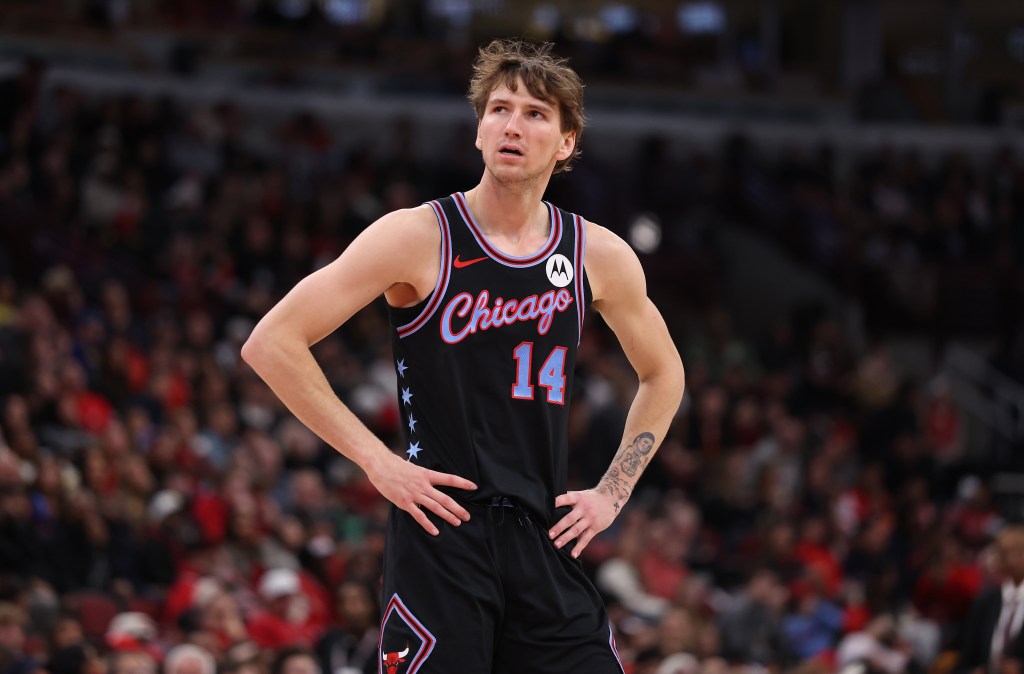
The final quarter of Wednesday’s win over the Utah Jazz defined the dichotomy between the Chicago Bulls and the rest of the NBA’s approach to youth development.
On the court, Keyonte George attempted to take the lead. The third-year Jazz guard refused to be turned away from the rim. He peppered shots over defenders and drew whistles and disbelief in equal numbers from the Chicago Bulls assigned to guard him. George scored 15 points in the final eight minutes of the game.
On the bench, Matas Buzelis waited patiently for his turn. The forward stood dutifully for 3-point celebrations and hyped up his teammates during timeouts. He tried not to glance at the scorers table. The clock slowly ticked down until the buzzer sounded on a Bulls clutch victory that barely included the second-year forward.
Coach Billy Donovan pulled Buzelis off the court 1 minute, 44 seconds into the second half, a decision he attributed to a few missed box-outs and a lack of help rotation on defense. He gave Buzelis a few more minutes at the end of the third quarter, then benched him for the entirety of the fourth quarter.
This is familiar for the Bulls. Buzelis, 21, lives on a shorter leash than any other Bulls player. Make enough mistakes — especially on defense — and he often finds himself riding the bench.
“He’s done some really good things,” Donovan said after the win. “He has gotten a lot better. I feel like my responsibility is to challenge him to be better in those moments and be better in a back-to-back and figure out ways to really come and play. Because it’s hard. The games are hard and physical. These are the growth opportunities for him.”
Donovan said it wasn’t just a Buzelis problem. He pulled out the four remaining players from the starting rotation roughly three minutes after Buzelis, calling on the bench to provide a needed boost after the Jazz tied the game at 82.
“That group didn’t play well,” Donovan said.
But unlike Buzelis, the rest of that group — Coby White, Nikola Vučević, Isaac Okoro and Tre Jones — got another chance on the court. A real one. All four logged at least seven minutes in the fourth quarter and closed the game on the court. Only Buzelis was left to watch the final clutch seconds from the sideline.
Donovan kept things positive when he talked about Buzelis after the game. He emphasized growth. He encouraged the forward to think back to his entire routine from the moment he woke up on Wednesday, to truly study how he could have brought better energy to the game.
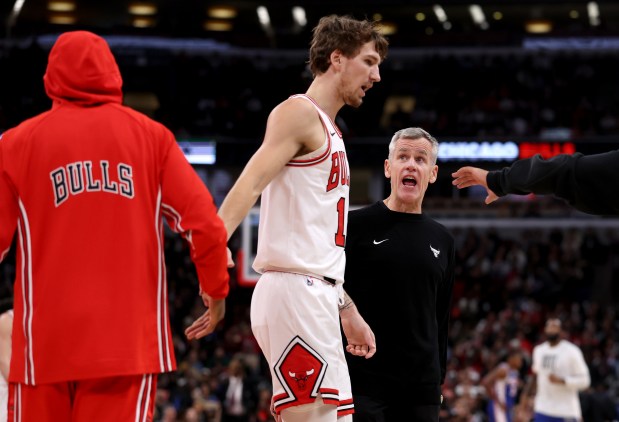 Bulls coach Billy Donovan talks with forward Matas Buzelis going into a timeout against the 76ers on Nov. 4, 2025, at the United Center. (Chris Sweda/Chicago Tribune)
“I am not trying to be vindictive at all,” Donovan said. “I just think that there’s a standard of play — and with that, an understanding that there’s going to be mistakes, right? It’s not so much to teach him a lesson, but there’s certain things he’s got to mentally hold himself accountable to and responsible for.”
Donovan’s perspective on Wednesday’s win muddies the bigger picture of how the Bulls aim to approach this season.
The front office came into the season more prepared than ever to lose. Unlike in previous preseasons, executive vice president of basketball operations Artūras Karnišovas did not take a “playoff or bust” stance last summer. The front office is focused keenly on the 2026 offseason as the next truly meaningful period in the Bulls calendar for growth and development.
That outlook should take the pressure off individual games for the Bulls. Yet on Wednesday night, Donovan followed the same guiding principles that often define his tenure as a coach — win no matter what, even if that means pulling the player whose development matters the most to the Bulls.
Maybe this would mean more if the Bulls were healthy and competitive and winning more games. If the hot streak from the start of the season had continued and prompted the front office to call for a full-on blitz toward the top of the Eastern Conference — OK, that’s fine, go make a run for it.
But that’s not the case. This is a 19-21 team. The Bulls are barely holding onto their 10th-place standing in the East. This team still might make the postseason via the play-in tournament — heavy on the “might” given the outcomes of the last three iterations of that tournament — but they haven’t made a convincing argument for their ability to make it out of a seven-game series.
Throughout the last two seasons, Donovan set a standard of making Buzelis “earn” his minutes — a challenge the forward took to with gusto. That explanation returned after he was benched in Wednesday’s win.
“I don’t know if you just start handing out minutes for the sake of handing out minutes,” Donovan said.
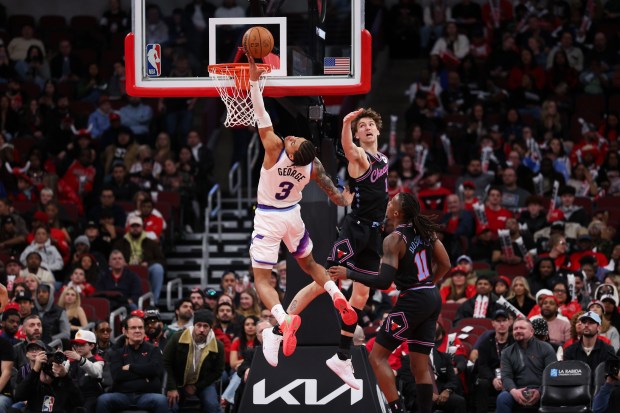 Bulls forward Matas Buzelis guards Jazz guard Keyonte George during the third quarter at the United Center on Jan. 14, 2026. (Armando L. Sanchez/Chicago Tribune)
The problem with this argument, however, is that someone has to play the minutes, especially when three main rotation players — Josh Giddey, Zach Collins and Julian Phillips — are sidelined with injury.
On Wednesday, that was sixth-year forward Patrick Williams, who played nearly five more minutes than Buzelis, including 4:43 in the fourth quarter. Williams did not demonstrably outplay Buzelis on the boards or in the defensive gaps. He provided the same generic output — most notably knocking down a trio of spot-up 3s — that has otherwise dropped him to the bottom rung of the Bulls rotation. So why Williams instead of Buzelis?
The concept of “earning” minutes in the Bulls rotation has become somewhat nebulous — at least when applied to Buzelis. And even Donovan admits that it’s an imperfect science, especially in the heat of a clutch game.
“I’ve always said this — I’m going off my gut a lot of times and I’m not always going to be right and I’m the first one to acknowledge that,” Donovan said. “But at that time, watching it, I felt like I needed to do something.”
Donovan pointed to the defensive efforts of Kevin Huerter and the clutch-time valor of Tre Jones as exculpatory evidence for his decision to keep Buzelis on the bench. The Bulls need their youngest star to develop, he argued, but that can’t come at the cost of the rest of the roster.
“You’ve also got a responsibility to the other guys too,” Donovan said.
This is a conscientious outlook on player management. It fits the ethos and ethics of Donovan as a person and coach. It also lacks pragmatism.
All players are not created equal on a basketball team. Maybe that’s not kind. But it’s true. A lottery draft pick is more important than a role player on an expiring contract. It is more important that Buzelis — above any other player — earns meaningful minutes in tightly contested games. And as they take the initial steps of a second rebuild under Karnišovas, the Bulls can’t afford to ignore their hierarchy of needs.
Donovan is right that Buzelis needs to grow. He’s one of the highest-volume shot blockers in the league but still struggles to match frontcourt players with physicality. His off-ball defensive reads still lack consistency. He’s not shooting enough. But in Year 2, those improvements have to occur on the court in live games — regardless of whether the Bulls are up or down by 10 points.
George did not win that game for the Jazz.
He tried. With four seconds left, George dodged to the top of the key to accept the inbound pass, took two dribbles to buy a few inches off the hip of Isaac Okoro and pulled up to fire an off-balance 3-pointer. The shot lacked the momentum to reach the rim. George clapped his hands in frustration, gesturing at second-year forward Kyle Filipowski to communicate a missed read in the paint.
The Jazz don’t mind the loss. Winning wasn’t the point. They are in the early stages of a planned nosedive to the bottom of the Western Conference with the intention of securing another high seed in the draft lottery.
Luck hasn’t always been in their favor — the Jazz slid to fifth in the 2025 draft despite having the third-best odds for the No. 1 pick — but the franchise has been committed to this approach. In the meantime, their young foundation is growing into a genuinely special group.
So for the Jazz, even Wednesday’s loss went according to plan. One of their youngest stars had the ball in his hands and a chance to test out a potential game-winner. It was the shot — and the guy taking it — that mattered. Whether the ball actually went into the basket was inconsequential.
The Bulls don’t ascribe to this philosophy. When it comes to Buzelis, it seems they never will. It’s not like the kid hasn’t had his chances this season — he’s averaging 14.8 points in 27.7 minutes as a starter this season.
But patience can only last so long. And midway through his second season, it’s unclear when the training wheels will be fully taken off for the centerpiece of the Bulls’ upcoming rebuild.