
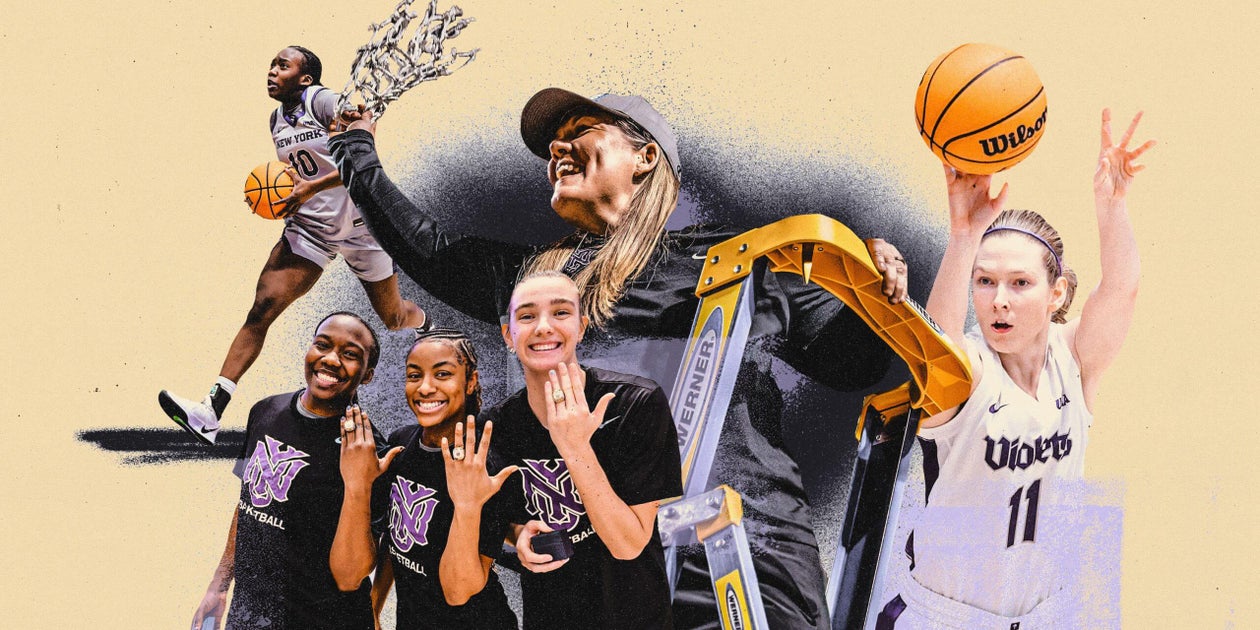
NEW YORK — Something sinister happened to the NYU women’s basketball team on March 11, 2023. At least, that’s the rumor.
The Violets played Transylvania in the Elite Eight of the DIII tournament, and legend has it that NYU lost.
Among current players, only senior Caroline Peper knows for sure. Everyone else has only experienced winning. This mythical, terrifying beast they call “losing” isn’t something that happens to them. It happens to their opponents.
The Violets have won 76 games in a row, a streak that includes back-to-back Division III national titles and spans over 1,047 days. That’s the longest active streak in women’s college basketball and the third longest in the sport’s history — behind only UConn’s streak of 111 in Division I and Washington University’s (St. Louis) 81 wins as a fellow DIII program.
The No. 1 Violets are poised for yet another championship run. They’re a small group in a big city, doing something that is typically reserved for giants of the sport. UConn’s streak, which took place from 2014-2017 and included three titles, has been written about to excess. The Violets are forging on with little recognition.
That loss in 2023 is enough motivation to keep them going.
“I actually watched it the other day,” coach Meg Barber says. “I ended up having to turn it off. It still eats at me.”
No wonder they haven’t lost since.
A few blocks from Washington Square Park and a half mile from “The Cage,” a famous pickup court in the heart of Greenwich Village, sits another basketball facility. The Paulson Center, a multi-use facility constructed in 2023, houses NYU’s basketball courts. Among the school’s varsity athletes, the women’s basketball team is a source of inspiration.
Last season, the men’s team advanced to the Division III championship game before falling to Trinity College by just four points. It was the team’s second loss of the season.
“We thought we had this incredible season, but then you see what the women’s team is accomplishing,” senior guard Bryan Moussako said. “It really motivates us because we want to do what they are doing.”
But the moment the Violets step outside the Paulson Center’s glass doors, they fade into anonymity. Nearly 9 million people live in New York City. Sixty-one thousand students attend NYU, a school renowned for its Tisch School of the Arts and its numerous celebrity alumni.
When junior Eden Williamson was a freshman, she remembers proudly telling her classmates that she was on the basketball team.
“We have sports?” they wondered. Over time, as the Violets continued to win, interest has grown. Spike Lee, more famous for his sideline seats at Knicks games, came for a team meet-and-greet, and highlights from the Violets’ win over Rochester appeared on SportsCenter. Barber’s wife jokingly called her a D-list celebrity, but last season, people occasionally recognized Barber when she went out for coffee. Since then, she’s been updated to C-list status.
Still, most Violets games only have a smattering of fans in attendance.
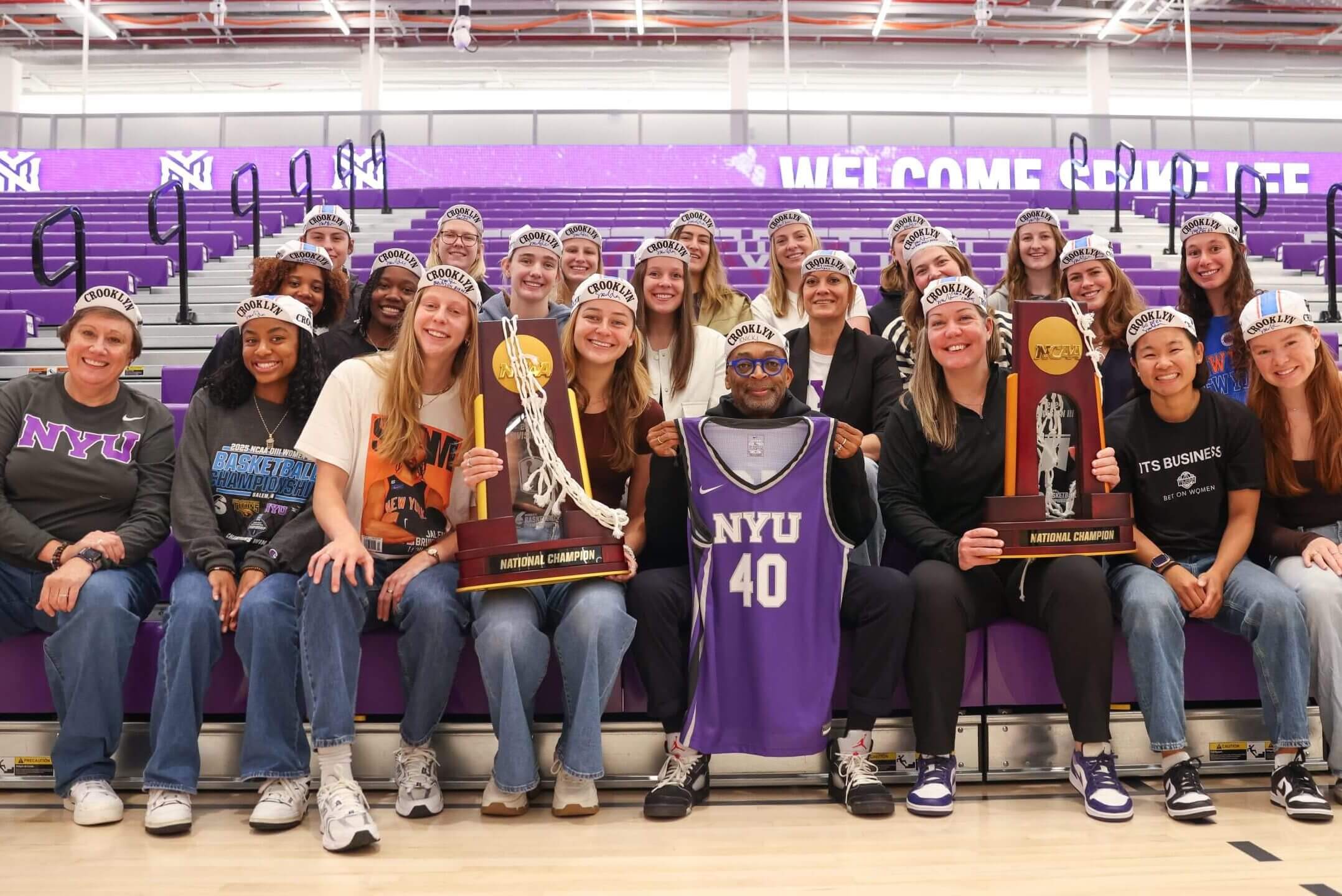
NYU’s 2025 national championship team had a special visitor: Spike Lee.
There’s no glory in being a DIII athlete. NYU doesn’t offer athletic scholarships, so players often pay upwards of $90,000 for tuition, room and board.
They come to their gym every day between their rigorous class schedules and other extracurricular commitments. They watch film, learn scouting reports and perform dribbling drills with half-moon goggles to limit their vision. They put up shots, learn plays and work on conditioning just like any other team. There are no summer workouts, yet every season, the Violets return to campus in better shape than when they left.
There is a purity to this level of basketball. No pro dreams clouding minds. No bank accounts overflowing with NIL money. No scholarships tying players to the program.
“Other levels are transactional,” associate head coach Nettie Respondek said. “There’s nothing holding these girls here. They can walk away at any time. But they play because they love their team, they love the game and they love the work. There’s nothing holding them here except the culture and the experience, because there is nothing like it.”
Before their games, the Violets sit on the sideline and cheer on the men’s team. They style each other’s hair, snack on pretzels and drink Red Bulls. Coaches hug friends and family in the stands. The accessibility to the team and the camaraderie between the men’s and women’s squads feel like high school.
The basketball does not.
It doesn’t look like the stereotype of Division III, either. After watching the Violets, the idea that anyone can play DIII basketball, or that it’s the sad, unskilled little sibling of DI and DII is comical.
Over the last 2 1/2 seasons, NYU has defeated its opponents by an average of 38.8 points. This season, the Violets are averaging 25.1 assists per game to their opponents’ 10.4. They force 19.4 turnovers per game and score 42.5 points off of those miscues. Everything NYU does is marked with dominance.
If doubts remain, assistant coach Annie Barrett has a solution: “Come see us play.”
These aren’t players who were spurned by better divisions. Almost every Violets player received DI interest, including scholarship offers. Instead, they wanted to come to NYU for the athletic-academic balance. Players don’t report in the summer, so players can work or get internships.
“I love a lot of other things besides basketball,” said freshman Aila Kaibara, who is considering a future in law school or an artistic career. “I have so many aspirations, and I get opportunities here. And after my four years, I’ll be set up for a great future.”
No one on this team is just a basketball player. For Barber, it’s the foundation of how she built the program.
After playing at NYU, Barber was an assistant coach at two Division I programs, William & Mary and Temple. She also coached in the national team system. Respondek played at Vanderbilt and was an assistant on four Division I teams. They know high-level basketball
“Before I even took the job, I called Nettie and said, ‘Listen, I know one thing about this place, and it’s that we can win a national championship,’” Barber said. “‘But I want to do it with people that I want to be around every day. And I want it to be a really fun, but competitive and uplifting experience.”
NYU’s strong academics and NYC’s career opportunities are obvious selling points in recruiting. But Barber and Respondek convince players with a simple question: Do you want to play at a DI midmajor and win single-digit games, or do you want to compete for a championship every season?
“Basketball is basketball,” Barber said. “Division III does not mean third-rate.”
The national landscape is starting to wise up to what the Violets have already figured out. Earlier this season, DIII Scranton defeated DI Pittsburgh. Carnegie Mellon defeated St. Francis, and Johns Hopkins bested Morgan State. NYU will likely never get the chance to join that club.
“They wouldn’t play us,” Respondek said of potential matchups against DI teams. “It’s a no-win situation for them. Losing is too much of a risk, and they get nothing if they win.”
Tear It Up had a little extra bling this time around
New ring, new banner, new jerseys but same @nyuwomenshoops handling business pic.twitter.com/EvqmJrNsk7
— NYU Athletics (@NYUAthletics) November 25, 2025
It wasn’t always like this. The stack of wins, the ascension to becoming a DIII powerhouse, the No. 1 ranking, the shiny new arena with purple bleacher seats and a fancy digital scoreboard. That all happened in the last few seasons.
NYU offers 23 varsity athletic teams. Funding for athletics is done largely through the alumni base of former athletes and their families. The better teams do, the more people want to donate.
“I can’t overstate the impact of the women’s basketball team,” athletic director Jake Olkkola said. “We are working on building a championship culture, and we want all of our teams to compete. They are showing that this is a place for elite athletes at the DIII level.”
The women’s basketball dynasty started with a speech. Barber — who played at NYU from 1998 to 2002 and returned to the program in 2018 to become its head coach — stood in a circle with her players, none of whom she had recruited.
“I want every team in this league to hate us,” she said. “I want that target on our backs.”
It was hard to picture. Barber and her coaching staff worked out of a dorm basement.
Before 2023, NYU bounced around, playing at Hunter College, St. Francis College and the Brooklyn Athletic Center, a gym that sat only 180 people. The team traveled to games by subway, dressed in Violets gear and carrying their equipment up and down the steps. They made their commute like many New Yorkers, navigating multiple lines and dealing with inevitable delays. Former players remember showering after games as cockroaches scuttled past their feet.
Even then, the good outweighed the bad. After going 17-10 during Barber’s first season at the helm, NYU started building its reputation as a winning program, eventually leading to back-to-back titles and the start of its winning streak.
“This streak means we are being talked about in the same breath as UConn,” Olkkola said. “I mean, that is just incredible.”
But before any of that could happen, NYU had to lose that 2023 game to Transylvania.
“To this day, if I bring that game up to parents or players, the blood pressure goes through the roof,” Barber said. “I really felt like that year we had a team that could win it all. It felt like our flame was put out a little bit too early.”
Playing the Violets is like being a sugar cube in a steaming cup of tea. Opponents can survive in the short term, but eventually the heat becomes too much, and they lose all sense of structure before completely dissolving.
Rochester found that out on Friday. NYU led by 12 at halftime, a seemingly manageable deficit, especially considering that the Violets had won their previous games by an average of 53 points. “They are dead tired,” Williamson said in the locker room with a hint of a smile.
Williamson was right. Within minutes of the second half starting, the lead ballooned to 22 — an insurmountable advantage when it comes to NYU.
There’s Williamson, a staunch defender tasked with guarding the opponent’s best ballhandler. Forward Yasmene Clark has a nose for offensive rebounds. Kaibara is a swaggy ballhandler who plays with a bounce to her step. Zahra Alexander drives to the rim like it’s her sole mission in life. There’s dependable Brooke Batchelor, who plays with seemingly unlimited energy.
And of course, the team’s steady leader, Peper, affectionately called “Pep.” Every shot is a good shot for Peper, who averages more than 10 3-point attempts per game, making 38 percent of them.
She knows better than anyone what it takes to win, especially in a top-10 matchup, like the one the Violets played against No. 9 Emory on Sunday.
Every game with Emory is heated. It’s the team captain’s job to make sure the young Violets understand the rivalry.
Peper, the team’s lone senior, is a math major, a self-described nerd and a soft-spoken introvert with an extensive vocabulary. Yet when her teammates turn to her before tip-off, she commands the locker room.
“This team” she says of Emory as her eyelashes flutter while she collects her thoughts. “I cannot stress this enough.” Then, her heterochromatic eyes snap open. “This team f—ing hates us.”
The tension lifts as the Violets laugh at Peper’s frankness, but the giggles don’t last. They know she means it.
Every opponent wants to be the one to break NYU’s streak. Emory wants that more than most.
When freshman Sofia Corral, an Illinois native, signed with the Violets, friends were shocked to discover NYU had gone two years without losing.
“Are you going to make it three?” they asked.
That’s the goal, but it’s not the focus.
“I don’t even know what the streak is,” Peper said. “The streak is something we will look back on, not something to think about now. We are too competitive for that.”
With their eyes trained on Emory, the Violets cruised to a 93-66 victory. The streak lives on.
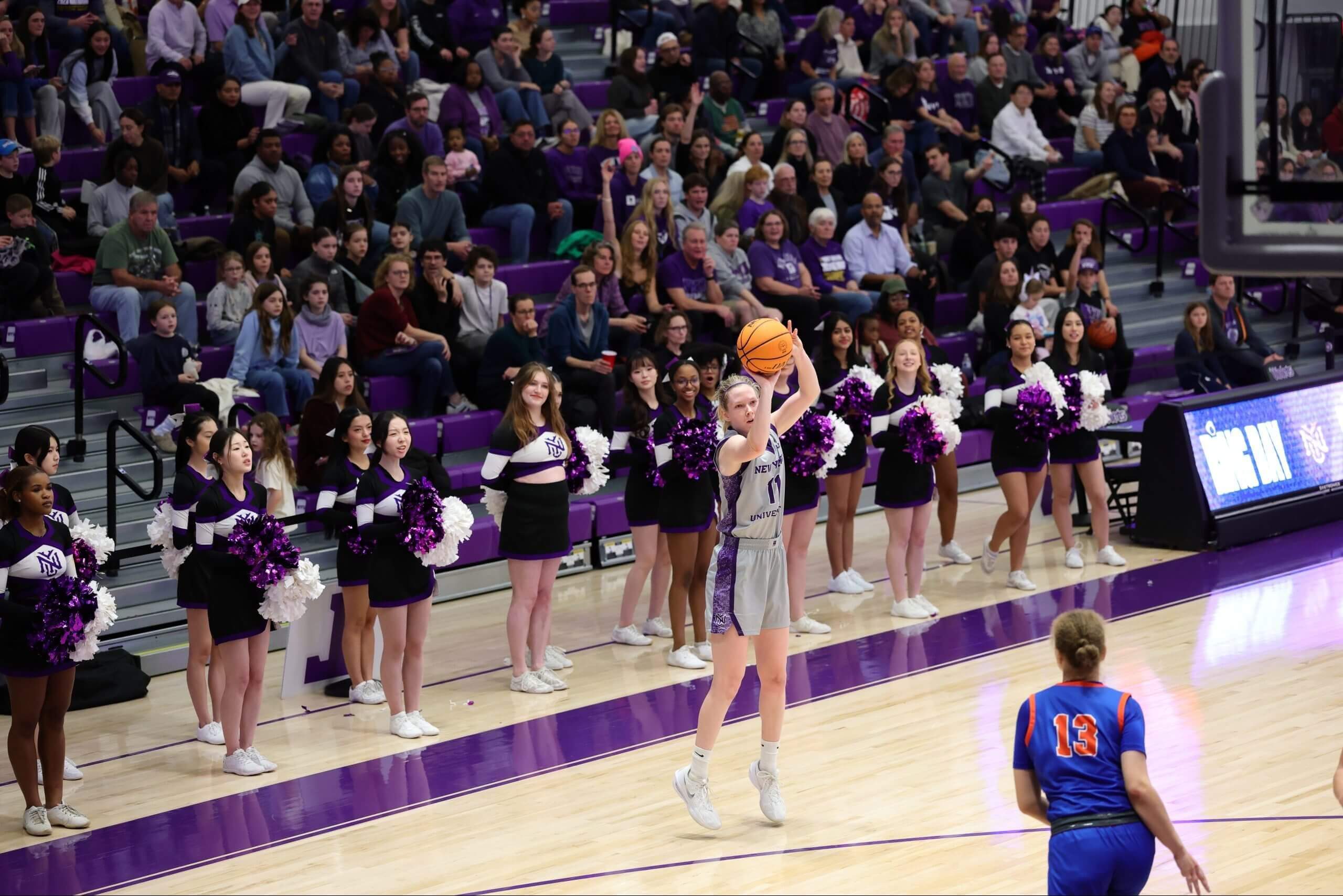
Caroline Peper is NYU’s 3-point leader who is eyeing a third-straight national title. (Vinny Dusovic / NYU Athletics)
Barber knows this moment is fleeting. The Violets could go on to break WashU’s record this season. They could break UConn’s next season. Or they could lose their next game. Living in New York makes that feel all the more real.
“The hottest restaurant in town today can be out in the next month,” Barber said. “Then it’s on to the next new thing.”
Soon these Violets will be on to their next new things, too. Peper will graduate and take her high IQ from the hardwood to the workplace. Alexander wants to study law. Kaibara is an artist who draws, paints and plays guitar. Peper plays the saxophone, too. Corral loves photography. Clark will pursue a Ph.D. in chemical engineering. Every day in New York provides new experiences and new opportunities.
They’re dominant basketball players, but they won’t go on to play in the WNBA. They won’t secure signature shoes or sports drink endorsements.
“The fact that we’ve won back-to-back national championships is amazing, but honestly, in this city and in this sports landscape, it’s not enough,” Olkkola said. “The fact that we’ve done that and had this incredible winning streak is something unique because it goes beyond DI, DII, DIII.”
All of that for a sliver of recognition. For Williamson to finally be asked by classmates what time her games are. But to this team, none of that matters — which is probably why the streak continues.
“These kids are so insanely talented at other things,” Barber said. “But right now, at this moment in time, they see themselves as basketball players.”
Not just basketball players, but Violets basketball players.
And that means everything.