
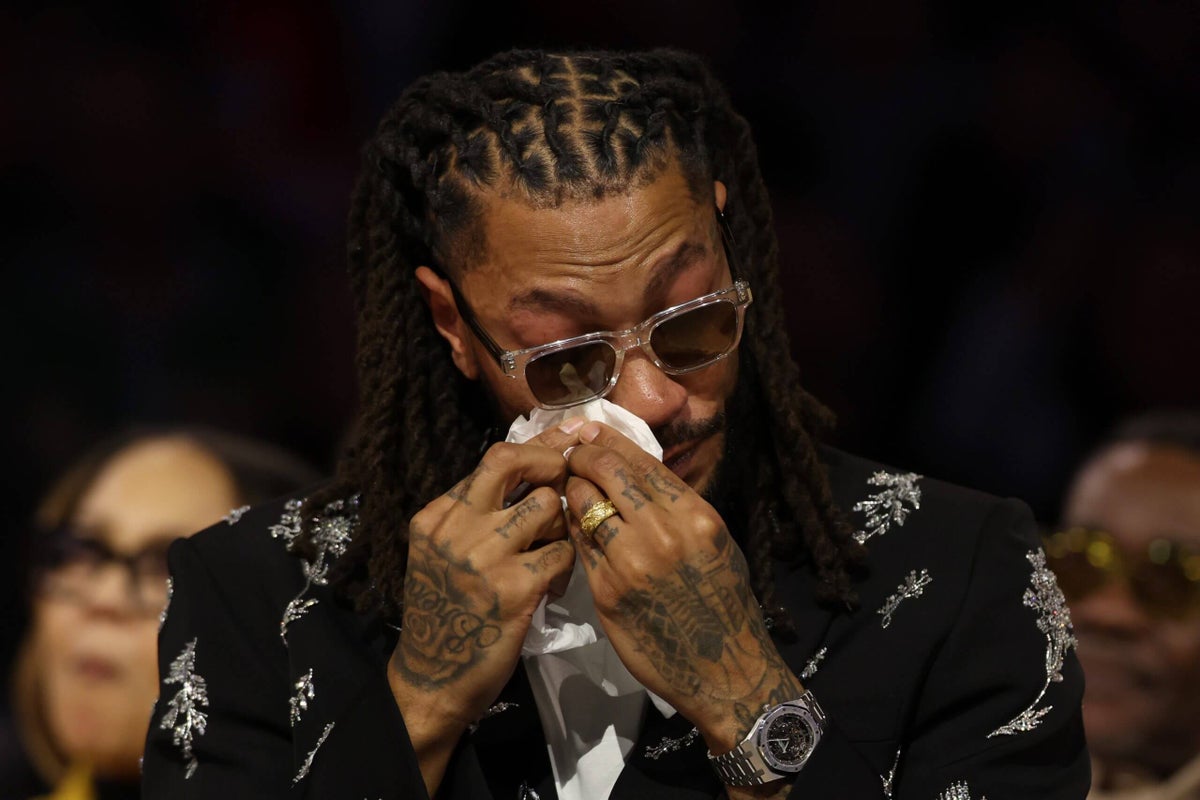
CHICAGO — For as long as he has played basketball, Derrick Rose has been celebrated and commodified. Saturday night was no different.
Everywhere you looked at the United Center for Rose’s long-awaited number retirement ceremony, there was Rose for veneration and Rose for sale.
On a cold, snowy night on the West Side, fans waited like they did when they were hoping for good seats at one of Rose’s Simeon games. Lines snaked through the merchandise stores. Some fans got actual roses (he started a flower business), and others bought throwback jerseys, Rose-branded hats, shirts with his visage and $350 letterman jackets.
You could order a margarita that came with a rose in a large ice cube. The jersey retirement ceremony was sponsored by an insurance company.
As usual, Rose was for sale, and there were buyers aplenty. The only thing Chicago loves more than itself is a favorite son. Fifteen years after he hit his peak, Rose can still lift a city, and he can still sell out an arena.
Someone told me once that it used to bother Michael Jordan that so many people made money off his name. I don’t know how Rose, who has cashed in quite well over the years, felt about it — I do know he felt the pressure of carrying a city and a franchise — but one of his sayings back in the day was “Everybody Eats.”
That still holds true, and the United Center felt full once again.
No. 1 is officially in the rafters 🌹 pic.twitter.com/jAcen09t9A
— Chicago Bulls (@chicagobulls) January 25, 2026
With two Rose tribute nights spread over two years, it’s easy to be cynical about the Chicago Bulls’ intentions. Would they have celebrated Rose like this if the team were competing for championships without him? Would they have retired his number at all? We’ll never know, but I have my suspicions. After all, they tried to give his number away immediately after trading him. Bulls fans revolted online, and the team stopped trying to forget him.
Rose was always No. 1 forever here.
Thanks to the Jordan years, the Bulls still sell tickets with a middling product, but there aren’t many nights that feel important here anymore. This night was the Bulls’ Super Bowl. (The Play-In Tournament is their NBA Finals.)
Besides Rose and the Jordan-era teams, there just isn’t much nostalgia left to market. They’re not doing a 10th anniversary of the “Three Alphas” team, and they’re not retiring Zach LaVine’s jersey.
Since trading Rose 10 years in a quixotic journey to get “younger and more athletic” (which began with adding Dwyane Wade and Rajon Rondo), the Bulls have tumbled into relative irrelevance. Their national TV appearances are nil, and in Chicago, fans mostly complain about everything they’re not.
But Saturday night, it felt like the old days when they were the hottest team in town and Rose was its biggest star.
Fans wore Rose jerseys, and if they didn’t have one, they got black jersey tees draped over their seats, which the players also wore for their warm-up shirts. In the atrium, near the Michael Jordan statue, the team exhibited local artists’ work based on him. There was a line to take a picture with a virtual Rose on a large computer screen.
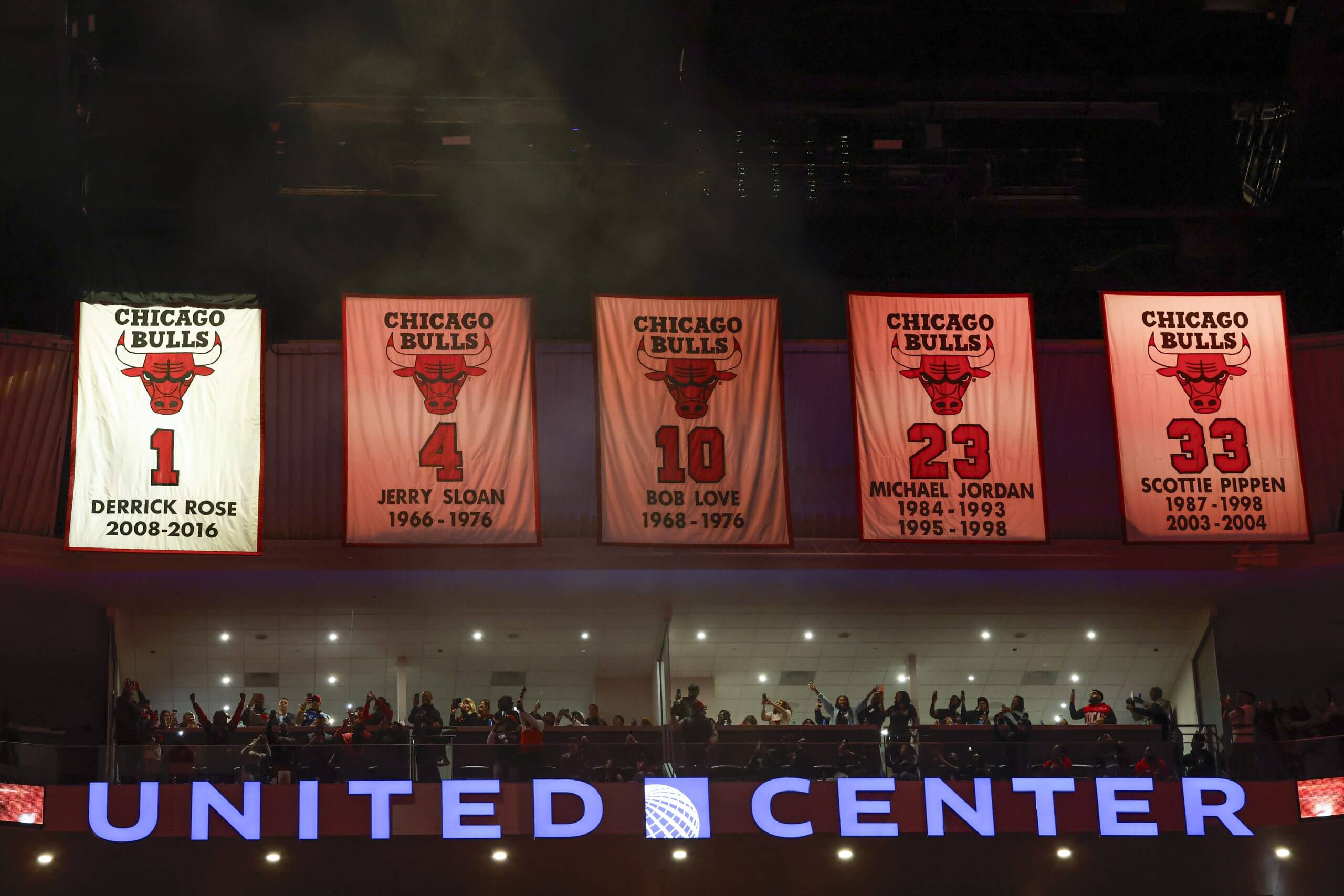
A banner of Derrick Rose’s No. 1 is unveiled during his jersey retirement ceremony Saturday night. (Kamil Krzaczynski / Imagn Images)
Rose meant something different to everyone. For fans, he represented hope. For the Bulls, he represented full houses, playoff games and a chance to show they could win it all without Michael Jordan.
There’s a reason the city and the franchise went collectively wild when Rose’s career veered off course. A lot of livelihoods, a lot of happiness depended on that lightning-quick first step and skyscraping vertical.
When the banner went up to the rafters with Bob Love, Jerry Sloan, Jordan and Scottie Pippen, it offered closure on that too-exciting, too-brief era that lifted spirits and hopes before crashing down to reality.
After the actual game, a 114-111 win over the Boston Celtics, the stage was set for the ceremony. There were videos honoring him and heartfelt words from teammates Joakim Noah, Taj Gibson and Luol Deng. His former coach Tom Thibodeau spoke movingly of Rose’s leadership, and when they hugged, Thibs, that old softy, told him he loved him. They all made Rose cry.
Family reunion ❤️ pic.twitter.com/DNUbjqeSSx
— Chicago Bulls (@chicagobulls) January 25, 2026
That Bulls team didn’t win a title, though they were the only ones to make a conference finals since Jordan’s final season, but they are beloved in Chicago just the same. And the group has stayed close, as evidenced by how many people from all the teams Rose played for came back for the weekend.
Championship teams win banners, but as Deng said, their legacy will live on through their friend.
“This thing is forever,” Deng said of Rose’s banner. “When people talk about the minutes, the injuries, everything we went through, that’s our trophy. That’s our trophy, man.”
Rose really lost it with that one.
When it was his turn to talk, he gave a passionate, rambling, bewildering, bewitching speech that came from the heart. He told stories about his life growing up in Englewood, about his family and his friends. He talked about Thibodeau’s belief in him and rebutted the notion that the knee injury that changed his career was his coach’s fault.
“I’m here to say f— that,” Rose said.
Rose is long past those days when he thought his life was over because of an ACL tear. Now a father of three in his late 30s, he has said he wants to move on from basketball. He wants to be a billionaire, a businessman with interests well outside of the sport. He said he wants to “curate” a new lane for himself. He wants to show people he’s more than an athlete.
In the later years of his career, and even more so now, Rose has been prone to this kind of philosophizing. He’s a man figuring out who he is and who he will become.
On Saturday night, Chicago celebrated who he was and who he still is, someone very special to this city.
“This journey was never about me,” he said. “Right from the jump, it was about creating a synergy that somehow people from the city can pull from. And somehow, I was that beacon or that vessel for the movement. But now, being 37 and looking at the totality of it, it never was about me. It was about everybody that found ways to come to my games. Somehow, we had some type of vibration that connected. … It was always meant to be.”