
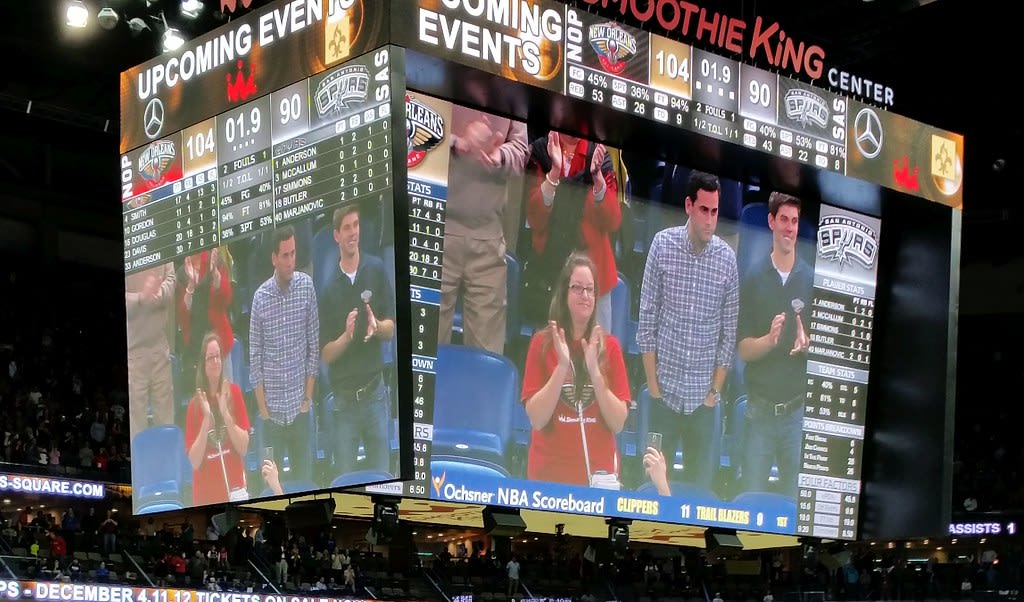
Every time the New Orleans Pelicans and San Antonio Spurs share the court, it feels like a quiet battle for basketball’s soul. Not in some dramatic headline sense, but in a tangible, stylistic divide that’s hard to ignore. The Pelicans play with this flash of controlled chaos—a team built on burst and creativity, sculpted around Zion Williamson’s unique gravity. The Spurs, though, are the NBA’s most enduring idea of order. Even in their current era, with Victor Wembanyama still threading himself into the fabric of the league, the structure remains deliberate. Watching these two teams collide isn’t just about who scores more; it’s about which philosophy feels more like the future.
I’ve always found myself drawn to games like these, where the subtext runs deeper than the scoreboard. The Pelicans’ offense often looks like improvisational jazz—notes bending and looping, trying to find harmony through instinct rather than sheet music. Wembanyama and the Spurs, meanwhile, operate more like a minimalist band. Simple patterns, precise adjustments, and an insistence that beauty lies in repetition. It’s the difference between experimenting and refining, and in this matchup, that contrast played out minute by minute.
Zion’s energy felt gravitational—not just in the literal sense of his rim attacks, but in how it bends the defense’s attention. Every possession he’s involved in becomes a small test of will. Can defenders survive contact? Can rotations hold their shape when he cuts through space like a wrecking ball? Against San Antonio, I watched him go from patient facilitator one possession to brute-force finisher the next. What’s remarkable isn’t just the power itself—it’s how he reads openings, how that force has matured. The Pelicans rely on that rhythm, this intuition that their collective talent can adapt faster than any defensive scheme.
The Spurs, on the other hand, seemed almost serene in response. That’s always been their way. Even in a rebuild, Gregg Popovich’s imprint is steady. There’s no panic, no overreaction—just discipline layered with experimentation. Watching Wembanyama move on both ends of the floor was like seeing the Spurs’ identity being reimagined in real time. He’s a player built from contradictions: a seven-foot-four defender who moves like a wing, a scorer who thrives on patience rather than impulse. I found myself less focused on his stats and more on his presence—how even when he’s quiet, everyone else plays differently because of him.
Games like this remind me that basketball, at its best, is a living conversation. Coaches are debating without words, systems clashing mid-motion, and players forced to answer questions on instinct. When Brandon Ingram starts hitting midrange fadeaways over hand-in-face defense, it’s not just skill—it’s a philosophical rebuttal. It’s saying, “I can still win this way.” When Wembanyama calmly contests three shots in a single sequence, he’s saying, “Your chaos still bends to order.” Neither side is fully right, and that’s what makes it beautiful.
The thing that stood out most, though, was silence. The quiet parts of the game. How both teams slow things down, feel the rhythm before deciding how to attack. Wembanyama drifting out to set a screen just as the Pelicans’ defense flinches. Jose Alvarado is sneaking into a passing lane. Trey Murphy is pulling up from deep just when defenders sag too far. Those are the micro-moments that get lost in box scores but define how a game breathes. The contrast between control and unpredictability sharpened with each quarter, and by the final minutes, I didn’t care who won as much as how they both held onto their identities.
What fascinates me about this specific matchup is its reflection of generational change. For two decades, the Spurs were what the Pelicans are trying to chase: continuity, system, identity. Now the Pelicans embody the modern restlessness of the league—a team built through trades, lottery picks, and bold identity shifts. Meanwhile, the Spurs are the patient antithesis to that. They develop quietly, move deliberately, and refuse to let the chaos of trends rush them into bad habits. Watching these two teams evolve in opposite directions makes me think about how identity in sports isn’t fixed—it’s negotiated.
And maybe that’s what this game represented more than anything: negotiation. Zion and Wembanyama are both physical outliers, two players who warp basketball logic just by existing. Yet their teams project entirely different ideologies through them. The Pelicans want Zion to be the spark that lights every play. The Spurs want Wemby to be the system—less flame, more architecture. It’s not about better or worse; it’s about what each franchise believes basketball should look like.
As the final buzzer sounded, I caught myself smirking at the box score. It didn’t tell the story I’d just watched. The rhythm shifts, the philosophical tug-of-war, the tension between flow and form—all of it vanished in neat columns of numbers. That’s the paradox of modern basketball analysis: it measures everything but sometimes misses meaning. The Pelicans’ victory—or the Spurs’, depending on the night—means less than how they earned it. One through raw instinct, the other through a cultivated system. And somewhere in the middle lies the version of the game I love most: messy, intelligent, contradictory, human.
Because even with all the analytics and broadcasts and online arguments, what keeps me watching isn’t who wins—it’s the act of watching a team assert what it believes about the game. The Pelicans believe in motion and instinct. The Spurs believe in patience and design. And I believe that somewhere between the two, the modern NBA keeps evolving, trying to make sense of both chaos and control.