
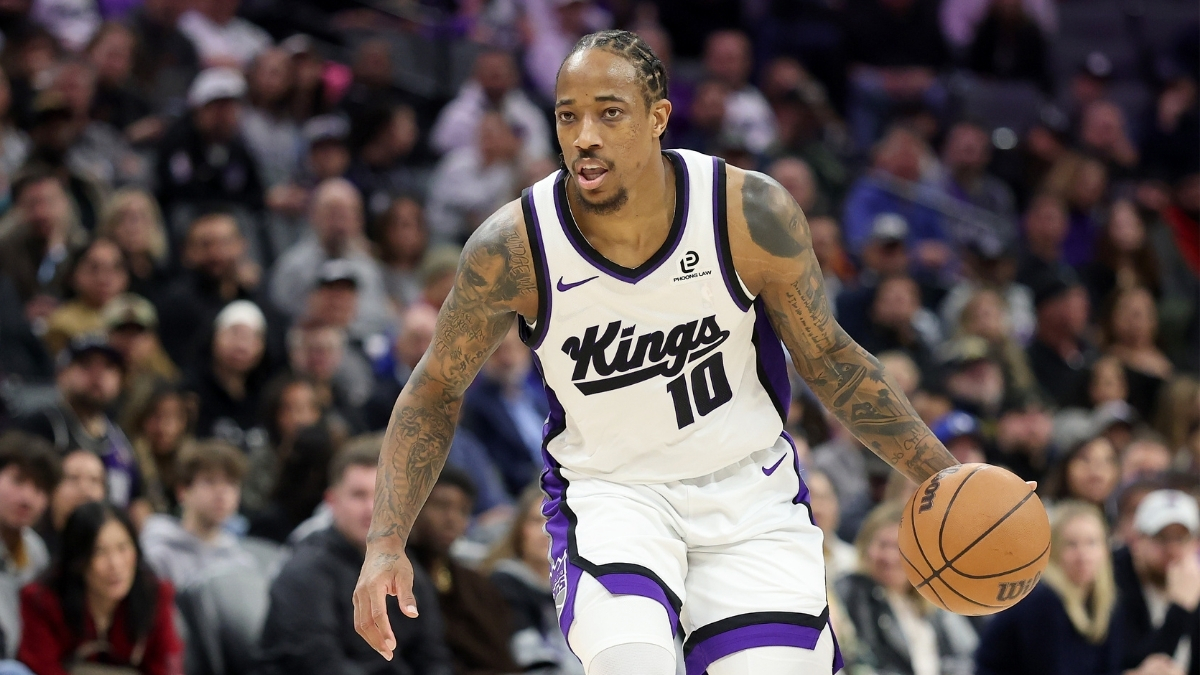
The NBA never stands still. A skill set that defines winning basketball in one era can quietly lose value in the next. Shot profiles shift. Lineups shrink and stretch. What once felt indispensable can suddenly feel inefficient. Just ask DeMar DeRozan of the Sacramento Kings.
DeRozan remains one of the league’s most polished midrange scorers. Even now, he is producing, averaging 18.8 points, 3.9 assists, and 3.2 rebounds across 47 games while carrying a significant offensive burden. His efficiency inside the arc and ability to manufacture points late in the clock still matter.
But the league has moved in a different direction.
DeRozan’s reluctance to fire from deep — just 2.1 three-point attempts per game — limits lineup flexibility. His defensive impact has waned. And at 36, teams are less inclined to build around his strengths rather than around spacing.
By contrast, John Collins of the Los Angeles Clippers fits neatly into the modern archetype. Collins isn’t a high-usage scorer, but he stretches the floor, runs in transition, and finishes efficiently around the rim.
That contrast raises an interesting question: could these two veterans be traded for one another?
LA Clippers Land DeMar DeRozan in NBA Trade Proposal
Sacramento Kings Receive:
Los Angeles Clippers Receive:
Why the Sacramento Kings Do the Deal
If the Kings are expecting draft capital for DeRozan, they are misreading both the market and the moment.
The Kings sit near the bottom of the Western Conference at 12–36, well removed from the play-in picture and buried behind teams that have already pivoted toward younger cores. In that position, clinging to an aging offensive centerpiece whose skill set no longer aligns with the modern game offers little upside.
An aging wing who doesn’t meaningfully space the floor or defend at a high level is unlikely to command premium assets — particularly in a buyer’s market. If teams struggled to extract a first-round pick for younger, more versatile stars, there is little chance Sacramento does so for DeRozan.
That doesn’t mean the Kings walk away empty-handed.
Collins has averaged 13.4 points, 4.9 rebounds, and 0.9 steals in 42 games while shooting 42.6% from three-point range on solid volume. His 65.6% true shooting reflects the efficiency Sacramento has lacked around its primary creators.
Whether the Kings commit to a full rebuild or attempt to stay competitive, Collins helps. His spacing could unclog the floor for Zach LaVine and Domantas Sabonis, two ball-dominant players who benefit from vertical and perimeter gravity around them.
This roster has plenty of ball-handling. What it lacks is reliable frontcourt spacing. Collins addresses that imbalance immediately.
Why the Los Angeles Clippers Do the Deal
From the Clippers’ perspective, the logic is far less straightforward.
Los Angeles currently sits 10th in the Western Conference at 26–21, clinging to the final play-in spot in a tightly packed middle tier. The gap between surviving and slipping is narrow, and marginal offensive gains could matter.
On paper, this looks like a downgrade. Collins provides spacing, rebounding, and defensive versatility. DeRozan offers shot creation but compresses spacing — a concern for a roster already built around James Harden and Kawhi Leonard.
But context matters.
The Clippers already have more shooting than Sacramento, and Derrick Jones Jr. can absorb many of Collins’ vacated minutes. Leonard’s ability to function as a self-contained scorer has always allowed Los Angeles more flexibility in lineup construction.
To maximize DeRozan’s value, the Clippers would likely deploy him as a sixth man. He should rarely share the floor with Harden. If managed correctly, DeRozan could provide a steady offensive engine while keeping Harden fresher for the postseason — assuming Los Angeles gets there.
That’s the gamble.
The Clippers’ season has been uneven, but they remain within striking distance of the playoff picture. If DeRozan adds offensive diversity and late-game shot-making, the move looks defensible. If not, they lose a clean-fit modern big in Collins — though their roster is better equipped than Sacramento’s to absorb that loss.
Bigger Picture
Sacramento is in a difficult position. The Kings need to reset, but their most tradable veteran does not align with where the league is heading — and the market reflects that.
The Clippers, meanwhile, occupy a strange middle ground. Their core is aging, yet still effective. Leonard is playing at a near-peak level. Harden remains productive. The window is narrow, but not closed.
DeRozan represents a moderate risk and a stylistic bet. He is undeniably a more dynamic offensive player than Collins, even if the fit is imperfect. For Sacramento, however, the conclusion feels clearer.
The Kings no longer need DeRozan’s services.
If they want to move forward — and keep pace with where the NBA is headed — this may be the cleanest path available, even if it lacks flash or draft-pick upside.
Latest NBA News & Trade Rumors