
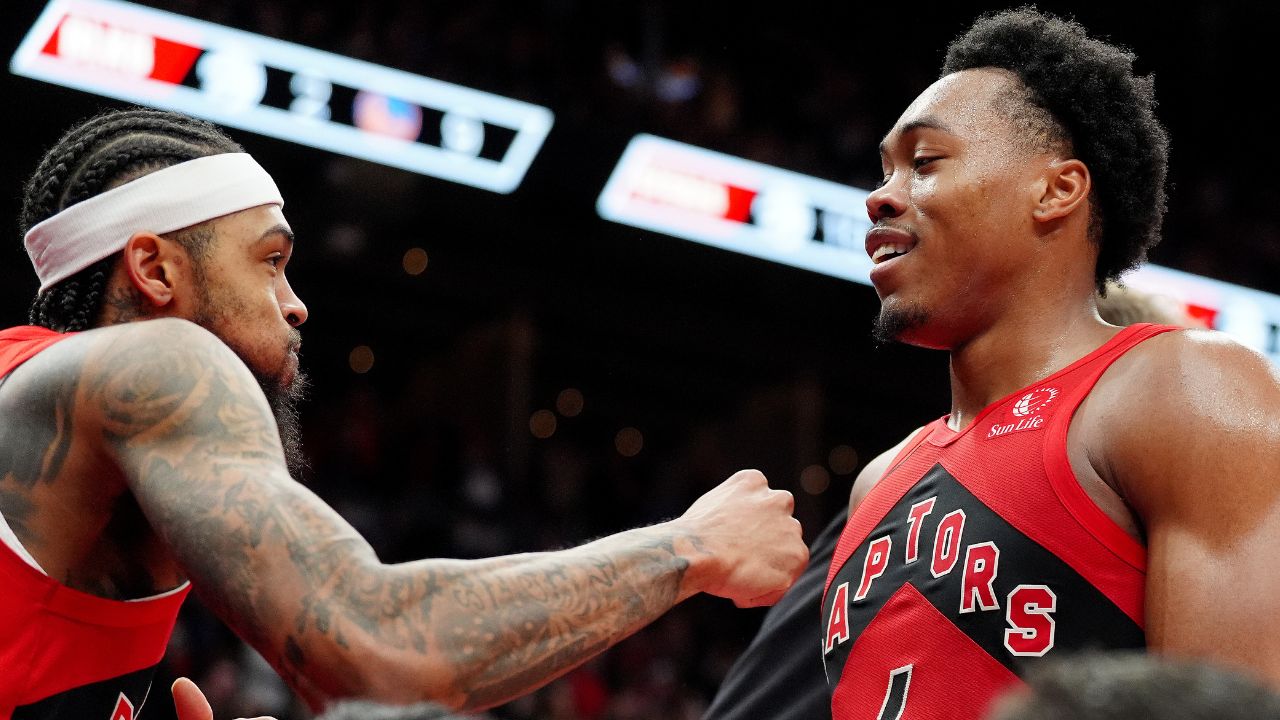
But their most important individual and collective accomplishment this season has been forming the bedrock of the Toronto Raptors‘ journey from a team playing for lottery odds this time a year ago to one that is in the thick of the Eastern Conference playoff race with the all-star break just two weeks away.
As good as they each have been individually this season, the Raptors have been successful because they’ve been good together.
Ingram has no bigger fan than Barnes, who has the locker next to him in the Raptors’ dressing room.
“He does so much for our team,” says Barnes. “And being from where our team was last year to this year, his impact on our team is instrumental to our success.”
They very easily could both have been named all-stars when the 14 reserve selections — seven from each conference — for the Feb. 15th mid-season spectacle were named, as voted on by the coaches and announced Sunday night.
In the end, it was only Barnes who had his name called.
It was a neat moment at Scotiabank Arena when word filtered through the crowd, followed by a roar when Barnes image and the words ‘all-star’ were flashed on the videoboard.
Barnes’ teammates mobbed him during the timeout. He looked genuinely pleased, if faintly embarrassed. Afterwards, when his 18-month-old daughter, Milli, was handed to him in the hallway outside the Raptors locker room, he was announced as “Daddy All-Star.”
It has a ring to it. The 24-year-old earned an all-star nod as an injury replacement two seasons ago, but this time around was a no-doubter. I spoke with various coaches in the weeks leading up to the vote, and their collective message was uniformly the same when it comes to voting on reserves: winning matters.
His own coach, Darko Rajakovic, said that was the point, exactly:
“I don’t think anyone around the league had any doubt he deserved this,” said Rajakovic. “His growth and his improvement and how he’s supporting the team to win … when you’re voting all-star, it really comes down to how you’re affecting your team winning; how you’re affecting your teammates.”
It makes sense, in that context, that Barnes wasn’t swept away by the individual honour, but rather seemed a little bit sheepish about the attention, especially since it was coming out of a timeout in the first quarter.
“I was trying to win. I wasn’t really thinking about it,” he said later. “I was just trying to find ways we could get some stops, to be honest. But it was a pretty good moment.”
Has it sunk in yet, he was asked after the game.
“I really don’t have the time to think about it right now. I’ll think about it more when I get home, but of course I’m excited for it, I look forward to it.”
Barnes is a more-than-respectable scorer at 19.4 points per game, but it’s all the rest of the plays he makes, as captured by his averages of 8.3 rebounds, 5.6 assists, 1.3 steals and 1.5 blocks.
He’s the only player in the NBA hitting those thresholds this season. Since the 1990-2000 season, the only other players to do it are Kevin Garnett (5x), Giannis Antetokounmpo (2x), DeMarcus Cousins, Joel Embiid and Barnes, who also did it in 2023-24, his other all-star season.
Ingram’s contributions haven’t been quite as wide-ranging, but they’ve been vital for Toronto and have helped relieve the burden to create offence from Barnes and, to a lesser extent, Immanuel Quickley and RJ Barrett, who have benefited.
And Ingram is the first to recognize how Barnes has contributed to his success in his first season as a Raptor.
“He does a lot of things on the defensive end: blocks shots, on-ball defence, help defence, he’s everywhere,” said Ingram. “On the offensive end, he’s able to push the basketball, see passes before everyone else, running in transition, feeding guys on cuts, feeding guys on the wing.”
Ingram didn’t get named an all-star for a second time, which would have been his first since 2019-20 when he was in his fourth season and first in New Orleans. The 10-year veteran could be justifiably disappointed that he didn’t make it in his first full season in Toronto, but he says the snub only makes him more determined.
“In the moment, of course, it stung,” said Ingram. “It was hard to internalize during the game. I had to put it away and figure out the best way to be effective on the floor and win the game today.”
Barnes called the snub “ridiculous.”
For Ingram, there is some small victory in even being considered, coming off a season when he played just 18 games, and injuries have become as much his story as his production. He said before the season he wanted to use this year to remind the NBA of what he is capable of when healthy. It’s still a work in progress.
“I ain’t done it yet. I think I gotta do it again [prove himself],” he said. “I’ve kind of stepped back and given myself a little grace. There have been days when I’ve woke up a little tired, my body wasn’t feeling great, but I still pushed through. Shout out to the medical team for keeping me on the floor as much as possible. This is as much as I’ve played in a long time. The second half of the season should be a great one.”
Ingram leads the resurgent Raptors in scoring with 21.9 points per game on one of the league’s toughest shot diets — almost by design, Ingram takes well-contested two-point field goals, often with the shot-clock winding down as his primary protein. In that context, his 47.2 per cent (including 36.1 per cent from three) field goal percentage is even more impressive. His defence and rebounding have been better than advertised, and there’s no question that his presence has helped provide punch to a Raptors offence — rated 19th before Sunday — that can go punchless too long, too often.
There was certainly some of that on Sunday, although the Raptors were able to squeeze out just enough to earn a 107-100 win over the visiting Utah Jazz. The win improved the Raptors’ record to 30-21 while the Jazz fell to 15-34.
Neither Barnes nor Ingram had performances Sunday that would bolster their all-star arguments on a standalone basis. Barnes finished with 14 points on 5-of-12 shooting, nine rebounds and four assists, but his two steals and four blocks underscored how — even when his offence is coming in fits and starts — he can change the momentum of a game or part of a game like few others. Meanwhile, Ingram was 2-for-8 for six points in the first half as the Jazz led Toronto 56-51. The Raptors got on top of things in the third quarter in large part because Ingram scored six of his 13 second-half points in a two-minute stretch in the third — all on unassisted buckets — that gave the Raptors the lead, which they held the rest of the night. He finished with 19 points on 7-of-19 shooting.
Barrett led the Raptors in scoring — he had 21 points on 6-of-12 shooting in his strongest outing since returning from his recent ankle injury — and his presence has been essential to the Raptors season, also, but in part that’s because he’s benefited from Barnes and Ingram’s steadiness. Quickley had 17 points on 12 shots while Sandro Mamukelashvilli had 20 points off the bench on 6-of-9 shooting (4-of-7 from deep).
Big picture, the biggest win for the Raptors this season is that both Barnes and Ingram have been so healthy — they’ve missed three games between them this season — and that they have proven to be a better fit than might have been automatically expected.
“There are things that Brandon does at an elite level and there are things that Scottie is doing at elite level, but they’re so different,” said Rajakovic. “You know, Scottie is amazing in open court and transition. Now, BI is taking advantage of that. He’s doing a better job in open court as well. BI is elite score in half court, in [isolations] and post-ups, and I think they have a lot of respect for each other, and what they bring to the team at the end of the day, winning basketball games is that’s what they do. They help the team win.”
The Raptors sitting in fourth place, nine games over .500, is more proof of that than getting one all-star berth or two.