
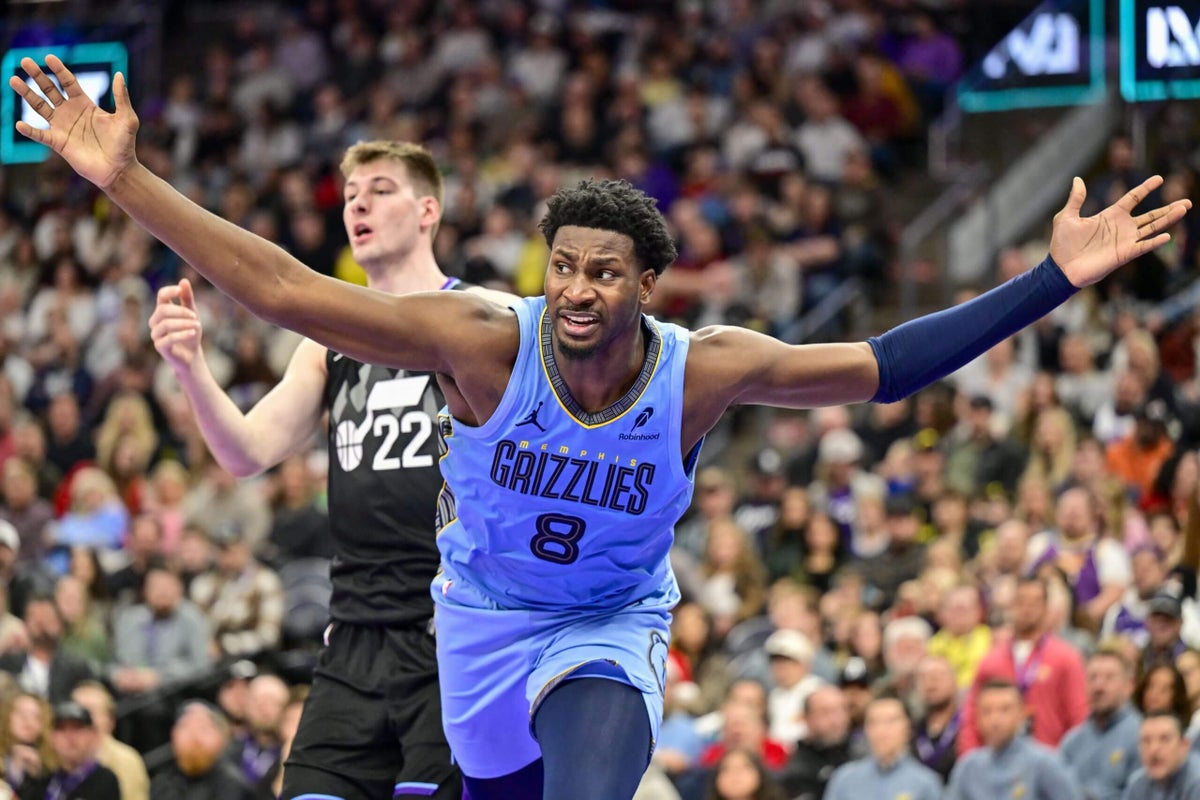
With the trade of Jaren Jackson Jr. to the Utah Jazz for a package centered around Walter Clayton Jr., Taylor Hendricks and three first-round picks, it might seem like a once-promising era for the Memphis Grizzlies has officially come to an end.
But realistically, the Grizzlies never got a chance to get airborne, and this era ended long ago, even as the team’s front office tried as long as it could to rekindle the fading embers. Even at the peak of Grizzlies fever in 2022, when Memphis earned the No. 2 seed in the Western Conference, Ja Morant posted his lone All-NBA campaign in his third season, Jackson was emerging into a true defensive force and Desmond Bane became one of the league’s best shooters, the team was still flawed. That was laid bare in the West semifinals against Golden State, when the Warriors shut down Morant and the Memphis offense to win in six games. To take the next step, Morant would have to become the kind of shooter whom defenses didn’t go under screens on, and the Grizzlies needed another secondary playmaker next to him.
Unfortunately, we know what happened from there. Memphis won 51 games again in 2022-2023, but Morant got suspended for eight games in March for conduct detrimental to the team due to gun-related shenanigans. The team was soundly defeated by the Los Angeles Lakers in the first round, including a 40-point drubbing in the decisive Game 6. Morant was suspended again for the first 25 games of the 2023-24 season for continued reckless behavior and played only nine games after undergoing shoulder surgery in January.
The vibes never returned. Morant’s shooting hasn’t been the same since. And what looked like such a promising moment in the post-Grit-n-Grind era was just that: a moment. Morant will assuredly be next out the door, either at the deadline or in the summer.
In many ways, the 2021-22 Grizzlies are a cautionary tale. But even if Morant’s decisions and injuries were the main culprit, it’s worth noting that the trades of Bane (to Orlando) and Jackson over the last eight months occurred for another significant reason: The ground underneath the Grizzlies changed in the West. While their No. 1 option wasn’t improving, other teams’ top guys were. Anthony Edwards took the leap for Minnesota, leading the Timberwolves to back-to-back West finals. Shai Gilgeous-Alexander developed into the MVP just as Oklahoma City’s Sam Presti was accumulating massive draft capital and selecting Jalen Williams and Chet Holmgren.
Given those factors, right now seems like a good time to rebuild in the West. Let’s break down the Grizzlies’ efforts to do so with this deal, then we’ll also talk a bit about why I liked this deal for the Jazz, too.
Why this deal made sense for the Grizzlies
The Grizzlies traded Jackson, Jock Landale, Vince Williams Jr., and John Konchar for Clayton, Hendricks, Kyle Anderson, Georges Niang and three first-round picks. Two of the first-rounders will come in 2027, when the Grizzlies will receive the best out of Utah’s, Minnesota’s, or Cleveland’s picks as well as the Lakers’ top-four protected pick. Then in 2031, the Grizzlies will also get Phoenix’s unprotected first-rounder.
The picks are the key to the haul here, so let’s talk about their value. To do that, we have to start assessing the 2027 NBA Draft, which is not seen as particularly strong. Why? The incoming freshman class is not all that exciting. I was having a conversation this week with an NBA scout who works heavily in the high school space, and we agreed that the top player in the 2027 NBA Draft class, whether that’s Tyran Stokes or Jordan Smith Jr., would be more like the No. 7 pick in this 2026 class. That perceived lack of upside is likely why Utah felt comfortable trading away picks without much protection attached.
However, it’s unclear right now how deep the 2027 NBA Draft class will go, and the Grizzlies have as strong a track record as any team in the league at spotting talent deep into the draft. They’ve nailed picks from lower selections going back years under this regime led by general manager Zach Kleiman. They’ve mined quality out of quantity. To wit:
● In 2019, they selected Morant at No. 2. They also took Brandon Clarke at No. 21, a clear win before injuries slowed him down, and spotted Konchar as an undrafted two-way who stuck with the team for over 350 total games.
● In 2020, they traded back into the first round at No. 30 to select Bane. They also picked Xavier Tillman in the second round, a player who is still in the NBA six years later and who played over 200 valuable games with the Grizzlies.
● In 2021, they made a mistake trading up to take Ziaire Williams but drilled the Santi Aldama pick at No. 30.
● In 2022, they took Jake LaRavia at No. 19 (even if they declined his fourth-year option too early) and found Vince Williams Jr. in the second round — though missed on the David Roddy pick late in the first round.
● In 2023, they used their lone pick at No. 45 on G.G. Jackson, who at least looks like an interesting player.
● In 2024, they nailed the Zach Edey pick at No. 9, assuming he can stay healthy. Then, in what was considered a down draft, they also hit on Cam Spencer and Jaylen Wells in the second round, two players who have started an awful lot of games for them this season. Wells and Edey were both All-Rookie picks, and Spencer looks like one of the best shooters in the NBA.
● Then in 2025, they moved up to No. 11 to acquire Cedric Coward, a player well on his way to a first-team All-Rookie selection this season.
Basically, the Grizzlies hit on three of their four lottery picks, then also hit on eight of nine picks outside of the lottery, including several deep into the second round. Clarke, Aldama, Wells, Spencer and LaRavia have turned into terrific rotation players taken outside of the top 20, which is pretty hard to do.
Will any of the players they take with these future picks end up as good as Jackson? Maybe not, but Jackson’s departure also allows Memphis to more forcefully tank around a cheap young core of Edey, Coward, Wells and Spencer while utilizing the draft find its next superstar. The Grizzlies have 13 first-round picks in the next seven drafts and could look to add more by taking on bad contracts in the midst of this rebuilding period.
Don’t sleep on the players they acquired here, either. Clayton and Hendricks have at least shown flashes. Clayton is the more interesting of the two right now. An elite shooter and underrated athlete who won Final Four Most Outstanding Player on Florida’s NCAA Tournament title team last season, he has been OK for the Jazz as a backup guard. Clayton is only shooting 30 percent from 3, but he’s made 94 percent of his free throws and there’s no reason to believe he won’t develop into a monster shooter.
He’s proven to be a good decision-maker and generally doesn’t turn the ball over. As soon as his shot starts falling off pull-ups again, he should become a very useful offensive player while playing off two feet and using the threat of his shot to open up driving lanes. While I don’t know that he’s ever going to be a dynamic lead guard initiator, he’s a likely rotation player with some starting potential if his development breaks right — and he’s on a cheap deal for three years beyond this one.
Hendricks is in his first year returning from a fairly gruesome broken leg that occurred at the start of the 2024-25 season. Whether it’s his recovery or confidence, he’s not quite moving with the same level of fluidity or quick twitch that we saw from him at UCF, which prompted the Jazz to take him No. 8 in the 2023 draft. The idea was always a big 3-and-D wing, but he hasn’t made shots or guarded at the level required yet to make that work. Maybe with more time away from his injury and with more of a runway to develop, those skills can come back for Hendricks. He has had a couple of fun 20-point flashes this year. But too often, he has been invisible for the Jazz when he’s on the court, and the team has tended to be drastically worse when in his minutes.
The key question in the Jackson deal is opportunity cost. Did Memphis make the right choice to trade him now versus waiting until the offseason, a question the Milwaukee Bucks are asking themselves in regard to Giannis Antetokounmpo. In my opinion, trading him now was the right call.
Because of Jackson’s renegotiation and extension last offseason with the Grizzlies, his salary is set to rise from $35 million this season to $49 million next season. That jump would have made it harder to consummate a trade with many teams, so the timing was right to get something done now. Additionally, while Jackson is an excellent player whose ability to cover ground on defense while spacing the court from behind the 3-point line on offense is rare, he has some risk factors that make him a more variable asset than most.
First and foremost, Jackson’s poor defensive rebounding has long stopped him from manning the center position effectively, a potential counter that could be wildly effective in high-leverage moments. Even at the power forward spot, Jackson is a below-average rebounder. Jackson also hasn’t really grown much on offense this year and his true-shooting percentage is again slightly below the league average. The good news is that it is largely driven by Morant’s absence, as according to DataBallr, Jackson carries a 62.3 true-shooting percentage when Morant is on the court this season, but only a 56.6 true-shooting percentage when he’s off. Basically, if you can get Jackson into more situations where he’s not being asked to create and instead is just being asked to finish off plays, he can be successfully efficient. But in the minutes with Morant, Jackson is only averaging about 18 points per 100 possessions, which is more in line with a third option as opposed to the second option he’s being paid as.
There is a real case that Jackson’s contract might have looked less attractive by the end of the year, and the Grizzlies might not have gotten in the summer what they did now if they moved Morant without Jackson. This was the right time, and the right deal.
Why this deal makes sense for Utah
The Jazz are pivoting into a new era of their team build under owner Ryan Smith, new basketball operations lead executive Austin Ainge and longtime general manager Justin Zanik. After three years in the wilderness when they have been immensely unlucky with the draft lottery, Utah is now well-positioned to create its first post-Donovan Mitchell winner.
The Jazz decided to move early on acquiring a star player under contract for significant years who also fills a defensive deficiency. Most importantly, they did so without limiting their future flexibility. This isn’t an all-in move; it’s a next step. And most importantly, it’s a next step with Jackson, who was arguably the best available player that the Jazz could have possibly acquired on the market.
Per Basketball Reference, in each of the last five seasons, Jackson has averaged at least 1.5 3s, one steal, and 1.5 blocks. In the history of the NBA, there have been 13 seasons in which a player has done that. And Jackson has five of them! Rasheed Wallace and Victor Wembanyama are the only other players to do it twice. It’s incredibly hard to find players who can both knock down shots from distance at volume as well as defend at an elite level. And that defensive help is what the Jazz desperately need.
In each of the last three years, the Jazz have been last in defensive rating league-wide. Their 123.4 mark this season on the defensive end is currently not just the worst raw defensive rating in league history; it’s actually the third-worst mark compared to league average in history behind just the 1998-99 Denver Nuggets and the 2005-06 Seattle SuperSonics, per Basketball Reference. To say the Jazz need to upgrade on that end is an understatement.
However, I don’t think their defensive infrastructure is as bad as it would make it seem. Fourth-year center Walker Kessler has missed the entire season. He’s a terrific rim protector; the team has a 118 defensive rating with him on the court throughout his career, which is three points better than what happens when he leaves the court. He consistently contests shots at the rim and also does a great job cleaning the defensive glass. He’s the perfect center to play next to Jackson, who can be weaponized as one of the best defenders in the league when used well.
The key to Jackson’s success in Memphis has often been playing next to a true anchor rim protector at the center position so that he can scramble all over the place, using his balance and coordination to cover ground well and clean up mistakes. For instance, in the two years when Edey has been on the court, the Grizzlies have a 107.5 defensive rating when both are out there. But when Jackson is out there without Edey, the team posts a 115.5 defensive rating. The same was true when Jackson played next to Steven Adams during his Defensive Player of the Year-winning 2023 season. With Adams on the court with Jackson, the Grizzlies allowed just 107.3 points per 100 possessions. With Adams off the court, they allowed 110.1.
Because Jackson can roam and take himself out of rebounding position, it’s important for the team that has him to have a player in the middle who can handle the glass. Kessler should have no issues doing that next year when he returns from injury. He’s a restricted free agent this summer, but it would be a surprise to see the Jazz let him go, given his low cap hold. With Kessler and Jackson on the interior, the Jazz should at least shoot up toward the middle of the pack on defense next season — with the potential to go even higher than that depending on their other moves, given how long and athletic the team could be around those two with Lauri Markkanen and Ace Bailey.
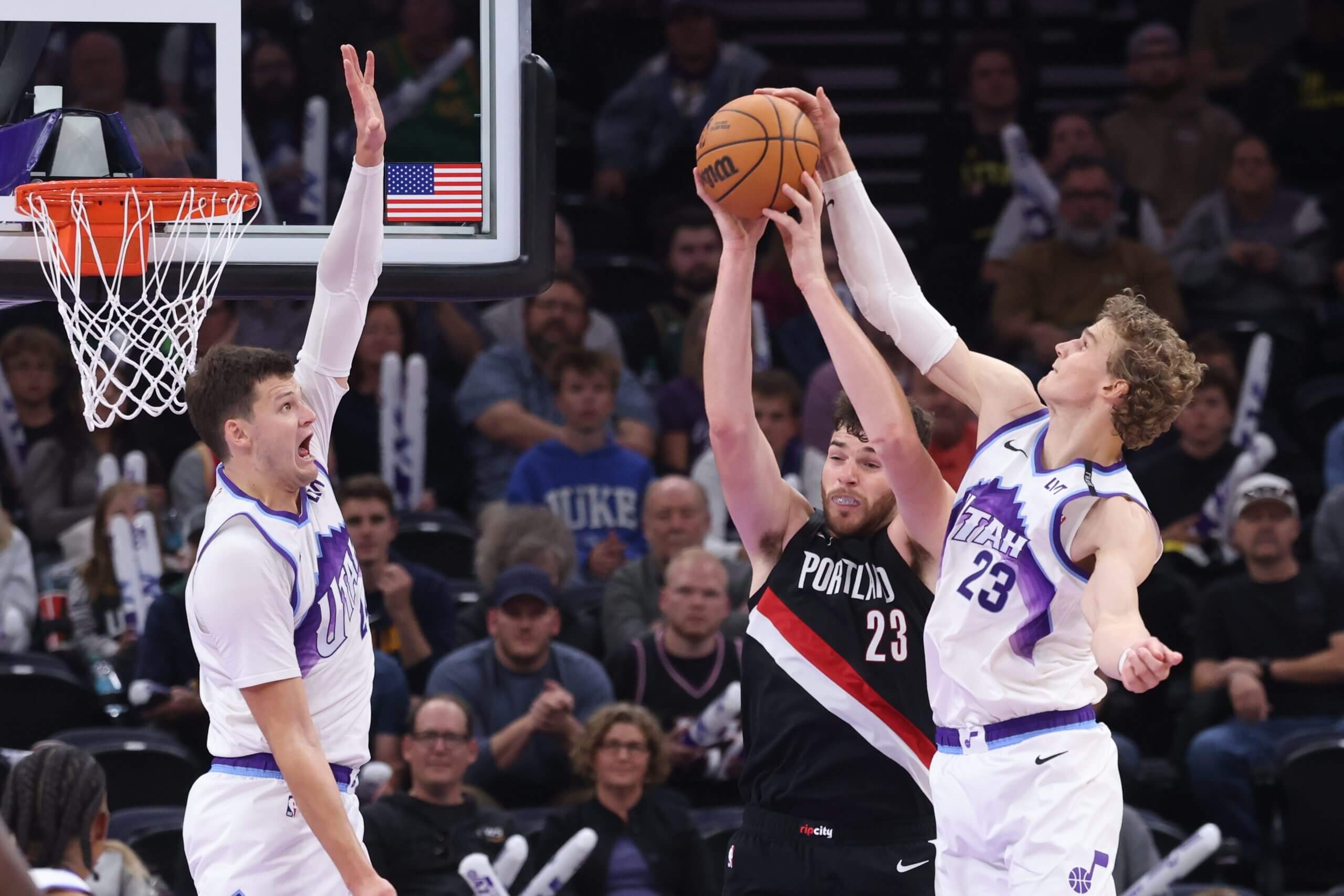
The Jazz could go huge with Jaren Jackson Jr. joining Walker Kessler, far left, and Lauri Markkanen. (Rob Gray / Imagn Images)
The Jazz also prefer to play a four-around-one style of offense under coach Will Hardy that plays right into Jackson’s skill set as a shooter who excels best at finishing plays when advantages are created for him. Hardy’s offenses typically involve a lot of ball movement and screening, which is where Jackson can be at his best. He’ll be able to space the floor, occasionally attack off the bounce in a closeout, get out in transition and cut to the rim. I would expect Jackson’s overall efficiency to improve in this offense.
And while the price point might seem aggressive, I don’t think it’s quite as important to the Jazz as simply having Jackson.
Utah had a surplus of picks and a solid, young, developing core of Keyonte George, Bailey, Markkanen and Kessler, among others. The Jazz are a step ahead of Memphis in their respective rebuilds because they started theirs nearly four years ago. Assuming they keep their first-round pick this season — more on that in a second — the Jazz will still own all their selections moving forward, plus one in 2029 from either Cleveland or Minnesota. That’s why they could afford to be more aggressive in a deal like this for Jackson than other teams. If this deal doesn’t work out, they have options to pivot in a new direction or to add to the core.
I have one overriding question about the roster construction, though. Markkanen, Bailey and Jackson are excellent play-finishers on offense who can maintain and thrive on advantages that get created for them. But they all have a weakness when it comes to dribbling and making plays for themselves. With Markkanen and Jackson locked in at nearly $100 million next season and well-established as past All-Stars, they’re going to get the lion’s share of the minutes. Can Bailey continue to improve his handle enough to play with them when the team shifts into winning mode? Or will Hardy end up having to stagger them and have Bailey come off the bench?
The burden for creation out of ball screens and isolations will be very high on George as this offense is presently constructed. I wonder if the Jazz should get another creative player in the backcourt to help him in most lineups. A two-way player in the Jrue Holiday mold would fit best next to George, but Holiday’s contract makes him unaffordable for Utah after next season.
But Utah doesn’t need to have all the answers now. With how well Jackson slots in between Kessler and Markkanen, this deal feels likely to work out once we see the final picture.
The key for the Jazz for the rest of the season will be making sure the trade doesn’t work out too well. The Thunder own the Jazz’s first- round pick this season if it falls outside of the top eight. Utah (16-35) is in sixth place in the tank race, with Dallas at No. 7 (19-31) and the Grizzlies and Bucks tied for eighth at 19-29.
Memphis feels unlikely to win many games the rest of the way. The Bucks could also tank if Giannis is traded in the coming days. If the Jazz were to finish sixth, they would have only a 3.9 percent chance to lose their pick on lottery night. If they finished seventh, they would have about a 14.2 percent chance of losing the pick. But if they finish eighth, they would have just a 58 percent chance to keep their pick, and at ninth that plummets all the way down to a 23 percent chance to keep their pick.
Utah has been creative in finding ways to sit players like Jusuf Nurkić, Markkanen and others this season. But the Jazz are probably going to have to get more aggressive with Jackson, and the league will likely watch their actions closely, given how high-profile this is slated to be and how much the league has looked into tanking reform.
The Jazz would enter the stratosphere as one of the most exciting young teams in the league if they find lottery luck for the first time in the team’s long history this May. I bet that Utah at least finds a way to put itself in that position.