
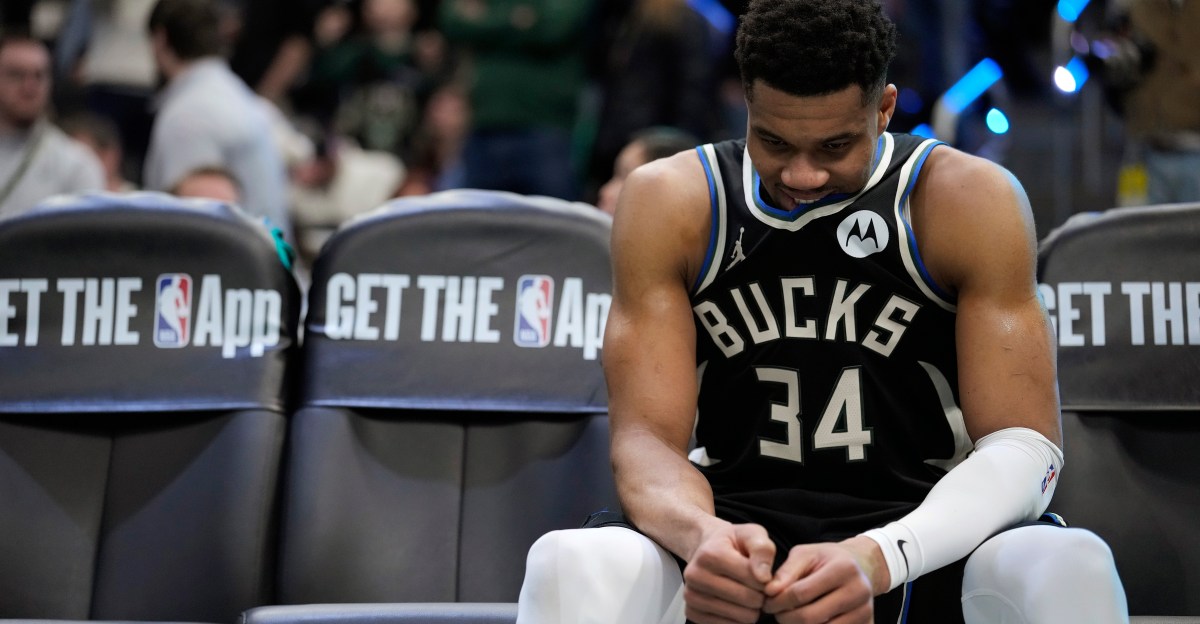
This season has been a miserable one for the Bucks, whose record will only get worse now that Giannis is out for an extended period (again). Simply put, they are a bad team that, for the first time in a long time, sits at the lunch table with the NBA’s bottom-feeders as opposed to its contenders. I don’t need to go through the reasons why—we all know them by now: team has a major talent deficit, coaching is among the worst in the league, yada, yada, yada. The question is this: what should the Bucks be hoping to gain from this season at this point? As I’ll explain, they have the option to tank with somewhat minimal downside—a unique quirk of this season. Alternatively, the Bucks could do what they’ve always done and make moves to improve the roster and compete until the bitter end.
For me, the place to start this conversation is to evaluate the incentives for each option. Look, I think there’s at least a chance that this team could make the play-in tournament, even with Giannis playing just the final portion of the season. I wouldn’t say it’s very likely, but it’s possible. From that point, there’s no telling what the eternal play-in trio of Atlanta, Chicago, and Miami will serve up. With Antetokounmpo, I’d give the Bucks as good a chance as any to at least win the first play-in game. Maybe they’d sneak into the playoffs. Maybe they’d win a game over the Pistons, Celtics, or Knicks. But I think it’s fair to say that they’d lose the series in a noncompetitive fashion. Now, I suppose there is some level of incentive for this path—both from a playing perspective and the org’s bottom line—but neither of which I see as anywhere near important enough to override the upside of the alternate route.
Put simply, there is a significant incentive to what I would call a “qualified tank” for the rest of the season. I added the word “qualified” because Milwaukee must still keep an eye on New Orleans. The Bucks own the least favourable of their own first-round pick and the Pelicans’ pick in this year’s draft. It’s easy to assume New Orleans won’t win much this season and will stay at the bottom of the standings. I guess it’s relatively likely that it ends up that way. Still, we should remember that 1. the Pelicans have no incentive to tank, while the teams around them do (and what do you think will happen when these teams play each other?), and 2. they actually have a pretty talented roster when healthy. This is why it’s not necessarily smart for Milwaukee to try to tank every game indiscriminately.
Ideally, the Bucks lose at the same rate the Pelicans lose, and win at the same rate they win (unless it’s the very end of the season and there’s a situation in which the Bucks can move up the draft odds order by losing, but the Pelicans cannot move down by winning). But let’s be honest, it’s also completely unrealistic to think the front office could hatch a plan in which they dictate who plays from night to night based on whether the team needs a win or a loss. I get that this strategy is somewhat typical for younger teams (that also generally don’t have to worry about swap obligations), but probably not for a veteran-laden squad like Milwaukee.
My take on the situation is that the Bucks, especially without Giannis, are very bad and will lose a lot of games without needing lineup manipulation. They’ll win the odd game too, which will probably be a good thing, because the Pelicans won’t go winless the rest of the way. From there, it’s simply out of Milwaukee’s hands. All Bucks fans can do is 1. hope New Orleans loses as much as possible, and 2. hope the other bottom-feeders win, though they will be increasingly trying not to as the season draws to a close. As I’ll get into, this is the ultimate foil for any “disaster” the Bucks could run into vis-a-vis the draft.
On a broader level, though, the Bucks need as high a pick as possible, so this dance is a necessary one. I want to remind folks of Milwaukee’s daunting first-round pick outlook moving forward. Should everything stay as is (which, it must be noted, could change), the Bucks will likely not have the opportunity to control their own destiny regarding their pick until 2031. Why? Because they don’t own their pick next year, and Portland either owns their pick or has swap rights in the three years after that. If you ask me, the Blazers are likely to be better than the Bucks by that point and thus swapping for Milwaukee’s more favourable picks.
However, as I mentioned, this year’s pick swap is with New Orleans, which is obviously worse than Milwaukee (right now, at least). Sidenote: the Pelicans’ pick is owned by the Hawks, but I hesitate to even mention this because it just confuses people; the only thing fans need to know is that it is New Orleans’ and Milwaukee’s picks in the swap. Anyway, assuming the Pelicans remain a bottom-feeder, the Bucks are likely to retain their own pick since they will probably finish a good number of spots above New Orleans in the standings.
That said, even if Milwaukee finishes with a similar record to New Orleans (at the bottom, crucially), the situation could still turn out fine for Milwaukee—and actually has higher-reward outcomes than the scenario above. Sure, the Bucks would have a much higher chance of their pick being swapped, but both their and the Pelicans’ pick will have a high floor to fall back on. For example, let’s assume just for argument’s sake that the Bucks end up with the third-worst odds and the Pelicans end up with the second-worst. Both of those picks would have a floor of seventh.
Alternatively, let’s lay out a scenario in which the Bucks end up with the ninth-worst odds and the Pels end up with the second-worst, but Milwaukee’s pick somehow jumps above New Orleans’ pick to number one (see Cooper Flagg). The Bucks would give it away, which wouldn’t be great. However, the Pelicans’ pick would have a floor of sixth. Of course, the disaster scenario is that by the end of the season, the Bucks and the Pelicans have somehow swapped spots with roughly where each team currently sits. Milwaukee could give up a top-three pick and only get swapped one seventh or after. Fingers crossed that does not happen.
So now that I’ve gone through the incentive to tank (again, provided the Pels are also bad) from a long-term team-building POV, let’s get more specific and discuss the strength of the 2026 draft itself. Obviously, no two drafts are the same. The no. 1 pick in one draft does not hold the same value as the no. 1 pick in another draft. I mean, just compare Cooper Flagg to Zaccharie Risacher (all due respect). Notably for the Bucks, this upcoming draft is loaded, per all the experts. There are three bona fide contenders for the top pick—Darryn Peterson, Cameron Boozer, and AJ Dybantsa—but the talent remains exceptional all through the lottery, first round, and heck, even second round.

Darryn Peterson

Cameron Boozer

AJ Dybantsa
From SB Nation’s Ricky O’Donnell’s recent mock draft:
The 2026 NBA Draft was always destined to trigger a massive tanking race. This class clearly had three potential No. 1 overall picks from the very start of the process, and all three are living up to the hype to start their one-and-done college seasons.”
“The depth of this freshman class has also impressed, with North Carolina forward Caleb Wilson dominating on both ends with his high-motor, breakneck style, and Houston point guard Kingston Flemings emerging as a legit top-5 pick in his own right as the biggest surprise of the year so far.
“It isn’t just freshmen that make this draft class special. A group of upperclassmen led by Michigan’s Yaxel Lendeborg, Iowa State’s Joshua Jefferson, Iowa’s Bennett Stirtz, and Florida’s Thomas Haugh are proving that staying in college for a few years won’t kill your draft stock in the NIL era.
“With that in mind, it seems clear that the incentives behind a tank are a lot more intriguing than Ryan Rollins getting playoff reps, rich owners getting richer, and the Bucks getting a pick in the mid-teens. I believe that moving forward, whether Giannis is in the picture or not, it’s a no-brainer to get as high a pick as possible in this draft and leave this season with the best possible asset. That player can slot in as a core building block for a team with the very few of those.“
Other than the obvious concern that the Pelicans go on a winning streak, the only other part of a “tanking” plan I worry about is whether Jon Horst will actually commit to it. I don’t expect him to change much about how the team operates, including lineup manipulation (other than holding Giannis out for the rest of the season, which I absolutely think the Bucks should do for several reasons). What I do worry about, though, is Horst trying to improve the team with a trade for some reason that gets them, like, five more wins than they needed. He’s only acted aggressively in the Giannis era. Is he capable of switching speeds and recognising the golden (but admittedly complicated) opportunity in front of him?
Finally, just a note on tanking in and of itself. Look, I admit that after hoping for this team to win every game for so long, as all fans did, it brings me no joy to now be “cheering” for the opposite result (most of the time). Tanking is tough for both teams and their fans. By the same token, finishing high in the lottery is the easiest way to acquire elite talent, which is what allows you to win in this league, especially in a small market like Milwaukee. Just about every team has tanked it or will tank in the future. I’m not here to get into the whole “is tanking bad for the league?” conversation; that’s a topic that’s been covered extensively at this point. I would just say that until the NBA changes the tanking incentives—which, to be clear, I don’t think it should—teams are going to operate with those incentives top of mind. Don’t hate the player, hate the game.