
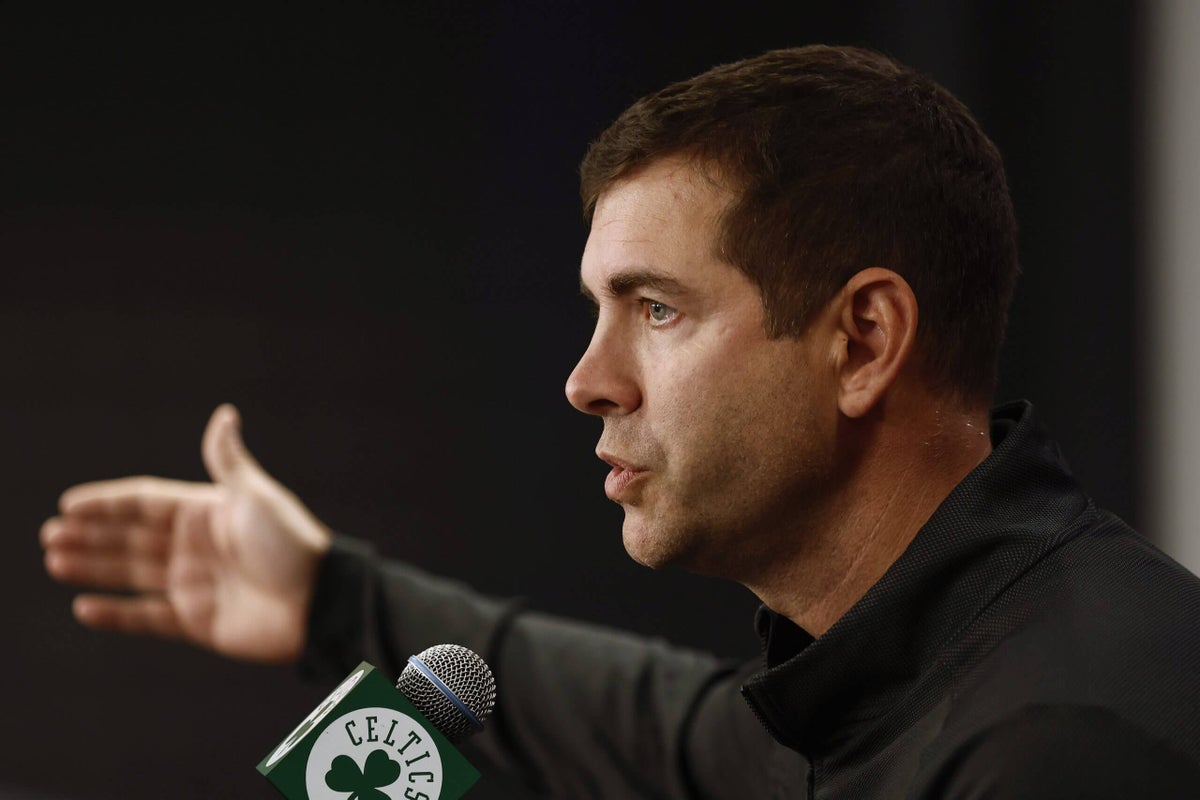
BOSTON — Though Jayson Tatum’s potential return looms as a major variable for the Boston Celtics, president of basketball operations Brad Stevens said it had “very little impact” on the decision to trade Anfernee Simons earlier this week.
Stevens said the trade, which landed Nikola Vučević, was driven by the Celtics’ desire to add another talented frontcourt player.
“If you kind of look at who you have to go through, the paths you might have to take, you just can’t get worn down physically,” Stevens said. “And we were going to be much smaller. And now we at least have big options. Obviously, any team with Jayson Tatum’s going to be better, so if that happens, that happens. And if it doesn’t, it doesn’t. But we just thought that redistributing our positional needs was probably the most important thing.”
Stevens said Tatum has “hit a lot of the thresholds” he will need to check off in his rehab process but still has “a ways to go” in his recovery from a torn Achilles tendon. He has missed the entire season after suffering the injury during the second round of the playoffs in May.
Recently, Tatum expressed on “The Pivot Podcast” that he’s worried about how he will fit back onto the roster if he returns midseason. He even said he has considered the possibility of delaying his return.
“The best time for Jayson Tatum to come back is when he’s 110 percent healthy, he’s fully cleared by everybody that matters in that decision, and he’s got great peace of mind and he’s ready to do it. That’s it,” said Stevens, adding that he had not listened to the podcast. “That’s the objective, and that’s what we’re going to stick with.”
With a little more than two months left in the regular season, Stevens was asked whether the Celtics have a deadline by which Tatum would need to come back before they decide to push his return to next season.
“When it’s right, then we’ll all sit down and talk about it,” Stevens said. “There’s still no force from us. There’s no pressure from us. But there’s also not gonna be any of us saying, ‘Well, why doesn’t he just take another week?’ When he’s ready, he’s ready.”
In Vučević, Boston acquired a two-time All-Star who remains highly productive at age 35. As excited as the Celtics have been about the play of Neemias Queta and Luka Garza, Stevens believed his team needed extra frontcourt help before a playoff run that could produce matchups against Joel Embiid, Karl-Anthony Towns, Jalen Duren and/or Jarrett Allen.
“Nikola is a good player,” Stevens said. “He’s been a good player for a long time. Obviously, the shooting and scoring get a lot of attention. The passing is a big factor for us, and it’s something we really like in bigs. So it’s just something that gives us another look, and I think our two guys that have played the majority of the minutes at that position have been outstanding, so we’re excited to have all three of them and see how it all fits together.”
In acquiring Vučević, the Celtics also escaped the luxury tax by trading Xavier Tillman, Chris Boucher and Josh Minott in salary dumps. Stevens said his front office never had a directive to avoid the tax but saw it as an opportunity after shedding about $6 million in salary in the Simons-Vučević swap. After that deal, the Celtics were able to duck under the tax without losing any more rotation players.
“This summer we had to get under the second apron,” Stevens said. “(The Celtics had) every basketball reason in the world for that, and it was the right thing to do. The directive at this trade deadline was, ‘Let’s see if we can find some size that we could give ourselves a little more depth there and make sure we are more prepared for some of the physicality that’s coming down the road if we’re able to be in the playoffs and however long you’re in the playoffs.’ You have to have that. It’s just a physical toll that can be taken on a team.”
The Celtics have just 12 players under contract after converting Amari Williams’ contract to a standard deal. Eventually, they will need to fill two more roster spots. Stevens said they will add “at least one more ballhandler and then see how the rest of the needs play themselves out.” The team’s two-way contract players — Ron Harper Jr., Max Shulga and John Tonje — could figure into the mix. Tonje was acquired from the Utah Jazz in the Boucher trade.
Stevens said the promise of the Celtics’ other young players also factored into his decision-making at the trade deadline.
“I think we’re all encouraged … by some of our youth and where they’ve come,” Stevens said. “And a large part of that has been because of opportunity. And (coach Joe Mazzulla) has done an amazing job of throwing them all out there — and sometimes pulling them fast, but throwing them all out there and letting them gain great experience and great opportunity. And you’ve seen kind of this jump on a couple of them. And then if you take that away for the next three months, are you actually worse, right? Or can they take another jump? So I think that’s part of it, too.
“Now, we still have some ability to add in the free-agent market, and then we’ll figure it out after this year, what that looks like. But I hope we go on a hell of a run, and I’m not going to put a ceiling on us, just like I haven’t from day one.”