
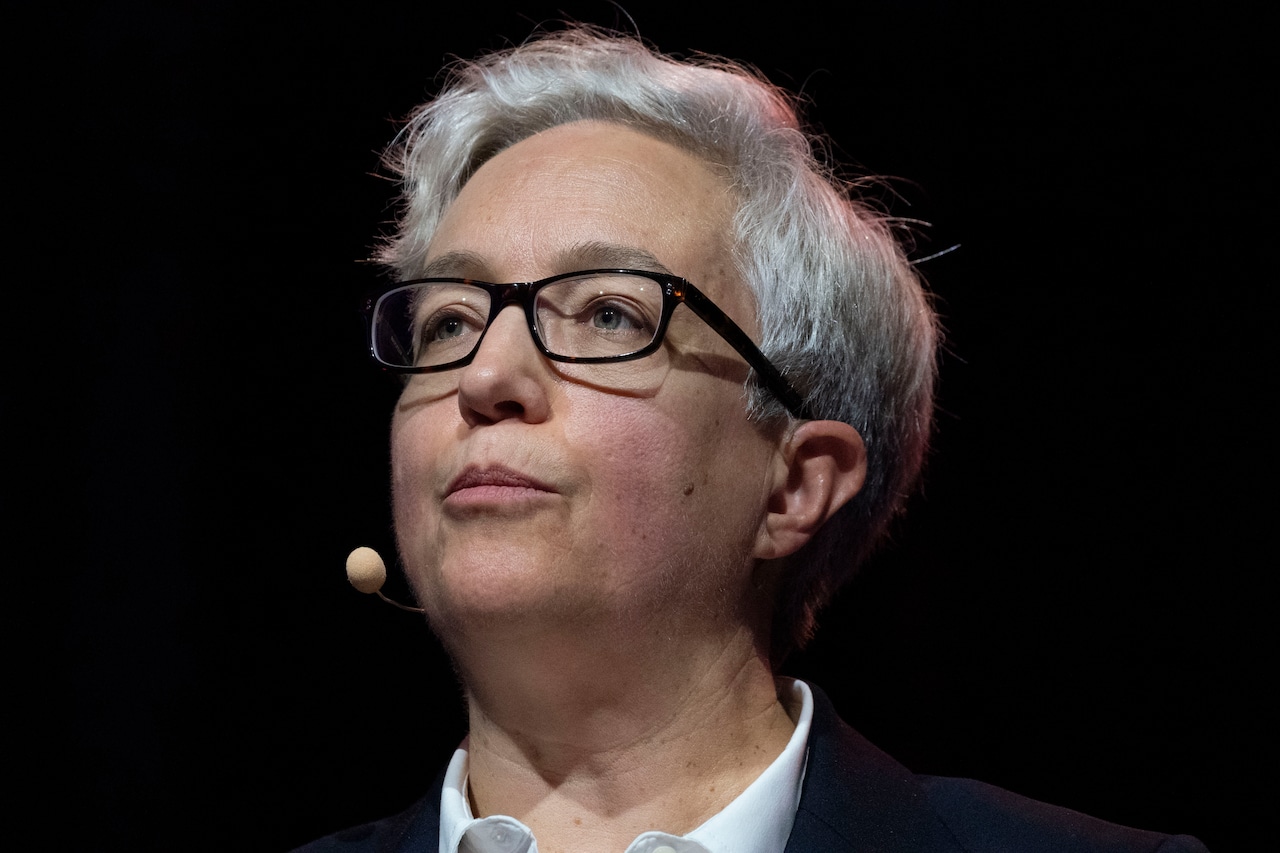
As state lawmakers wait on a bill that would help fund Moda Center renovations, Oregon Gov. Tina Kotek spoke with NBA Commissioner Adam Silver last week as part of her full-court press to ensure the Trail Blazers do not relocate from Portland under new ownership.
Kotek’s calendar shows a conversation with Silver on the afternoon of Jan. 30 that a spokesperson for the governor said lasted about 15 minutes and was scheduled at Kotek’s request.
“That was an opportunity for her to reinforce her support for a deal to keep the Blazers in Portland for the long term directly to the commissioner,” said the spokesperson, Elisabeth Shepard.
The call came amid a tense moment for the future of the Trail Blazers. The franchise has worked with the state, city of Portland and Multnomah County to orchestrate a complicated multi-governmental funding package that would generate roughly $600 million toward renovations that are seen as critical to keeping the Trail Blazers in Portland.
The state is expected to be asked to contribute $360 million through bonds backed by income tax from players and other performers at the city-owned Moda Center, while the city was originally expected to commit $75 million through its voter-approved climate fund, while the county was on board to provide $75 million generated by the motor vehicle rental tax.
However, if the package is going to move forward it may have to be without a key piece of the initial funding proposal. The Trail Blazers and Multnomah County are at odds over upwards of $40 million in business tax revenue that will be paid to the county from the sale.
The total package was originally designed to hit the $600 million target with the proposed inclusion of capital gains tax generated by the sale that all sides originally believed would be paid to the state. In recent weeks, a discovery was made that the tax revenue, expected to be roughly $110 million, would not flow through the state as the sides originally believed, but would instead land with the city, county and Metro as a business tax.
Metro’s relatively small slice, an expected $20 million, will be paid directly to homeless services, leaving approximately $50 million for the city and $40 million for Multnomah County.
While the city has agreed to reinvest the business tax revenue it expects to receive from the sale, Multnomah County has not made the same commitment and some leaders view the $40 million windfall as an opportunity to infuse underfunded programs with newly found cash.
The county could be willing to use a portion of the tax revenue toward the renovation, but some county leaders have so far only shown a willingness to apply those funds in place of some of the rental car tax revenue.
Behind the scenes, the Blazers have argued that the county should stack that tax revenue on top of its original $75 million pledge. Rather than moving the goalposts, Blazers officials have argued, it would simply maintain the spirit of the initial agreement when it was believed to be state money.
A Blazers spokesperson declined to comment for this story, citing the “ongoing nature of the discussions with all of our partners in government.”
Multnomah County Commissioner Shannon Singleton told The Oregonian/OregonLive that the Trail Blazers are “critical both economically and culturally for our community” and indicated a willingness to accommodate the franchise’s request.
“We have additional resources that I’m willing to consider adding to this deal,” she said, “and trust our partners’ word that labor and community benefit agreements will be a part of this renovation plan.”
Responding to a question from The Oregonian/OregonLive, Commissioner Julia Brim-Edwards said in a statement there was “no tension” between the county and the Trail Blazers and that Multnomah County “proposed a contribution that matches the amount requested, taking into consideration the County’s fiduciary responsibilities.”
She added: “We look forward to seeing details from the State and City on the purchase and commitments of the Blazers to stay in Portland, and how they meet the County’s proposed requirements and community priorities.”
The Blazers had hoped to have the funding from local governments buttoned up before introducing its bill in the Legislature, but may not have that luxury. On Friday, the Legislature concluded the first week of its 35-day short session that runs through March 8.
The lack of clarity from the county is but one of the issues facing the Blazers efforts to secure an arena renovation. The city’s plans to dip into its clean energy fund have already encountered pushback.
If the franchise is not able to move forward with the bill during the short session, the Allen Estate risks handing over the keys to the Trail Blazers later this spring to incoming owner Tom Dundon without a clear long-term vision for the Moda Center. The arena opened in 1995 and has never had a major renovation.
With a lease with the city that expires in 2030, and an urgent desire to give the building a dramatic facelift before the NCAA Women’s Final Four that spring, a failure to secure public funding for the project could give Dundon an opening to explore moving the franchise if he were so inclined.
If that were to materialize, the Texas billionaire would have no shortage of cities to consider. Whether one of those could be Seattle is unknown. Portland’s larger neighbor to the north has long been seen as the likely landing spot for an expansion franchise ever since the SuperSonics left in 2008, but that has not yet occurred and the state’s leaders are hard at work to win favor with the NBA.
In fact, six days after Kotek’s call with Silver, her Washington counterpart, Gov. Bob Ferguson, requested to meet with the NBA commissioner, as well.
“Governor Ferguson initiated the call to introduce himself to Commissioner Silver and they had a good conversation,” NBA spokesperson Mike Bass told Seattle-area media on Thursday.
It was not immediately clear if the situation unfolding 115 miles south of Olympia might have been a topic of discussion.