
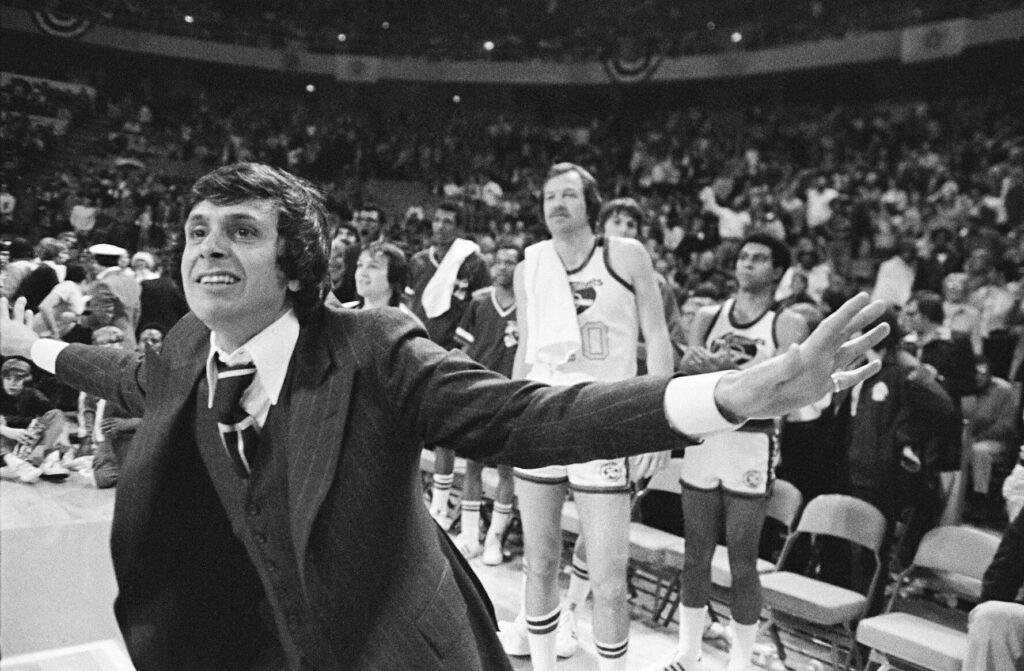
Fifty years later, new documentary series takes nostalgic look at how the rebel American Basketball Association changed the NBA – and the world
Three-point ABA trivia question: What do rapper-actor Common and Grammy Award-winning singer India.Arie have in common?
Answer: Their fathers both played for the Denver Rockets of the American Basketball Association.
No, I am not kidding. Lonnie Lynn and Ralph Simpson. You never would have believed it, but that is what you call a fact swish from downtown. And that was the ABA to a “three.”
The ABA was nine of the fastest, craziest, big-hairiest, funnest and funniest seasons in basketball history. Filled with all kinds of unlikely moments and memories you never would have believed unless you were there.
Like, say, that first-ever All-Star Game slam-dunk contest between David “Skywalker” Thompson and Julius “Dr. J” Erving here in Denver back in 1976. The mystery pre-game concert that day that turned out to be Glen Campbell and Charlie Rich. Julius Keye’s seven-point play against Utah. The witch’s curse.
Wait, the what?
In a brazen act of showmanship even for those crazy ABA days, the Indiana Pacers hired a brand-new mascot just before the 1975 ABA Western Division Finals against the favored Nuggets. Just before the Game 2 tipoff, “Dancin’ Harry” emerged on the court for the first time anywhere and placed a garish, pro-wrestling-worthy hex on the Nuggets in front of an overflow crowd of stunned Denver fans. And it worked. Down go the Nuggets 131-124, evening the series. The Nuggets tried to counter by hiring Robota, the so-called “Wicked Witch of the West,” to put a spell on the Pacers before Game 5. But it was all for naught. The Pacers won in a blowout, and eventually won the series in seven.
But talk about putting on a show!
Bonus trivia question: What do the origin stories of the Denver Nuggets and Broncos have in common?
Answer: They were both born into rebel rival sports leagues that threatened the establishment, leading to begrudging mergers that forever changed the NBA and NFL.
“Fifty years later, as I’ve said many times – the NBA today looks a lot like an ABA game,” said George Karl, a former ABA player and Hall of Fame coach who led the Nuggets to nine straight winning NBA seasons.
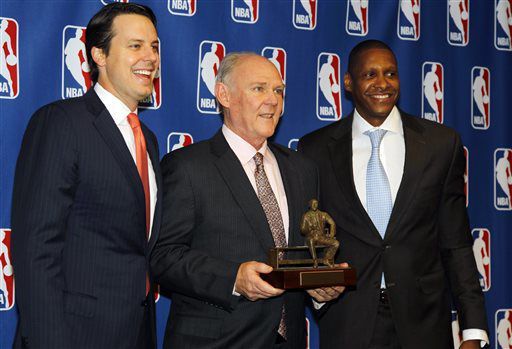 Denver coach George Karl, center, holds up the Red Auerbach trophy for NBA Coach of the Year on May 8, 2013. Joining Karl are team president, Josh Kroenke, left, and general manager Masai Ujiri.
The American Basketball Association, which lived magnificently from 1967-76, was a flashy, fast-paced game known for its red, white and blue ball, the 3-point shot, and its entertaining style, complete with sideline dancers and coaches like Denver’s Larry Brown wearing hot disco attire one game and denim overalls the next. (We called him “The Modfather.”)
The Black players’ Afros (banned in the NBA) were mountains of majestic beauty. Defenders might make incidental contact from 3 feet away. And Black players weren’t the only ones letting it grow. Back in 1973, Karl was a 22-year-old rookie with the ABA’s San Antonio Spurs, where his greatest accomplishment was being named to that year’s “All-Time ABA Big Hair Team.”
“I kind of liked my hair at that time,” Karl told me last week. “I don’t have any now, but I sure liked having long hair then. At (the University of North Carolina), Coach (Dean) Smith always wanted me to cut my hair, and I don’t know why. This was the time of the hippie generation. Long hair was in, and I kind of enjoyed it. I remember blow-drying my hair. I miss those days.”
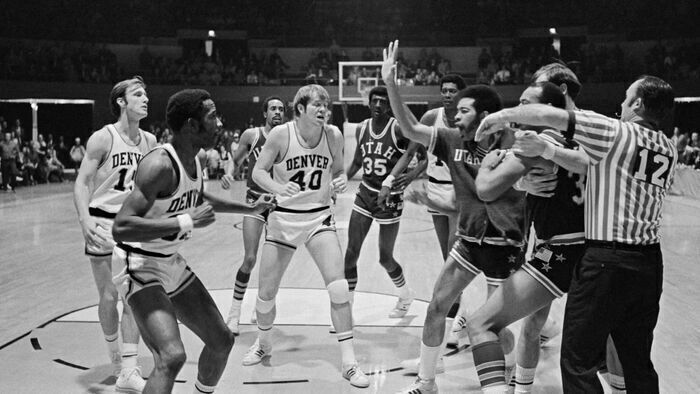
Everything was freer in the ABA. There were evocative team names like the Hustlers, Amigos, Chaparrals and Baltimore Claws – who folded after three exhibition games. (If they hadn’t, Denver never would have gotten Dan Issel, and I never would have gotten to interview him for my sophomore high-school journalism assignment to go out and interview someone famous. I asked him about his missing front teeth.)
Issel kindly gave that interview as a favor to my father, Ralph Moore, who covered the team for The Denver Post from its inception in 1967 through his retirement in 1984. That swath of history included a name change from the Ringsby Rockets to the Nuggets in 1974 to avoid conflict with the Houston Rockets in the coming NBA merger.

But the ABA and its impact on the NBA and the country at large was much bigger than just basketball, Karl said. He’s a producer, along with Common and others, of a sublime new four-part documentary series dropping Feb. 12 on Prime Video, just in time for the 50th anniversary of the ABA-NBA merger – and this week’s All-Star Game.
It’s called “Soul Power,” and it is being called the definitive history of the ABA – with a particular focus on the Denver story in Episode 4.
“The NBA kept saying the ABA is just a circus. That they play with a red, white and blue ball, and they don’t know how to play the game of basketball,” Karl said. “But once we started playing against the NBA, I think we all realized we were probably just as good or better than the NBA.”
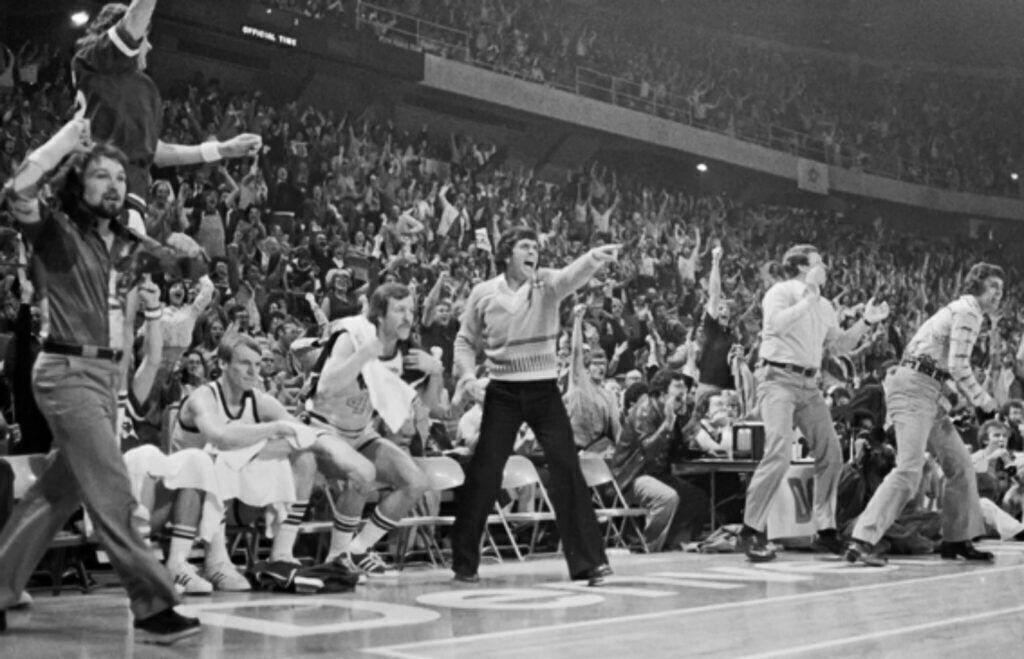 Former Denver Rockets player and Denver Nuggets coach Larry Brown in ‘Soul Power: The Legend of the American Basketball Association.’ At the far left is player Monte Towe. (Courtesy of Prime)
Pulling out the scrapbook
Reading my dad’s Nuggets coverage was like reading an ongoing adventure novel. He was reporting crazy ABA happenings just about every day. (But his craziest stories never saw the light of day.)
Karl and I swapped classic stories as I drank from a Denver Post replica glass imprinted with my dad’s report on the signing of David Thompson in July 1975. Pulling off that historic deal was so huge, it meant the team had to dump three players and be sold to owners with deeper pockets just so they could afford Thompson’s record salary of about $500,000.
Then there’s the one about the time Ralph scooped the world in reporting that the ABA had held its first draft — in complete secrecy. Seriously, no one knew that Denver had just drafted future NBA legend Walt Frazier (for naught) until my dad overheard it at a urinal.
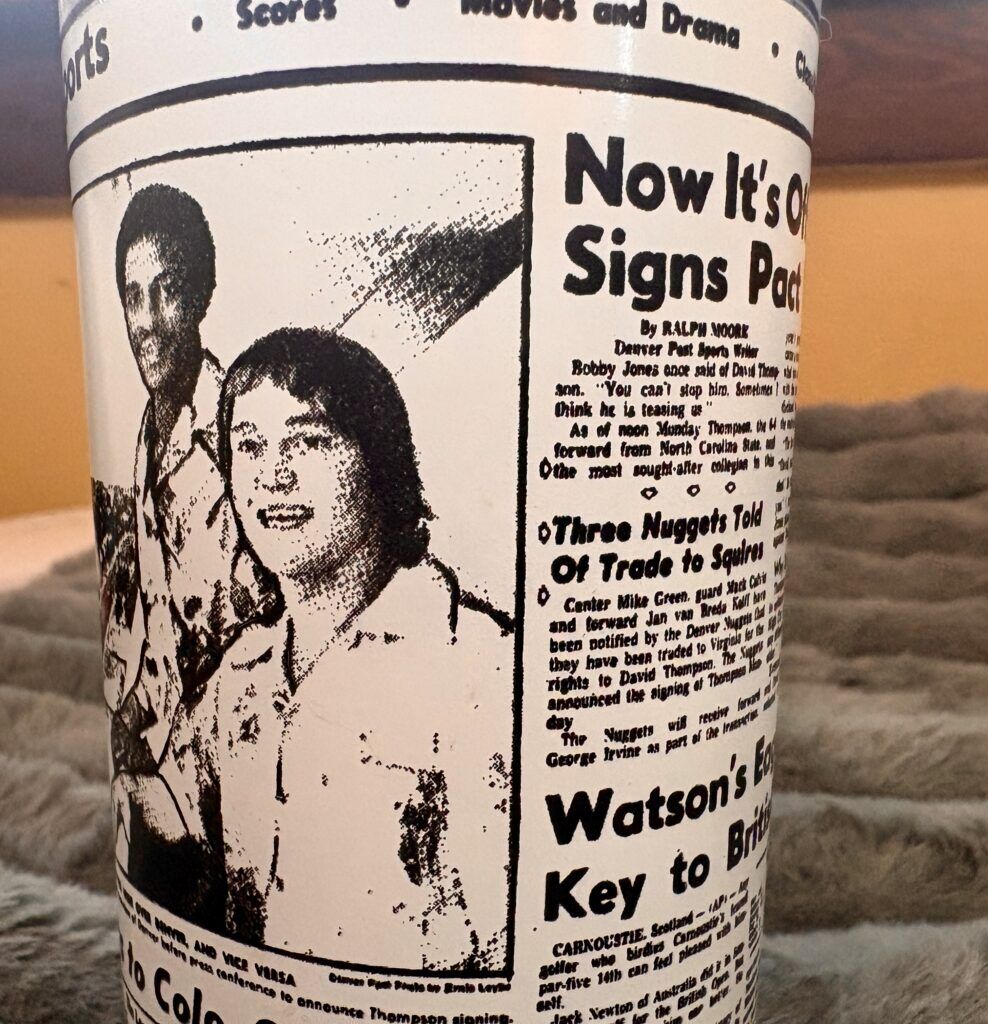 A replica glass of the Denver Post sportys section from July 1975 that announces the Denver Nuggets’ signing of David Thompspn and Monte Towe from North Carolina State. (John Moore, The Denver Gazette)
And of course the classic about how Rockets player Larry Jones avoided a process server in Pittsburgh by never getting off the team plane at the airport and skipping the team’s game with the Pipers altogether. (Jones was being sued by the Lakers for switching leagues. He never did get served.)
Or how about Spencer Haywood, who wanted to turn pro after his sophomore year of college at a time when the NBA prohibited underclassmen from entering the league until four years after his high school class graduated. With his mother raising 10 children while picking cotton at $2 per day in Mississippi, Haywood was granted a hardship extension from the ABA and soon joined Denver as its first legitimate superstar (and paving the way for all undergrads to come.)
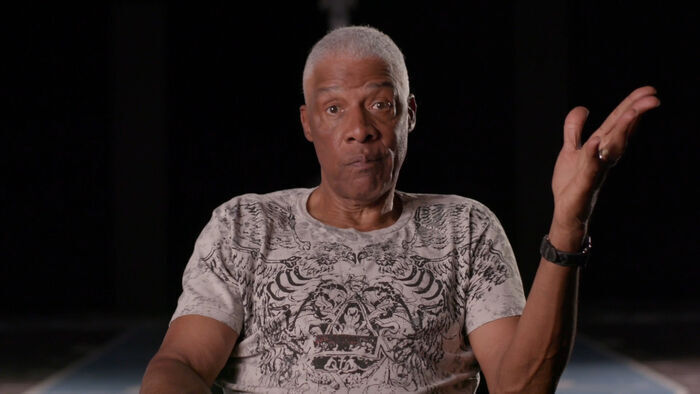 Julius Erving in ‘Soul Power: The Legend of the American Basketball Association.’ (Courtesy of Prime)
By poaching both established stars and emerging college talent alike, the ABA quickly grew into a legitimate threat to the NBA in terms of players, salaries and fan loyalties.
“The ABA opened up the window to the Black player and showed the world how good they were,” Karl said. The 1976 merger, he added, revolutionized the game both on and off the court.
“There was an unwritten rule back then that you couldn’t play more than three Blacks at any given time in an NBA game,” said Karl – “at least, that’s what we were told.”
Not so in the ABA.
It has been reported that the merger brought 63 of the 84 remaining ABA players into the NBA – most of whom were Black. We’re talking Thompson, George Gervin, Moses Malone and many more.
“But basically, they wanted one guy,” said Karl. “And that was Julius.” As in Dr. J. The man, it has been said, who walked so that Michael Jordan could fly.
On May 13, 1976, Erving and Thompson wrapped a bow on the ABA era with head-to-head performances for the ages. Thompson scored 42 points, Erving 31 (with 19 rebounds) as the New York Nets beat the Nuggets to win the final ABA championship. On to the NBA.
“But what the NBA found after the merger was that they got a lot more from the ABA than just Julius Erving,” Karl said. “They got 12 Hall of Famers.”
ABA stars tore up the NBA from the start. In the first season after the merger, the 10-player All-NBA team included four ABA veterans – and five finished among the top 10 in the MVP voting (Erving, Thompson, Moses Malone, Maurice Lucas and Artis Gilmore).
More important than anything, Karl said: The NBA was now fully integrated. “In one year,” he said, “the number of Black players in the NBA doubled.” And that changed everything in a country embroiled both in post-war civil-rights unrest and peaking Bicentennial patriotic fervor.
That proliferation of players also meant that players were finally allowed to show their creativity and personality both on and off the court.”
Denver was also leading the way in empowering women to play a more substantial role in NBA front offices.
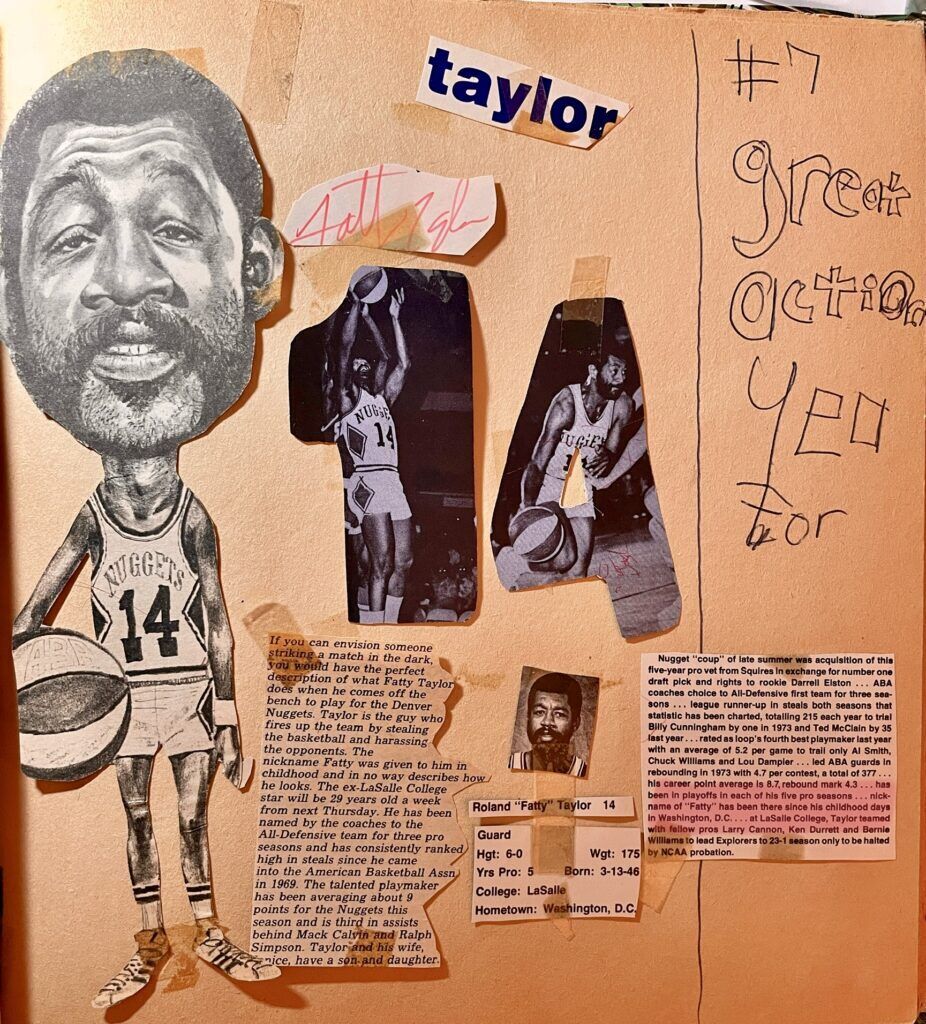 Denver Gazette Senior Arts Journalist John Moore kept a scrapbook deicated to every Denver Nuggets player in the mid-1970s, including guard Fatty Taylor. (John Moore, The Denver Gazette)
Paying the price
The merger itself was colossally unfair to the four surviving ABA teams. The Nets, Spurs, Nuggets and Pacers each had to pay a $3.2 million expansion fee to the NBA (a monstrous amount for the time). Additionally, the four teams had to pay for the folding of the two remaining ABA teams. They received zero television revenue for their first three seasons, and they were excluded from participating in the 1976 player draft.
The Nets were hit with an extra penalty for sharing the same city with the New York Knicks, a financial hardship that forced the cash-strapped team to sell Dr. J’s contract to Philadelphia, where their franchise player would lead the 76ers to the finals in his first NBA season.
“The players really enjoyed the challenge of being the underdog and showing the basketball world that we were really good,” Karl said. So how did the scrappy ABA survivors fare?
Well, the Nuggets went 52-30 and made it to the Western Conference semifinals in their first NBA season. While the Doctor-less ABA champ Nets were one of the worst teams in the NBA.
Before the merger, the NBA was turning into an offensive snooze. Dr. J, D.T., and Gervin brought an audacious brand of ball the older league had never seen before.
‘Once we started playing against the NBA, I think we all realized we were probably just as good or better than the NBA.’ – George Karl
The final day of the first NBA season came down, as it had the year before, to Erving and Thompson. Only this time, the stakes were settling the closest scoring race in NBA history. On the afternoon of April 9, Thompson went out and scored 73 points to seemingly clinch the crown. Until Gervin went out that night and scored 63. Shades of the ABA.
Scoring jumped in that first season – even though the NBA didn’t even steal/borrow/adopt the ABA’s signature 3-pointer until 1979. At first, the traditionalist NBA was slow to catch on. That first season, games averaged only about three made 3-pointers each. Now that’s up to about 35. Consider: There have been about 300,000 made 3-pointers in NBA games since 1979. Point, ABA.
Which brings me to my very favorite “Growing up Nuggets” story of all time.
It has to do with Larry Brown – both a superstitious coach and a stylish creature of habit.
My dad routinely took four of his eight kids to most every home game, and we’d meet him afterward by the team’s dressing room. After the Nuggets won their first home game as an NBA team, my brother, Kevin, approached Coach Brown for his autograph as he made his way into the locker room. Brown rubbed his head, signed his name and went along.
The Nuggets kept winning, and my brother kept asking for an autograph. Soon, Brown made this exchange with my brother a non-negotiable part of his post-game routine.
Seriously: Brown would stop at the locker-room door after each win and ask, “Where’s Ralph’s kid?” He wouldn’t go in without him. The Nuggets won their first eight games as an NBA team and opened that magical 1976-77 season with an astonishing 16-game home winning streak.
Which meant that my brother Kevin had to stand outside the Nuggets’ locker-room and ask for Coach Brown’s autograph after every home game until the Boston Celtics finally ended the Nuggets’ streak two months later, on the day after Christmas. Coach’s orders.
Now, I can’t swear to the truth of this next part, but when some in my family tell the story today, they say there were games during the winning streak when Kevin was back at home doing his homework (as he should!), so brother Danny or I would take his place. Brown never knew the difference but, in fairness, we did look like carbon-copied buzzcuts of slightly varying heights.
It was a glorious time to be a young Nuggets fan. I call them our “Stand By Me” years – minus the dead body. It was clearly a glorious time to be an ABA basketball player as well.
“The NBA has been tremendously influenced by the 3-point shot, and the evolution of the Black athlete – and it was now allowing the players to show their creativity, both on and off the court,” Karl said. “On the court, they could do it with their talent. And off the court, they could show more of their personality.”
Black players in the 1970s fundamentally changed the game of basketball forever – even Time Magazine has said so. Even before the merger, Time reported, the competition between the two leagues allowed Black players to demand higher salaries, which broke the monopoly of the NBA’s restrictive, low-pay structure. And that competition benefited White players as well.
Karl, who played five seasons with the Spurs, said his $40,000 rookie contract “was more than my father ever made in his life.”
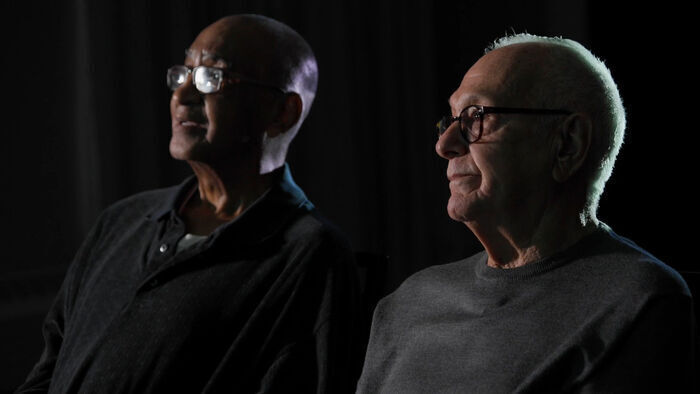 Former Denver Rockets player and Denver Nuggets coach Larry Brown, right, in ‘Soul Power: The Legend of the American Basketball Association.’ (Courtesy of Prime)
Karl, whose voice has turned raspy since a serious battle with throat and neck cancer starting in 2010, got inspired to produce a documentary history of the ABA from a 2020 podcast episode looking back at the glory days with Erving. He said it’s been a long road to get to this week’s national streaming launch, but worth every minute.
“We start from the beginning, telling the story of how a bunch of young entrepreneurs who were inspired by the old American Football League rallied up some money and took on the NBA,” Karl said.
“The most important thing is that the game of basketball was fun in the ABA. But today, there’s too much emphasis on the money of the game and not on the soul of the game. That’s what I think this movie will tell the world.
“This is an incredible story, and I’m proud that we made it.”
Long live the ABA.
‘Soul Power’
What: a four-part docuseries on the American Basketball Association
Date: Drops Feb. 12
Where: Prime video
Narrated by: Common
Directed by: Kenan Kamwana Holley
Appearances include: Julius Erving, Larry Brown, Moses Malone, Spencer Haywood, George Gervin, Rick Barry, Dan Issel, George Karl, Bob Costas, Charles Barkley and more