
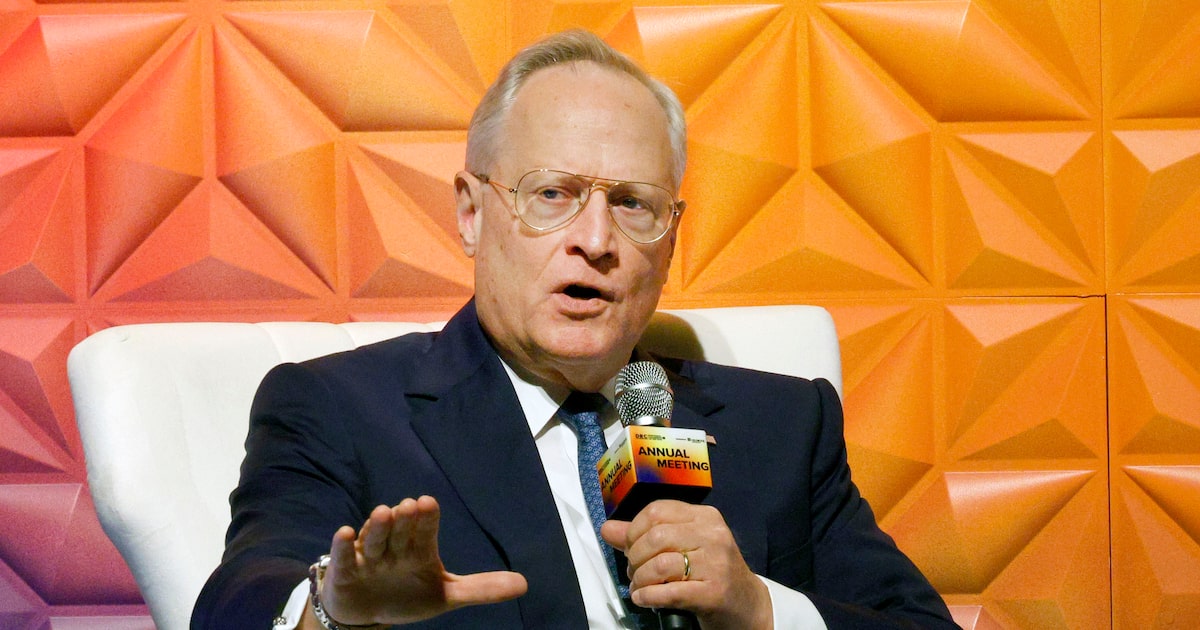
As multiple dramas unfold surrounding potential moves for the Dallas Mavericks and Dallas Stars — as well as the future of downtown as AT&T prepares to relocate — one of North Texas’ most prominent businessmen has some advice.
“Take your time,” Ross Perot Jr. said at a Dallas Regional Chamber event on Wednesday, directing his comments at the leadership of the Mavs and Stars.
“This is a very strategic decision. Let the emotion get out of the system between the teams,” the billionaire businessman and developer said.
“Let ‘em learn how to get along — that building can take care of them for another ten years — and really plan this decision right. Because the impact on Downtown is going to be huge.”
Business Briefing
Hillwood — Perot’s real estate firm whose projects include the massive industrial campus AllianceTexas and the 450,000-square-foot production studios used by ‘Landman’ creator Taylor Sheridan — also has a more direct connection to the unfolding arena saga, which could ultimately see both franchises vacate their current home in central Dallas.
In 1996, Perot Jr. bought the Mavericks, serving as majority team owner until he sold the team to Mark Cuban in 2000. It was also under Perot Jr.’s ownership that Hillwood developed American Airlines Arena, which opened in 2001, and served as an anchor project to spur more development in Dallas’ Victory Park neighborhood.
“We were competitors — hockey, basketball — historically we couldn’t get along,” Perot Jr. said, referring to Tom Hicks, the late former owner of the Stars.
“But Tom and I said, ‘Look, we have to get along. I mean it’s best for the city, and really it’s best for us to get along.’ And that’s why we came together to build that building.”
At the time, Perot Jr. added, he considered himself too young for “a 30-year-building,” so he insisted on an arena with a longer lifespan. “I want a 50-year-building, and maybe I’ll keel over then,” he said.
Perot Jr. made the comments on Wednesday as part of a keynote discussion, moderated by Bank of America Dallas President Jennifer Chandler, at the DRC’s annual forum.
‘Can I kill him outside The Barn?’
This year’s annual event, rescheduled because of the recent winter storm, was held inside the Music Hall at Fair Park, the century-old Spanish Baroque-style performing arts theater on the grounds of Fair Park. The lower levels of the 3,400-capacity theater were mostly full.
In addition to his comments on the arena, the charismatic developer also weighed in on new technologies, his famous father and Fort Worth’s ‘Landman effect,’ among other topics.
“AI is the next great revolution. Everybody community that embraces it will benefit from it,” Perot Jr. said.
He went on to mention Stargate, the massive-scale, Abilene-based data center project that politicians have touted as a force that will place Texas at the center of the AI boom. Separately, a major industrial deal his company closed last year with a Taiwanese firm is expected to build two new AI supercomputing facilities.
Perot Jr. also recalled how he was having lunch with Sheridan at The Barn, a venue on Hillwood’s sprawling Circle T Ranch campus in Southlake, when the director asked if he could film a scene for his new show “Lioness”.
“I said, “Yeah Taylor, you can film,’” Perot Jr said.
But a few weeks later, Perot Jr. went on, another contact told him about the planned scene, which would involve someone getting killed. It led a venue manager to object: “‘No no no, no one can get killed in The Barn.’”
“Ok,” Perot Jr. recalled Sheridan replying, “Can I kill him outside The Barn?”
The scene’s eventual filming, which included hundreds of workers and “300 drug dealers,” Perot Jr. went on, ultimately was a hit for the venue, Perot Jr. said. He also argued that local Hollywood productions brought an immense benefit to North Texas.
“So I’m at Davos World Economic Forum last week,” he said. “And I’m with the prime minister of Pakistan, all Pakistanis. And they asked me, ‘How did you get in ‘Landman’?” (The hit show has also referenced Perot Jr. directly.)
In addition to the keynote conversation between Perot, Jr. and Chandler, the DRC event featured welcome remarks from Darcy Anderson, vice chairman of Hillwood, and outgoing remarks from Jim Springfield, president of Blue Cross Blue Shield of Texas. Anderson is now serving as the chamber’s 2026 board chair, and Springfield served as 2025 board chair.
Both men praised the chamber’s recent work, citing the favorable North Texas business climate and the group’s efforts in attracting dozens of new companies to the region, and also spoke admiringly of Dale Petroskey, who recently retired as the chamber’s president.
“Dale’s leadership over 12 years at the helm of the DRC was incredible, and it was culminated by the Dallas Regional Chamber of Commerce being named the National Chamber of the Year,” said Anderson. “Clearly a recognition that all of us in the room are proud of.”
In his own remarks, Brad Cheves, the group’s new president, repeatedly emphasized the event’s theme of “Bold Bets, Big Futures.”
“And that is an apt way to describe this region, and it’s also an important reminder,” he said.
“Because bold bets don’t just happen in moments of crisis or reinvention. They’re made deliberately over time by leaders who are willing to make decisions to invest early, to think long-term and to stay engaged.”
For its part the DRC was working on developing its own three-year strategic plan in conjunction with a consulting group, Cheves added, to help shape the business group’s work.
“At the heart of that work is prosperity and economic development,” Cheves said. “We are focusing on strengthening the region’s competitive position, attracting companies, supporting innovation and telling the Dallas region’s story through research, data and partnerships that reinforce why this is a place where business can grow.”
He also mentioned the chamber’s focus on quality of life issues, shaping public policy and promoting economic growth in southern Dallas County, a part of the Metroplex that for years has suffered from higher poverty rates and failed to attract the same levels of new investment as more prosperous northern areas.