
Everything’s fine until it isn’t. The rationalizations are reasonable, the cliches calming, the flaws and foibles susceptible to sandpaper. Until they aren’t.
The NBA season is a daunting journey under the mildest of circumstances. You play a game roughly every other day for 24 weeks and for an unhealthy chunk of those “off” days you are traveling. If you are really good at it, more weight is added: The All-Star break isn’t a respite and the heightened intensity of playoff hoops piles on another week, another month, maybe even two, to the grind.
There’s a rugged pleasure to negotiating that bumpy road, even if you blow a tire, lose the air conditioning or run out of gas — until the axle breaks.
The 2025-26 Minnesota Timberwolves have tumbled their way through a chronically unsatisfying season, besmirching the fact they have won 60% of their games. After back-to-back years in the Western Conference Finals, the bar for achievement is at its highest point in franchise history. The organization — and especially the players — welcomed this and promoted their thirst for the challenge throughout the preseason.
They spoke of being taught a lesson about developing and sustaining good habits throughout the season in order to build momentum for the playoffs, meted out by the Oklahoma City Thunder, who thrashed them four games to one in last year’s conference finals. At a preseason dinner the night before the first practice, sage veteran Mike Conley clarified the stakes.
“What’s our goal?” Conley said he asked his teammates that night. “Are we coming here to put on a show, perform, or are we trying to win a championship? And the consensus was we are trying to win a championship.”
Then Conley got specific, repeating what he told the Wolves superstar leader, Anthony Edwards: “Ant, if you want to win a championship, we expect you to guard like you’re a top-five perimeter defender in this league, which we believe you are.”
Ant confirmed the conversation and endorsed the sentiment. “We’re trying to get back to the number one defense in the league, and I know it starts with me,” he said, adding that, “I told my teammates to hold me accountable, coaches included.”
Head coach Chris Finch put the cherry on top. “We’ve talked about consistency and the consistency of habit as one of the areas of improvement no matter what it pertains to. Ant has got to measure up here.”
It hasn’t happened. Fifty-five games into the season, the Wolves remain a woefully immature team unwilling to sustain the focus and energy required to ingrain good habits and foster genuine momentum. And the strain of not walking their proud, declarative, preseason talk is beginning to show as another highly competitive Western Conference playoff race pauses for the All-Star break this week before closing out the final 26 games of the regular season.
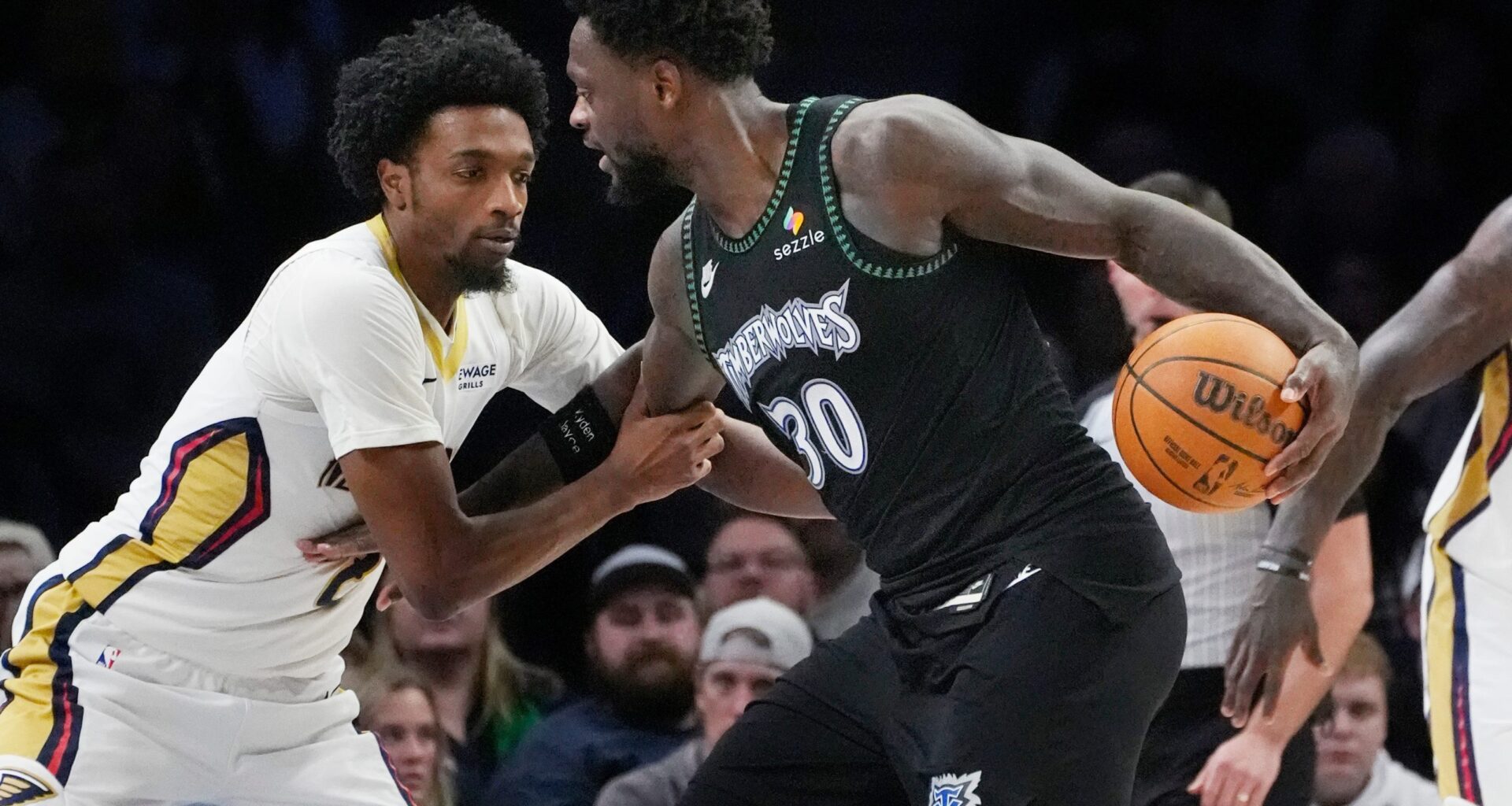
Early in the third quarter on Friday night against a New Orleans Pelicans team that had lost 40 of its first 53 games, a Rudy Gobert dunk off a feed from Julius Randle put the Wolves ahead by the score of 77-59. Then something that has become too familiar took place.
“We got up by 18 and we just relaxed,” said Finch after the game. “You could feel it, you could see it. There were a couple of offensive rebounds they beat us to. That kind of started it, we had a few turnovers and then the quarter ends with a bunch of (Trey) Murphy threes, which we should have been up pressuring him off the (three-point) line. The game tightened up and we couldn’t cover the ball.”
Moments later in the locker room, Gobert had had enough.
“Just no effort. We’ve seen that many, many times this year, last few years, since I’ve been here. We always know it’s coming. When it comes there is no sense of urgency, no accountability. So I think at some point, if the players don’t have any accountability, somebody has to be accountable for the players,” he said.
Pressed by a reporter about initiating accountability, Gobert continued. “It should start with ourselves but it seems like we don’t have that, so at some point I think from the coaches, yeah. It is not an easy position for a coach to take guys out of the game. It’s not something that you want to do, but I think if the players don’t show any effort, at some point, no matter how talented we are as a team, if you don’t have that you just can’t be a winning team.
“It starts with me,” he emphasized. “If I’m not showing effort, bench me. Take me out of the game. Everybody else will follow. Our best players, leaders, if you don’t show any effort, it doesn’t matter if you score 50, we’re not going to win. At some point, if we’re not mature enough to have that accountability ourselves, that might be a solution.”
The next day at practice, Finch was not pleased.
“Anybody who knows how we do things knows there is a high degree of accountability,” he said. “Secondly, I handle all my conversations with ourselves in-house. It’s disappointing he felt the need to go outside. Nonetheless that’s been addressed already today. There’s never been a team who’s won anything meaningful that has substituted their way there.”
This chain of events broke the surface on a source of tension that has been a long time coming. It indicates that the Wolves have reached a particularly significant inflection point in their ambitious chase for an NBA championship, one that began in earnest when they burst from the gate with the NBA’s best defense to start the 2023-24 season.
It is just as easy to overreact to this situation as it is to diminish and deny the legitimacy of why it occurred. Therefore the best way for me to deal with it is to offer my frank opinions without coming to any conclusions.
Gobert’s postgame sentiments were borne of understandable frustration and ratified what any longtime viewer of Wolves basketball has seen, particularly this season. Before Gobert spoke, the status quo was a preseason of this team thumping its chest over its commitment to the focus and accountability necessary to compete for a championship, followed by steady, intermittent bouts of them blatantly reneging on that pledge out on the court.
Finch himself has conceded that his team “gets bored” by the caliber of opponent. On the very night Gobert rebuked the team, Finch himself said they “relaxed” with a big lead against a hapless foe, then went into detail about the ways it occurred.
By referring to “the leaders,” who “score 50,” Gobert was plainly addressing the team’s top two scorers, Ant and Randle. It is an undeniable fact that both of those players play half-hearted defense on an occasional but regular basis, more so than most of their teammates, who are also at fault. Attempts to handle it “in-house” have not meaningfully improved the consistency of their effort. And using minutes as a cudgel to make your dissatisfaction palpable is a tool often used by coaches — in moderation of course, and not as the “substituting your way to meaningful wins” strawman that Finch presented.
Finch was likely peeved that Gobert invoked the coaches imposing accountability as a backup solution when the players themselves couldn’t solve the issue. I understand the pushback in that regard — with the important caveat that if players and coaches stipulate in public that certain things have to be done to achieve the desired goals, it’s on those players and coaches if the behavior belies the talk.
Related: Timberwolves return home in search of mojo after three-game skid
There is some important context here that must also be taken into consideration. One of the most prominent idiosyncrasies of Finch as a coach is giving his core players the leeway to define the team as much as possible. In one of the first interviews he gave after being hired, he said he prefers to develop plays and schemes around the interactive virtues the players demonstrate out on the court. His often-criticized reluctance to call time outs similarly stems from his faith in the players to figure it out.
When it comes to teaching and discipline, the players themselves frequently have noted when Finch has lit into them, usually after a lackluster first half or in the huddle after a few minutes of uninspired performance. And the number of players who praise Finch’s clear and direct communication style vastly outnumber the one or two exceptions who seem flummoxed or complain about what he’s asking of them.
That said, it does feel like Finch errs on the side of being a “permissive parent” as coach, at least when it comes to his core rotation players. He is a coach who prefers to coax instead of push. The emphasis by president of basketball operations Tim Connelly to stock the roster with quality individuals enables the coach to instill an atmosphere of mutual respect.
But there is a festering issue that somehow needs to be addressed and resolved. Both Ant and Randle have demonstrated impressive defensive capabilities. The game before the fiasco in New Orleans, Ant added the finishing rocket boost to a spirited second-half comeback on the road against the Toronto Raptors. The final seven minutes of the game may well have been the best two-way performance from a Timberwolf since the heyday of Kevin Garnett. Ant was everywhere, filling the passing lane for three steals, blocking a layup, grabbing five defensive rebounds and pouring in 13 points on aggressive drives to the paint.
It was another reminder that the ceiling for Ant is the Sistine Chapel or Stairway to Heaven. And that the ongoing loyalty he and Finch have for each other is a precious commodity in terms of the upside stability of this franchise.
But 48 hours later, Ant was one of the culprits in Finch’s recitation of defensive lapses. He didn’t box out on one of those offensive rebounds the Pels “beat him” to; he didn’t close out on at least one of those three-pointers when Trey Murphy should have been “run off the line.” When the lead hit 18, he “relaxed.”
For Randle it is the same dynamic with a more mortal ceiling. When he wants to be, Randle is second only to Gobert in denying opposing big men freedom to operate, with the clamps he put on Victor Wembanyama of San Antonio the most prominent recent example. But those highlights are outnumbered by occasions when executes defensive rotations as if in a fog, be it closeouts or entry feeds.
The on/off statistics verify the eye test. In the 1848 minutes Randle has been on the court this season, the Wolves have allowed 114.7 points per 100 possessions — the same amount the team has allowed in the 1,599 minutes Ant has played thus far. When Randle has been off the court, for 805 minutes, the Wolves have allowed just 103.3 points per 100 possessions. (In fairness, they miss Randle’s offense to the tune of only scoring 105.7 points per 100 possessions.) In the 1056 minutes Ant hasn’t played, the defense cedes 107.6 points per 100 possessions, while scoring 113.6 points per 100 possessions.
In the postseason, of course, everybody’s energy level intensifies, especially at the defensive end. But these games where less than optimal effort, especially on defense, result in losses hurt playoff positioning and thrust the Wolves into a position they said they would avoid — facing opponents with more momentum and unity due to more consistent, ingrained habits of teamwork.
The charismatic superstardom of Ant is mostly beyond reproach. But among the fan base, Randle and Finch remain arguably the two most polarizing figures in the organization. For most of last season, I argued for supplanting Randle and installing Naz Reid in the starting lineup. But Finch stuck to his fierce loyalty to Randle and was rewarded as Randle became a versatile playmaker and key cog in a 17-4 run to close the regular season, followed by stellar performances in the first two playoff series.
This season, the emergence of Jaden McDaniels as a three-level scorer and the ongoing improvement of Naz again makes it tempting to fantasize about speeding up the “second timeline” of Jaden and Naz more firmly around Ant. But Finch unequivocably has put his chips on Randle and both of them have earned the right to make that the status quo.
But it isn’t hard to state that consistency of effort is the biggest x factor in how the Wolves will finish this regular season and perform in the playoffs. It would be unfair to lay all the blame on Ant and Randle, who labor to generate a huge chunk of the offense. And it would be unfair to blame Finch, who presumably knows the best way to motivate his team — and perhaps knows how to dodge the kind of internal disruption that could sabotage everything.
On Monday night, the Wolves shelved all the bad juju arising out of anemic losses to the Pels and Clippers and thrashed the Atlanta Hawks. Before the game, Finch said the team had lacked “connectivity,” and chalked it up to one of the myriad valleys that any team endures in the NBA grind. Rather than push, he coaxed, instructing his offensive coordinator Pablo Prigoni to compile film examples of when and how the team was connected. After facing Portland at home Wednesday night, they will have a week off for the All-Star break and reset for the stretch run.
As with the two previous seasons, the Wolves are in the thick of a crowded field of quality teams, with final seedings still very much up for grabs. If and when they have an off night, the rationalizations will seem reasonable, the cliches calming, the foibles and flaws capable of being sandpapered into less harmful traits.
But after the first 56 games of the season, the margin of error is slimmer, the track record more pockmarked. Mike Conley is gone from the rotation but his preseason dinner questions linger: What’s the goal? To put on a show or to win a championship?
Related