
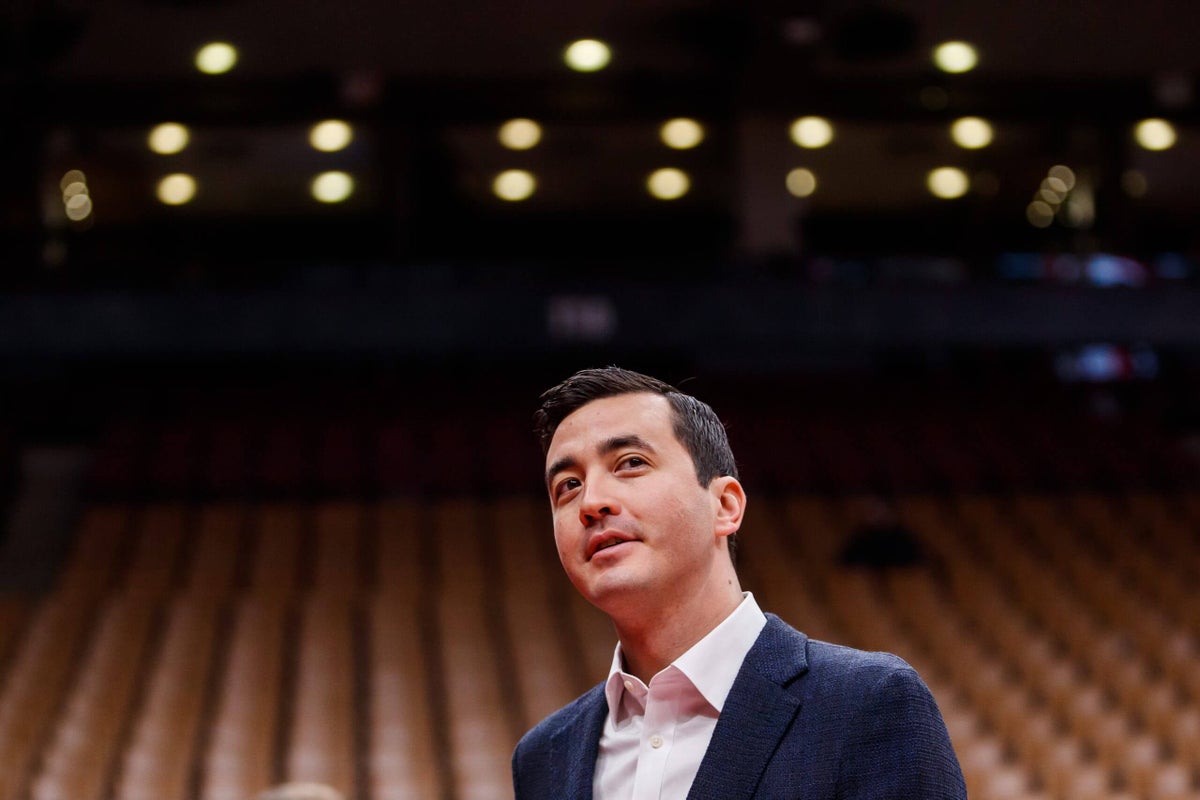
TORONTO — Bobby Webster’s voice does not quaver with emotion. He is not the type to be in the middle of a, let’s say, pre-playoff pep rally, cursing out an opponent to excite his fans.
This is Webster’s first year as the top basketball decision-maker of the Toronto Raptors, after several years as Masai Ujiri’s right-hand man, helping the franchise secure a championship in 2019. Things are going pretty well. On Tuesday, the Raptors found out that they’ll have a second player representative in the All-Star Game, Brandon Ingram. He joins Scottie Barnes. Darko Rajaković will coach the international team. Rookies Collin Murray-Boyles and Alijah Martin will be in the Rising Stars event.
Most importantly, the Raptors are 32-22 with just one game left before the break. They are fighting for playoff seeding after two years of chasing lottery balls. Webster must be having fun.
“I try to find my moments,” said Webster, who retained his title of general manager despite effectively rising a level in the organizational chart when Ujiri was fired last June, adding that the Raptors haven’t accomplished much yet. “What do they say? It’s better than the alternative, right?”
This is Webster, the even-keeled opposite of his former boss, who routinely delivered stump speeches and de facto Ted talks. Whereas Ujiri ended his sentences with exclamation marks, Webster leans on the question mark — 15 in this 12-minute interview, alone. He tries to underpromise and overdeliver.
He will forever be compared to Ujiri because Ujiri offered a massive shadow and a bigger legacy. Webster can only be himself, though, and doesn’t accept the notion that he has to go broader now that he’s in charge.
On the eve of the All-Star break, Webster sat down with The Athletic to discuss the positive season, quiet trade deadline and how his team will try to go from good to great down the road.
Some questions and responses have been edited for length and clarity.
In general, what have you made of the team’s performance so far this year?
Webster: I go back and forth between, ‘We haven’t accomplished anything’ and, ‘It’s OK to enjoy some of the moments along the way.’ Scottie and Brandon being All-Stars is great, having Darko coach the World Team, Collin and Elijah (playing in the Rising Stars event), that feels like a moment to recognize it, enjoy it and then get back to work. Those are the two mindsets I’ve vacillated between.
Whether it’s been you or Masai in the past, there has often been talk about how much this organization prizes flexibility. You have a few longer contracts on the books. Do you feel as nimble as you have before?
Webster: Until we feel like the team is at a high enough, sustainable level, I think we’ve always done that. Even when I said this summer, for all the talk about paying the (luxury) tax, we weren’t going to be a taxpayer. We wasted a bunch of words. That’s my perspective. We’re nimble. We kept all of our draft picks intentionally.
Can we perfectly time this, where every year we have a $25 million expiring (contract)? No. That was maybe the one we didn’t have this year. We obviously had the Ochai (Agbaji) contract and some other ones. I don’t see any major financial decisions that will hamstring us for the next couple years. But also, we need to get better. That’s the flip side of it. There’s always going to be change. But I think change, without boxing yourself in, has been (representative) of all the 12 years we’ve been here, and this is the 13th for me. I don’t think we’ve got into one of those situations. That’s probably just a roster-building philosophy.
To paraphrase what you said after the deadline, you’re still in the talent-acquisition phase. You can’t afford to be too choosy right now. At the same time, I would assume the type of player who becomes available would affect how aggressively you try to make a move. What skill does this roster need the most?
Webster: It’s what you said. We’re not there yet. We got Ingram last year. It wasn’t exactly perfect on paper. We got Trayce (Jackson-Davis) this year. He wasn’t exactly what (we need) on paper. The way we continued in the past is probably the way we’re going to continue to build: get players who are good, and if they exceed expectations, they kind of necessitate the next move. Sometimes contract decisions necessitate it. We don’t have any of those this summer. At the appropriate time, we will make (that choice). I just don’t see us there yet.
You mentioned Ingram as an imperfect fit on paper. Forget the paper: How do you think he’s fit?
Webster: If anything, BI’s game is very similar to what it has been the past couple years. I think the health and the medical are the huge (difference). We feel like that’s a huge competitive advantage we have here with the Raptors, having our medical staff. To bring him in, to have a long runway to get him up to speed, we thought that was sort of the bet. Do we sort of buy low?’ Whatever you want to say, the price was on him. We had some difficult scoring in the half court, in those sets. And that is one of Brandon’s strong points.
At some point before the season, I asked you about not getting a title change, but being at the top of the decision-making food chain. You said that the biggest difference was you’d get to have conversations with different levels of ownership. What have those been like? What have you learned that you didn’t know before?
Webster: It reminds me a bit of when I was at the league office and I worked with David (Stern) and Adam (Silver) at that point. One of the main jobs is to get to know all the 30 owners and know the personalities and backgrounds of those owners. What do they care about? What are they looking for? How much focus, how much time can they even put into these things? When I’m interacting with our ownership group, that’s how I am: What do they need to know about the team? How are we being proactive? How are we educating them about how we run the team? We had a lot of good professional development in that area in thinking about how to communicate with them.
As Raptors management changed, the dynamic above you changed (with Rogers purchasing Bell’s share of Maple Leaf Sports and Entertainment and becoming the majority stakeholder). What have you learned about (Rogers Communications CEO) Edward Rogers and what he cares about, specifically with the Raptors?
Webster: He’s incredibly passionate about sports. If not evident by what we did in ‘19, I think it was a reminder with the Blue Jays run this year, how captivating teams in Canada can be and (how they) bring people all across the country, and (people of) different backgrounds, together. I think that’s been apparent, his passion for sports and ability to have these galvanizing moments.
Looking at what happened at and around the deadline throughout the league, with the exception of the James Harden trade, the biggest trades were swung by teams likely heading to the lottery. It goes back to what you guys did with Ingram last year. The teams that are championship contenders didn’t really do much. Do you think that’s a product of the new CBA, lottery odds, a fluke? What do you attribute it to?
Webster: Trends are hard. Everybody’s trying to be strategic. It is probably harder for the high-end teams, or in this case, the high-salary teams, to keep adding. That’s probably what we’re seeing. It’s just hard for them to keep adding salary. Maybe that’s the natural order of the new CBA, which is the dispersal of talent, parity, which I think in many ways is great for the overall health of basketball and the league. I’d have to think about it more to say more. It’s probably not a bad thing.
As you guys get more competitive and play meaningful games, maybe playoff games, how does what you evaluate Darko Rajaković on change?
Webster: We’re all in, obviously, a results business. There are wins and losses. Anybody who has been around the team (knows) it’s an incredible environment, an incredible energy. He’s as communicative with this generation of players as any coach you’ll see.
The natural one for us (to think about) was the original run in ‘13, ‘14, ‘15. You don’t know what you don’t know. We have some playoff experience on the team, but we don’t have a ton of playoff experience. I think it will be fun to evaluate. These are the toughest moments. This is when each possession is magnified. Trying to tell them that is different from them having to live it and go through it all and process it all. That’s what I’m looking forward to — that process for them, as the games get more important, more magnified.
Speaking of Darko, I think he named Scottie Barnes a future NBA Finals MVP the other day. He’s enthusiastic. What have you made of Scottie’s season? Also, when you think about Scottie’s growth, where do you see that room to grow?
Webster: It’s always different when you draft a player. That’s what we have the benefit of with Scottie. We’ve studied him coming out of college. We drafted him coming out of the Tampa year. He comes here. We have success early. Now you think back to Scottie as a rookie to Scottie now, and the seriousness level on a consistent basis is what stands out. That energy and dynamic play every night really stands out to me and really impacts the winning on the court. He’s gonna continue to get better. He’s only 24. I don’t think your prime in the NBA is until 27, 28. Physically, he’ll get stronger. The game will continue to slow down for him. It’s our job to surround him with the right players, to complement him.
After the deadline, you said you would put your chips in for a bigger deal at some point. What do you have to see from the team to do that? And how much does what’s happening around you in the conference, even the league, impact the timing of that?
Webster: It all matters. What is the main driver? Seven different champions in the last seven years suggests there isn’t a huge dynasty in the current NBA. You want to be mindful of that. You have to stick to your guns on some of it as far as not overpaying, not chasing it. That’s sort of what I alluded to: We’ve kept our draft picks for a number of years on purpose. When you do go for it, is it a three- or four-pick trade, or do we peel them off one at a time? That’s what we did last time (with the acquisitions of Serge Ibaka and Kawhi Leonard).
There’s no right way to do it. Do you do it early? Do you do it in the middle? Do you chase late? We’ve looked at all the different builds that resulted in a championship team, and there’s no preferred route other than you have got to get it right. So when you do push them in, when you do consolidate, who is that player? Where is that player in his career? Does that skill set fit with the main guys? If anything, the trades in the past few years show that everything is fungible and you have to keep that flexibility.
How much have you heard from Masai this year?
Webster: A few times. I’ve been to dinner with him a couple times, I think. Normal from that standpoint.
Is he trying to stay out of your business or is he offering advice?
Webster: No, he’s out there cheering for us, as you would expect him to.