
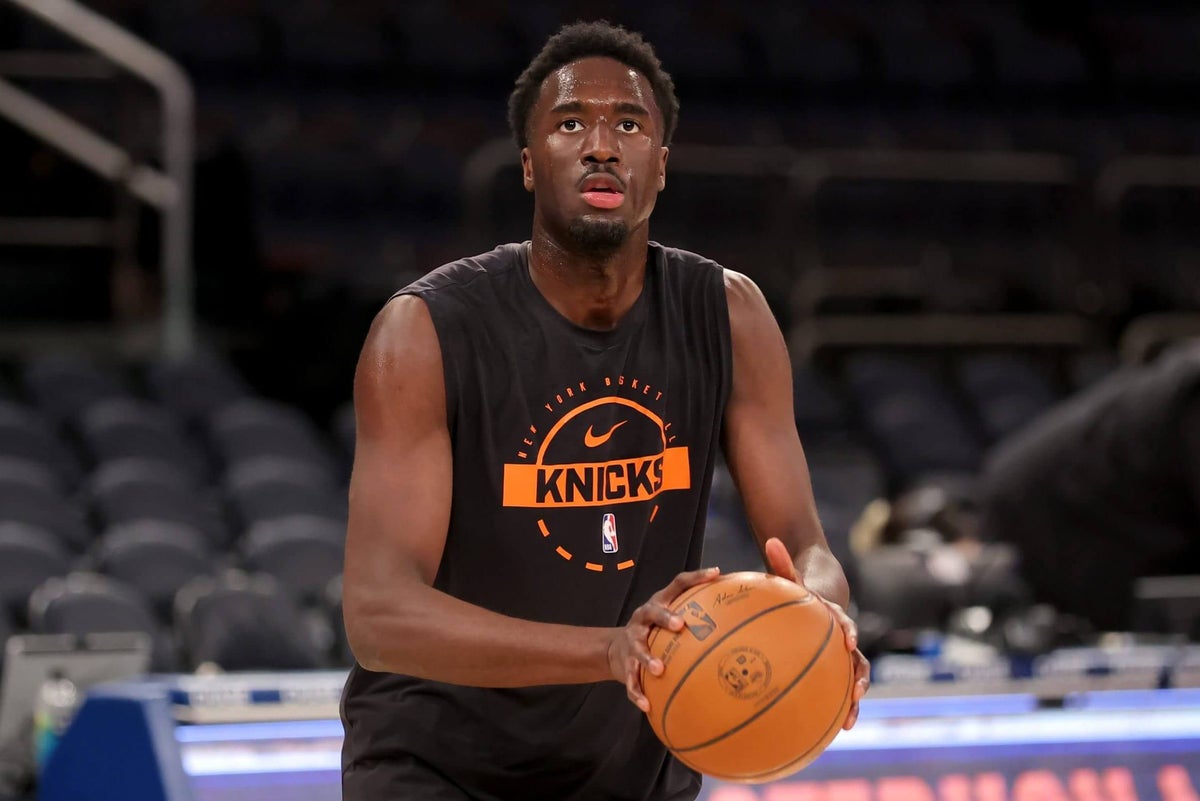
PHILADELPHIA — Mohamed Diawara’s love for the sport that now pays his bills started on a side hoop parallel to a girl’s basketball practice. When the French-born Diawara was around 8 or 9 years old, he’d tag along with his sister, Fatou, who played for her grade school as a hobby.
Diawara didn’t grow up in a hoops household. It wasn’t around him from the beginning. He was simply a little brother following an older sibling. Watching his sister and her teammates closely, along with the feeling of the leather ball on his fingertips and the sound of it going through the net, a seed of passion was planted.
“We never played one-on-one,” the Knicks rookie told The Athletic about his basketball relationship with Fatou. “When I started really playing basketball, she stopped. We were never on the court together.”
Diawara said he set his sights on becoming an NBA player around the age of 12, which coincided with a growth spurt. He traded in his soccer — sorry, football — cleats for sneakers.
“I was like, ‘That’s the perfect match,’” said Diawara, whose favorite player growing up was Kevin Durant.
Eight years later, despite being the 51st pick in last year’s NBA Draft, Diawara is turning into a useful player for a title-contending team. A little more than halfway through the season, the 20-year-old appears to be firmly in coach Mike Brown’s rotation. The raw, lengthy prospect that, at times, looked like a fish out of water at summer league in Las Vegas, looks more and more like a seasoned pro with each passing game, including Wednesday night’s 138-89 blowout win at the Philadelphia 76ers, in which he scored 14 points in 20 minutes off the bench.
At 6-foot-9, Diawara is making somewhat complex reads as a passer. He’s made 12 of his 13 corner 3s on the season and 40 percent of his 3s overall. On the defensive end, he’s made life uncomfortable for legitimately good NBA players.
Over the Knicks’ last five games, Diawara is averaging 20 minutes and 7.2 points. That might not sound like a lot to the average fan, but no one in New York’s organization thought this kid would play anything other than garbage time as a rookie — and possibly next year, too. Then, when Diawara got to training camp, the vision began to become clearer, and more people were impressed.
“In camp, I thought he was going to be real good,” Josh Hart said. “He’s young, raw and inexperienced. He’s good defensively, and he’s an even better shooter than I thought. It always looked good, but now it’s going in. I think he’s a good decision-maker in the pocket. He’s athletic and can finish at the rim, get guys involved. I love where he’s at, and he’s continued to work.”
Brown said something similar.
In camp, the coach would catch himself looking to see if anyone else saw what he did in Diawara. At that point, Brown wasn’t ruling out the possibility of Diawara logging legitimate minutes as a rookie, but he wasn’t sure if the positive qualities that he noticed would translate to the regular season.
Brown gave Diawara opportunities here and there at the start of the season, looking to see if he could do the little things before adding more each day. Diawara passed the tests through the first few months of the year, and as injuries hit the Knicks at various points, Brown decided to give him a little more rope.
“In the summertime, you started to see his feel,” Brown said. “His feel for the game is uncanny for a guy who is 6-foot-8 or however big he is and how young he is. Everything you try to teach him, he tries to absorb it and works very hard. He’s long and a pretty good defender … getting better.
“Just a lot of little things that you watch and go, ‘Oh, wow.’ All of those things, when they add up to a possible opportunity, it gives you more confidence as a coaching staff to throw him out there.”
Diawara found himself in a good landing spot with the Knicks, who already had one French player on the roster in Pacome Dadiet and would soon add another in the now-traded Guerschon Yabusele. They helped Diawara get acclimated to life in New York and formed their own clique.
Hart said that Diawara came into the organization a bit shy and still is, despite carving out a role and sharing a court with some of the game’s biggest names on a nightly basis.
“Now that (Yabusele) is gone, he doesn’t really … all he did was speak French to him,” Hart said. “Now that (Yabusele) is gone, hopefully that forces him to come out of (his) shell a little bit more. He’s part of the guys. We’ve got to get him more acclimated to rookie duties.”
Diawara didn’t know if he’d get drafted last June. He said he worked out for 13 different teams and, while the feedback was good, no team made any promises.
The Knicks’ roster building is limited because of financial commitments to their top-five players. So, even hitting on and developing a second-round pick, while it’s no longer life or death for the organization, can be important for long-term team-building plans.
No one, though, thought a player of Diawara’s status would pay dividends in the short-term plans, too. As things look right now, it might be hard to keep Diawara off the floor come the playoffs.