
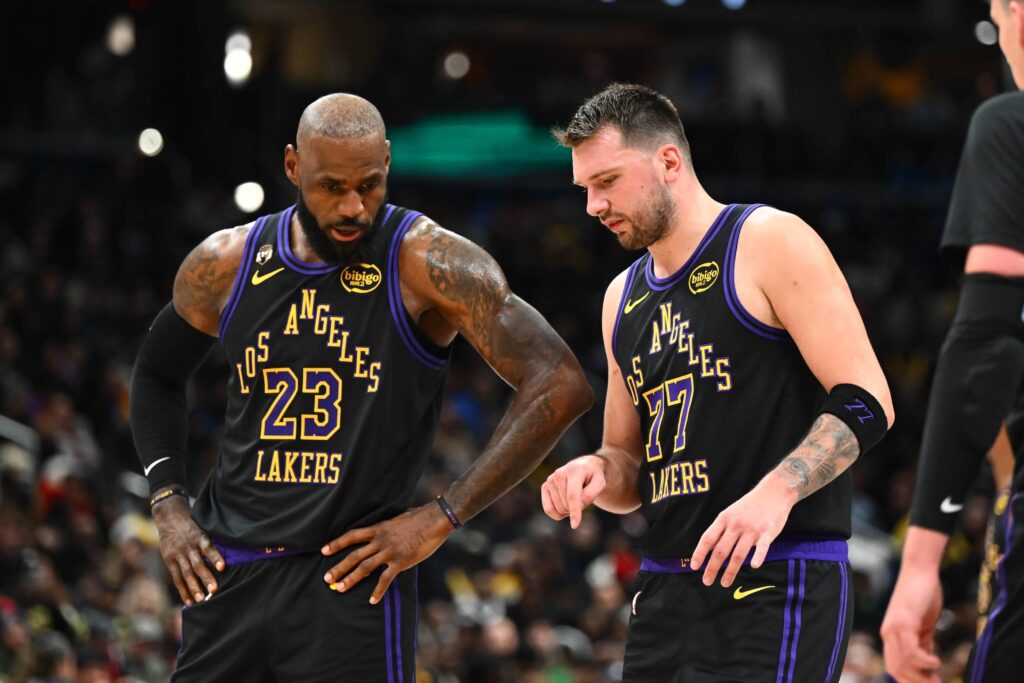
The Lakers hit the All-Star break with a 32-21 record, sitting in the thick of the West playoff race at the 6th spot, after a season that has already had multiple identity shifts.
The Luka Doncic trade was supposed to raise the ceiling overnight, and in a lot of ways it has. Doncic is at 32.8 points, 7.8 rebounds, and 8.6 assists per game, and the Lakers are getting elite shot-making every night. Austin Reaves has taken a leap into real co-star production at 25.7 points, 5.1 rebounds, and 6.0 assists. LeBron James is still bending defenses with playmaking at 21.8 points and 6.9 assists.
The problem is that the “contender” standards are different. The Lakers started the year looking more stable as a top-3 team, then the cracks showed up again: defensive execution, physicality on the glass, and a tempo that too often turns games into half-court coin flips.
With the break here, the Lakers have a clean moment to fix the specific things that keep showing up in the numbers. If they do not, the offense will keep them competitive, but not dangerous.
1. Perimeter Defense
Start with the simplest signal: teams are getting comfortable from three against the Lakers. That’s the main reason why they were trying to acquire a wing defender.
Opponents are shooting 36.6% from three against the Lakers, which sits 23rd in the league. That is not “slightly below average.” That is the kind of number that turns every good offense into a problem, because it removes the margin for error on the nights your own shooting is normal instead of hot.
It is not only about accuracy. The Lakers are also giving up a heavy three-point diet. Opponents are taking 37.1 threes per game against them (17th), and the bigger issue is the rate: 42.1% of opponent shots are coming from three, which is 20th. That rate matters because it tells you the problem is structural. Even when a team does not shoot well, the Lakers are still allowing the right kind of looks.
This is usually what happens when a defense cannot consistently contain the ball. If your first defender loses the dribble, the help comes early. Early help forces rotations. Rotations force closeouts. And rushed closeouts are where the modern league lives: kickout threes, swing-swing threes, and corner threes that feel like practice shots.
This has been the main theme earlier in the season, in blunt terms, with blow-by pressure as a perimeter concern that could carry over. And even in games where the Lakers look “active,” you can still see the same pattern in the math: the Lakers allow 13.6 made threes per game (19th).
The frustrating part is that the Lakers have the personnel to be better than this for long stretches. Marcus Smart is still their best point-of-attack tone-setter, and the defense has looked very different in his minutes. Smart’s own box score impact is real, too: 1.3 steals per game in a role that is almost entirely about disrupting timing.
So why is it still a problem?
Because the Lakers need more than one stopper. When Doncic and Reaves are on the floor together, teams will hunt them. That is not a character flaw. That is playoff basketball. Reaves is scoring like a star (and his efficiency is excellent), but opponents are not going to play him like a star. They are going to drag him into actions until he has to defend multiple efforts in one possession. Doncic is carrying a massive offensive load and playing 35.5 minutes per night (mainly what caused his hamstring injury); it is hard to also ask him to fight through every screen like an elite defender.
The fix is not “try harder.” It is a menu of specific choices: Fewer automatic help stunts off strong-side shooters, more switching with Smart on the floor to keep the ball in front and simplify the rotation tree, and cleaner rules on who helps at the nail and who stays home in the corners.
If the Lakers can move from “constant rotation” to “selective rotation,” the opponent’s three-point rate is the number that should fall first.
2. Inside Defense
This is where the profile gets ugly, because it is not just one leak. It is the whole two-point ecosystem.
Opponents are shooting 57.4% on twos against the Lakers, which is 27th in the league. Opponents also have a 56.3% effective field goal rate against the Lakers, also 27th. Those two numbers together usually mean one thing: the shots the Lakers are conceding are efficient shots.
The headline defensive number matches that story. The Lakers are allowing 1.141 points per possession, 23rd in defensive efficiency. It is hard to frame a real title case without at least a respectable defense. You do not need to be first, but you cannot be living in the 20s and expect four straight playoff series wins.
Now, here is the twist that makes the Lakers’ problem more specific than “no rim protection.” The Lakers are one of the better teams in opponent field goal percentage at the rim, with opponents shooting 48.6% there (fifth-best).
So what is going on?
It looks like the Lakers are not getting crushed at the rim on pure finishing. They are getting hurt in the larger paint area and in the quality of contests. They rank 26th in opponent non-blocked two-point percentage (62.1%). That is a clean way of saying: even when the shot is not a dunk, even when it is not blocked, opponents are still converting at a very high rate inside the arc with floaters, layups, and close jumpers. That points to late rotations, poor chest containment on drives, and a lack of verticality discipline when the helper arrives.
It also fits with the points-in-the-paint story. The Lakers are allowing 51.3 points in the paint per game (20th). That is not the absolute bottom, but it is bad enough when you combine it with the two-point percentage.
The roster context matters here because the Lakers made a franchise-altering choice at last year’s deadline: Doncic in, Anthony Davis out. That trade was a bet on offense and shot creation. It also removed the easiest “fix” a defense can have, which is a backline eraser who cleans up mistakes.
Deandre Ayton helps, at least sometimes, but he’s not the long-term answer either. He is at 13.2 points, 8.5 rebounds, and 1.0 blocks, and he is finishing everything at 67.5% from the field. But Ayton is not Davis. Ayton is a center who needs structure in front of him, and can’t be tagged as a backbone rim protector, which is what they also need.
So the fix has to be about reducing chaos: fewer blow-bys, which is why the perimeter defense section is directly tied to this one. Cleaner low-man timing. The helper has to arrive early enough to force a pass, not late enough to foul. And better “tag and recover” rules on rollers so Ayton is not pulled into two jobs at once.
If the Lakers can lift opponent two-point percentage into the middle of the pack, the whole defense looks different. Right now, it is not different enough.
3. Offensive Rebounding
This is the silent contender killer because it shows up as “effort” on TV, but it is really about roster balance, spacing decisions, and habits.
The Lakers have an offensive rebounding rate of 24.4%, which is 22nd in the league. They are also 26th in offensive rebounds per game at 9.7. That is a big deal because the Lakers’ best trait is scoring efficiency, not shot volume. They want to win the math with clean looks. When you do not rebound, you lose the easiest extra possessions you can create without changing your shot quality.
This also shows into one of the most useful single numbers: second chance points per game. The Lakers are at 13.4, which ranks 26th. Over a playoff series, that is not small. That is the difference between a one-shot possession game and a two-shot possession game. It is also the difference between letting a defense survive and forcing it to defend again.
Part of this is the roster reality of a Doncic-led team. When your offense is built around high-skill creators, you naturally have more players spacing instead of crashing. That is not wrong. But it demands a compensating plan.
Ayton is not a high-volume offensive rebounder in the way the league’s best glass teams are built, and the Lakers’ wings are being asked to do a lot of other things. LeBron is still impactful, but you cannot ask a 35-game sample of 33 minutes per night to also be your main crash guy.
The “fix” here is a targeted one: designate one crash player per lineup, not “everybody crash” or “nobody crash.” Get more from the non-stars. The Lakers do not need Luka sprinting in for putbacks. They need the wing next to him to hit first and pursue the ball. Finally, be honest about trade-offs. If the Lakers go small to juice offense, they have to gang rebound, or they are handing away possessions.
The most dangerous version of the Lakers is the one that pairs elite efficiency with just average possession winning. Right now, they are not average.
4. Pace
Pace is the section that most people misread, because “play faster” is not always the answer. But for this Lakers team, pace is about controlling who gets to set the terms.
The Lakers are 22nd in possessions per game at 101.9. Their pace estimate has them at 99.7, again signaling a below-average tempo at 19th. They are not a team that lives in transition either: 14.6 fastbreak points per game, 18th.
On one hand, you can argue this is fine because the Lakers’ half-court offense is efficient. Their effective field goal percentage is 56.9%, second in the league. They also get to the line at an elite rate (0.324 FTA/FGA, first). That is a real playoff-friendly profile: shot-making plus free throws.
But here is why pace still matters. When you are not a top defense, slow games are dangerous because every possession becomes higher leverage. If your defense is giving up efficient twos and steady threes, a slower game does not protect you. It just gives you fewer chances to outscore the damage.
Pace also connects directly to the rebounding issue. If you do not crash the glass, you are often telling yourself you are doing it to get back and prevent transition. But the Lakers are not dominating the transition prevention math enough to justify a bottom-tier offensive rebounding profile.
So what is the real fix? The Lakers do not need to become a track team. They need to add controlled early offense possessions. Push after makes and misses when Reaves is the ballhandler, and LeBron is the trailer. Reaves is producing 25.7 points with strong efficiency, and early offense lets him attack before the defense loads up.
Use Doncic’s gravity earlier in the clock. Luka’s 32.8 points and 8.6 assists mean every early drag screen forces a defense to declare its coverage immediately.
Cut down the empty possessions. Turnovers are not the main topic here, but they tie in: the Lakers are at 15.2 turnovers per game (21st). If you are going to play slower, you cannot also give away possessions.
The contender version of the Lakers is an offense that stays elite while the defense becomes competent. If the defense is only competent, pace becomes the swing variable that decides whether the Lakers get enough total attempts to cash in their efficiency.
Final Thoughts
The Lakers are not far from looking like a real playoff problem, but right now, they are still living on offense and talent more than reliable habits. That can win a lot of regular-season games. It rarely survives four rounds.
The post-All-Star stretch is where the margin tightens. Teams stop experimenting. Rotations shrink. Opponents start hunting matchups on purpose. If the Lakers keep giving up clean threes, easy paint touches, and extra possessions on the glass, they are going to need a perfect shooting series just to stay even. That is not a plan.
The good news is that these are fixable issues, not mystery problems. Perimeter defense is largely about screen navigation and discipline on rotations. Inside defense is about shrinking the floor without panicking. Rebounding is about roles and physicality, not just size. Pace is about choosing when to run, not turning every game into a track meet.
If the Lakers can climb to league-average in opponent three-point accuracy, opponent two-point efficiency, and offensive rebounding rate, the offense will do the rest. If they cannot, they are dangerous, but not scary.