
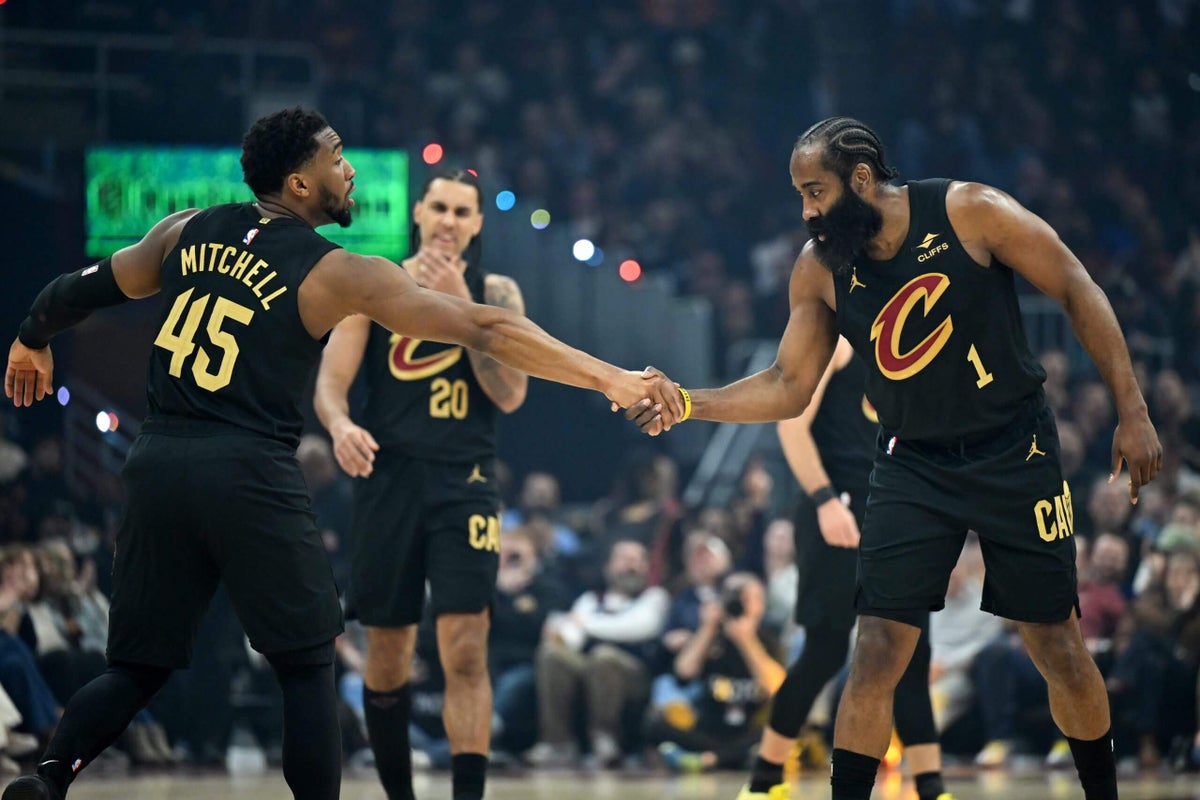
CLEVELAND — The Cleveland Cavaliers’ mascot wore the famous beard during pregame introductions, fans around the arena held up paper beards on cardboard, and the crowd roared as James Harden was welcomed to his new home for the first time.
The Cavs are Harden’s sixth team, and Wednesday night marked his sixth “first time” in front of new fans. That’s among the most for any active player who has been an All-Star. He is an NBA nomad now.
There was a time when that sort of movement across the league was unfathomable for a player of Harden’s stature: a Most Valuable Player, future Hall of Famer and an 11-time All-Star who resides in the top 10 in career scoring. Teams once built franchises around gems like that. Now they’re swapped like mid-cap stocks on the trading floor.
Russell Westbrook is on his seventh team, and Kevin Durant has played for five teams. So has Jimmy Butler. Kyrie Irving has played for four, and Anthony Davis will join his fourth when he makes his debut for the Washington Wizards — next season. That’s an entirely different conversation for another day.
If tanking is the league’s biggest scar, then stars’ team-hopping across the country is a beauty mark of sorts, a marriage of convenience that can be mutually beneficial. Like most things in life, it’s never going back to the way it was.
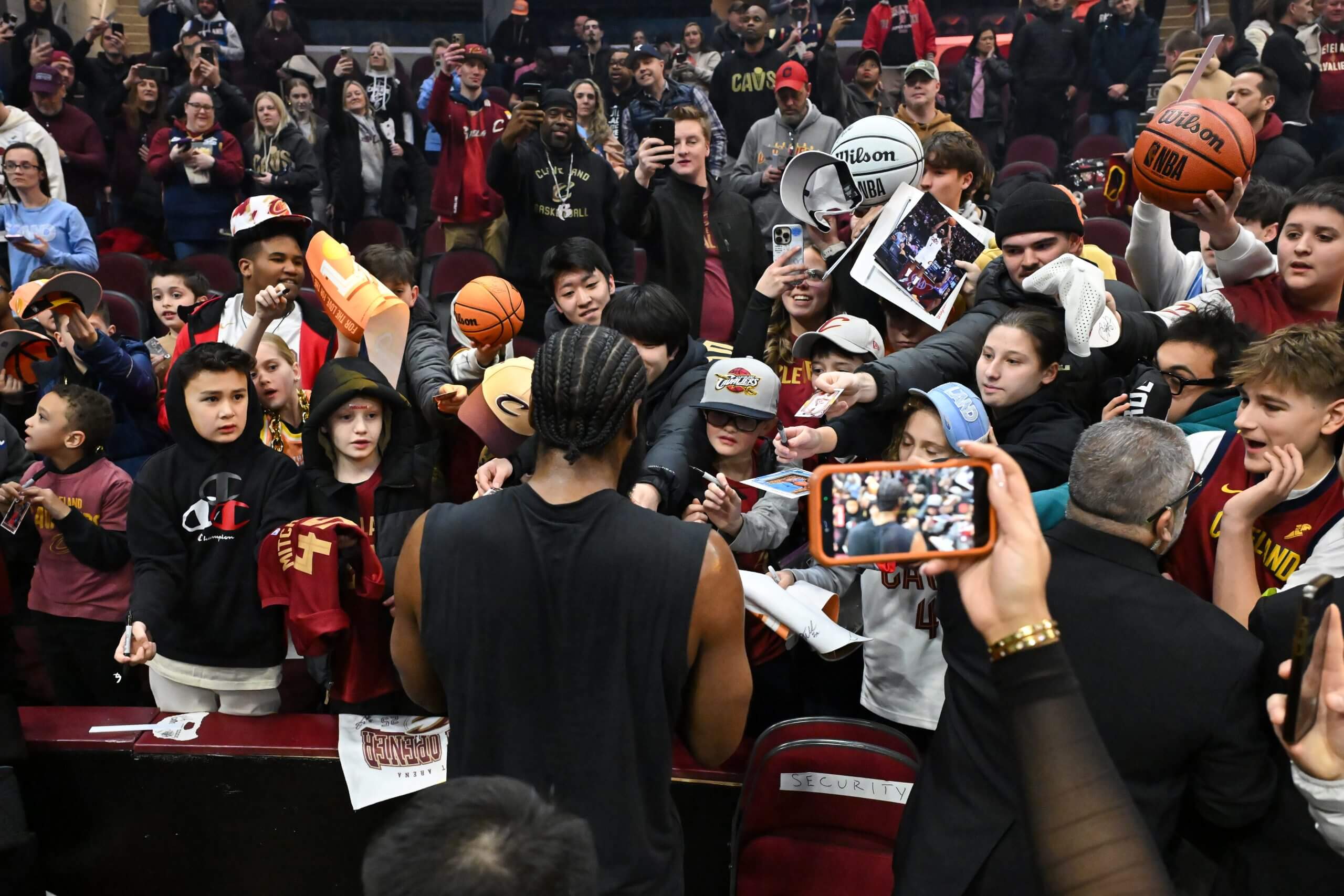
James Harden signs autographs Wednesday night before the Cavaliers’ game against the Wizards. (Nick Cammett / Getty Images)
Harden, Durant, Butler, Irving, Davis, Westbrook and Chris Paul have combined for 72 All-Star games over 38 teams.
“The whole quote-unquote loyalty thing, I think it’s overrated,” Harden said. “This is a business at the end of the day, and it’s a lot of money involved and a lot of decisions that have to be made.”
The days of Magic Johnson and Larry Bird spending their entire careers with one organization died around the time Michael Jordan put on a Wizards jersey. That made Kobe Bryant the anomaly, not the norm of a generation past.
Now, the anomaly might be someone like Donovan Mitchell, who has played for only two teams in nine years. Mitchell is extension-eligible this summer and could re-sign in Cleveland to extend the run.
“It’s a different age,” Mitchell said. “You adapt. I don’t know where it started. You adapt and figure things out. It’s the same thing on the court. It’s a faster-paced league. You adapt to what’s there. I’m not mad at it.”
Shaquille O’Neal played for six teams, including three in his last four seasons. Paul has made it to seven teams, and that doesn’t even count the Toronto Raptors, his current employer, who told him not to bother to show up after they acquired his contract at the trade deadline.
Whether Paul’s career is over remains to be seen. If this is it, he’ll end it much as O’Neal did, playing for three teams in his last three seasons.
Harden has never been afraid to force his way out when he’s ready to go. His latest move from Los Angeles to Cleveland might have been his most pleasant divorce, which came partly because the Clippers were uninterested in guaranteeing his contract for next season. He found a suitor in the Cavs, who were both a contender and willing to pay.
“I don’t lose focus of trying to compete for a championship, and then financially, making sure that my family is taken care of,” Harden said. “I’m very smart, and I’ve sacrificed a lot financially, which I don’t get credit for … I don’t get talked about. But I’m fulfilled, and I’m happy with it.”
Harden once opted out of a $47 million player option with the Philadelphia 76ers and took a $15 million pay cut to help them build a roster around him that could compete for a title. They lost to the Boston Celtics in the conference semifinals, and Harden was out of Philadelphia a year later.
“If a guy isn’t happy and he wants to be traded somewhere else, then it’s a problem,” Harden said. “It’s just so many different dynamics that go into it. Not even just the NBA, but … people that have normal jobs have those same problems. It’s just not magnified. You know what I mean?”
I once asked LeBron James, toward the end of his final season in Cleveland, after it became apparent he might be moving on again, how many teams are too many for a superstar?
He never really answered. He said once he saw Jordan in a Wizards jersey, it opened his mind to the fact nothing is forever. Not surprisingly, James didn’t believe three teams were too many, although he did concede he didn’t want to be that guy who played for five, six or seven teams as his career faded. He has been true to his word. James survived 23 seasons on three teams, although he could be on the move again this summer.
There are multiple reasons players now rent instead of buy. James gets blamed for a lot in the NBA today and will probably shoulder some blame for this, too. His move from Cleveland to Miami was groundbreaking.
Some of it ties back to the AAU culture of team-hopping. This is just how today’s players grew up, but it’s more complicated than James’ decision and youth teams.
Organizations are more willing to trade stars now than ever before. The Atlanta Hawks gave away Trae Young a few weeks ago, a four-time All-Star, just to get off his contract. The new aprons play a role in teams’ urgency to rid themselves of certain deals. That’s only going to continue as teams continue to feel the restraints of high payrolls, although it’s disingenuous to believe star trading arrived with the aprons.
Before the aprons, Blake Griffin was dealt by the Los Angeles Clippers a year after signing a massive extension. The same was true with Paul in Houston and Bradley Beal in Washington. Durant requested a trade less than a year after signing an extension in Brooklyn. Changes to the collective bargaining agreement over the years incentivized stars to stay with their current teams, so players elected to sign those deals knowing they likely weren’t going to finish the contracts in those cities. They can get their money now and figure out the rest later.
The aprons and supermax contracts have only escalated some of the departures. Teams such as the Suns spent their way into the apron with an incomplete team and had to deconstruct themselves to get out of the restraints.
“I feel like players should ultimately do what’s best for them and the front office does what’s best for them and their owner and their organization,” Harden said. “It’s two sides of the story.”
And many, many jersey colors.