
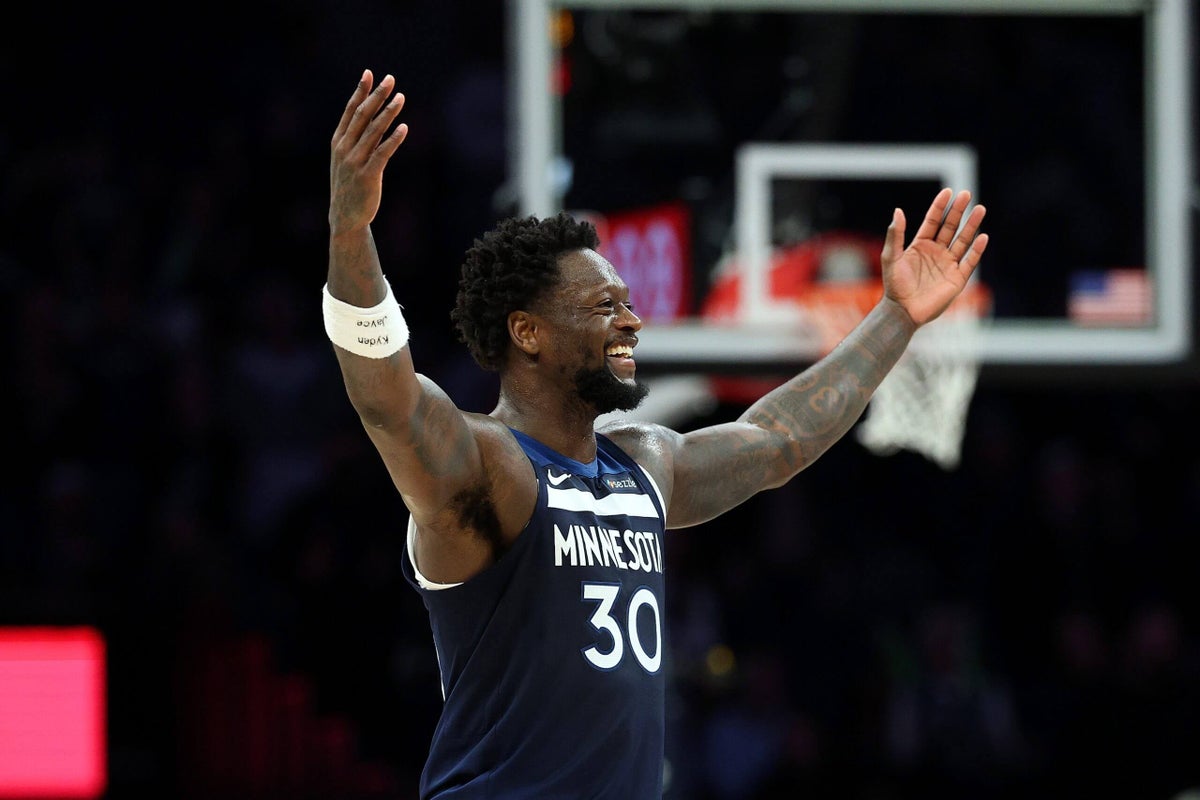
MINNEAPOLIS — The windmill dunk was fire. The 40-ball was overpowering. The 3-point efficiency was encouraging.
But the best part for the Minnesota Timberwolves about Julius Randle’s final performance before the NBA All-Star break was seeing that big smile across his face again.
The entire Wolves team had been down in the dumps over the last two weeks, carrying the weight of trade-deadline rumors and the fatigue of the dog days of the season like it was a piano on their backs. Randle was chief among the downtrodden, his name thrown around in the Giannis Antetokounmpo drama while he processed the disappointment of not making the All-Star team.
Everyone felt it.
“Julius is a guy who plays with his heart on his sleeve,” Wolves coach Chris Finch said. “He was kind of not himself recently. … He’s so important for us in so many ways. We just need him to come back to the pack, if you will.”
Randle followed up a triple-double against Atlanta on Monday with his best performance of the season on Wednesday against Portland to send the Timberwolves into the All-Star break with the good vibes flowing. He scored 41 points, 23 in the fourth quarter, grabbed seven rebounds and was engaged defensively in a 133-109 victory.
“I wasn’t invited to the cool kids table,” Randle said of the All-Star Game. “But it’s cool. I’ll go enjoy the beach with my family and worry about the most important thing, which is winning a championship.”
When he punctuated the night with a soaring dunk that prompted a Portland timeout, he raised his arms to the crowd before being mobbed by Anthony Edwards and Bones Hyland. When Randle is locked in like that, the Wolves are a formidable team. His teammates know they’re going to need that for the 26-game sprint ahead.
“It gets everybody going. He can get as many triple-doubles as anybody,” Naz Reid said. “He plays fast, plays strong, spaces the floor, he gets everybody else involved. I think that’s the key to winning, as well, just being super aggressive while also making sure everybody around you comes with you.”
The win pushed the Timberwolves (34-22) to 7-3 in their last 10 games. It doesn’t feel that way because the three losses — a blowout against the post-trade LA Clippers and defeats to tankers Memphis and New Orleans — were so ugly. But Minnesota enters the break fifth in the Western Conference, a half-game behind fourth-seeded Houston (33-20) and 1 1/2 games behind No. 3 Denver (35-20).
“Every game is going to mean something, and it’s fun,” Randle said. “This is the part of the year that’s fun because it’s competitive and every game means something. You gotta really be locked in and focused.”
It will be a 26-game dash to the playoffs. Here are some things to expect down the stretch.
Unlocking Jaden McDaniels
The magic number for shot attempts for McDaniels has been set at 10, according to Finch. That is not always an easy one to hit with how Edwards and Randle can dominate possessions and how McDaniels can sometimes sit back and watch it all unfold.
It became glaring in back-to-back losses to New Orleans and the Clippers last weekend. McDaniels took eight shots against the Pelicans and only four against the Clippers. He failed to reach double-digits in six of 10 games before Ayo Dosunmu’s arrival. McDaniels took 11 shots against Atlanta on Monday and 13 against Portland, scoring 21 points on Wednesday.
Finch has preached the importance of getting out in transition to maximize McDaniels’ opportunities, something this group has often been reluctant to do. There is no reluctance in Dosunmu. He pushes the ball as soon as it is in his hands, and McDaniels is right there running with him.
“It’s been pretty good. He’s coming from Chicago, which plays super fast,” McDaniels said. “I know that some plays, he’s outrunning all of us. He’s helping us run, he’s helping us get better. I just like the energy he brings and the effort.”
McDaniels is one of the Wolves’ best finishers on the break. If they can get him a few more touches on the run, it makes it easier for his shot totals to increase and just makes him feel included even more.
“We have so many great talents on offense that can score in so many different ways, so adding a different way to the offense is just going to make it harder to guard,” Dosunmu said. “I think it’s going to benefit us.”
Offense tweaks coming
Minnesota enters the break with the NBA’s eighth-ranked offense, and Finch wants to improve upon that down the stretch. He said before the game against Portland that he plans to make some changes over the break and use a rare two-days-in-a-row stretch of practices next week to implement them.
It has been a game-heavy schedule for the last six weeks, offering little time to practice. That’s not unique to the Timberwolves, but it is a challenge nonetheless to try to fine-tune and sharpen elements of the offense and defense that have slipped of late.
“There are some parts of our offense I feel like we need to simplify and/or retool,” Finch said.
One possible shift: more pick-and-rolls with Rudy Gobert. The Wolves have gotten away from utilizing him in that manner, in large part due to Mike Conley’s diminished role on the team and eventual trade. Conley is expected to return to the team sometime after the break. But even when he does, the addition of Dosunmu likely means his minutes will be few and far between. That means the Wolves have to find more chemistry in the pick-and-roll involving other ballhandlers working the set with Gobert.
Getting Randle and Edwards to trust Gobert with the pass more would open up a lot for the offense. McDaniels has already shown a willingness to get Gobert the ball, and that can be leveraged more down the stretch.
“I think it’s really tough to guard when (Randle is) able to look for me, even on the lob,” Gobert said. “It puts a lot of pressure on the defense and forces them to make tough decisions.”
Finch could also try to implement more Edwards-Randle two-man game. The two stars have shared the ball well during their time together, but the offense can get stagnant when the two of them resort to taking turns on who is running the show. Putting them in actions together can put tremendous strain on the defense, and it wouldn’t take an overhaul of the offense to get there.
Finch has Randle’s back
During Randle’s first season in Minnesota, particularly through a jagged first three months, there was considerable outside pressure on Finch to move Randle out of the starting lineup and insert homegrown Reid. It took Randle some time to make the transition from the high-scoring focal point in New York to Edwards’ wing man with the Wolves.
The coach never flinched. He never gave the idea of moving Randle to the bench even a moment’s thought. His history with Randle when the two were together in New Orleans gave Finch a foundation from which to work, and he felt he knew exactly what Randle needed to get going.
“It was incumbent on us to give it every chance to work,” Finch said during last year’s playoff run. “I was pretty adamant about that.”
After a superb start to the season, Randle has hit a dip at the start of February, shooting just 45 percent from the field and 20 percent from 3. He has also been much more inconsistent on defense, renewing concerns about the minutes that he shares the floor with Reid when Gobert is resting.
Gobert’s venting after a loss to New Orleans last weekend was directed, in part, toward Randle’s inactivity on defense. He said that Finch should bench any player who is not giving the requisite effort on that end of the floor, himself included.
Finch has done just that with Gobert in the past, less so because of effort and more to do with the matchups available on the floor.
Why wouldn’t he do the same thing with Randle? To put it bluntly, because not all stars are coached the same.
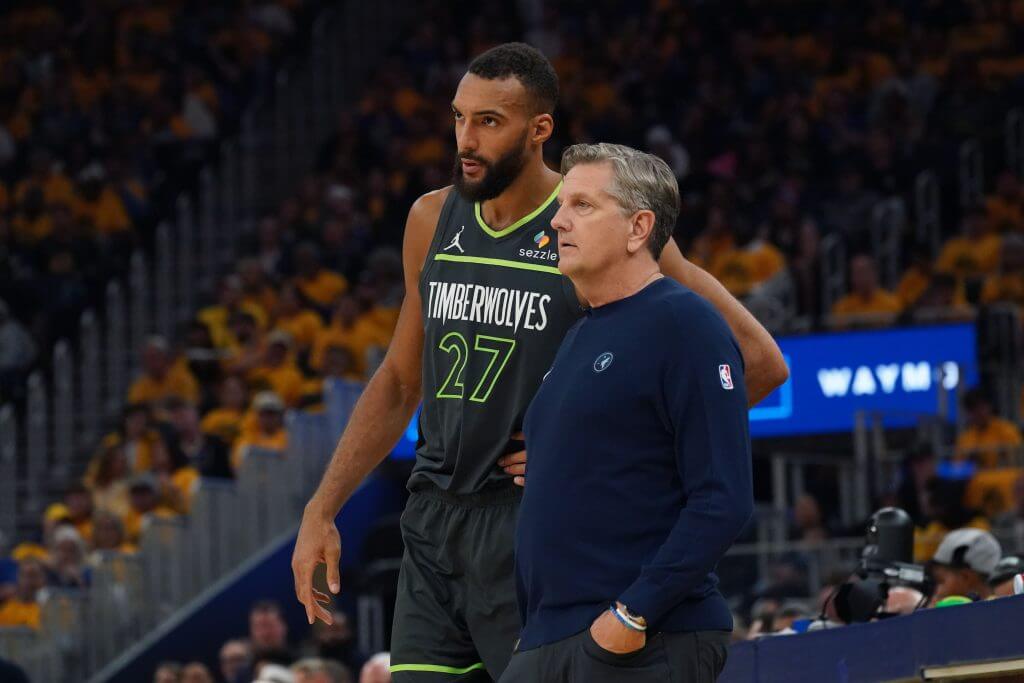
Rudy Gobert talks with Minnesota coach Chris Finch during a game at Golden State. (David Gonzales / Imagn Images)
Gobert responds well to being challenged. Each time a player, pundit or league voice throws some shade his way, a chip is added to his shoulder. It is the size of a boulder now, and the prideful center revels in proving his legion of doubters wrong every time they say he is overrated.
Randle has a different temperament. He thrives off of support, of trust being placed in him. The way things ended in New York stung him and made him feel left behind after helping the Knicks return to relevance.
Finch coaches him with that in mind. He has called Randle “our most important player,” a tribute to his complex role as a supporting scorer and a leading playmaker. His belief is that Randle responds best to that show of faith, and he coaches accordingly.
Getting some time to rest will be big for Randle as well. He has played in all 56 games this season, an impressive run of durability. He has dealt with small injuries to his left thumb and foot but pushed through, joining Donte DiVincenzo and Reid as the only Wolves not to miss a game this season.
He didn’t really find his groove last season until late February, when he came back from a 13-game absence due to a groin injury. Randle has often credited that time on the sideline with allowing him to step back and see the bigger picture on how he could fit in with the team. It also made sure he was fresh down the stretch.
Like most of his teammates, Randle is tired right now, physically and mentally. Being able to unplug for a week could be just what he needs.
“Yesterday, my middle child, Jacey, made like a 10-box checklist of everything we’re gonna do,” Randle said. “Sand castles, beach, football on the beach, basketball, 2K, Madden, make a cake, make ice cream, all this different type of stuff. I’m excited to spend some time with them.”
DiVincenzo will remain in starting lineup
Given the strong first impression from Dosunmu, some fans are starting to talk about considering a lineup change out of the break. Dosunmu is a notch better as a ballhandler than DiVincenzo, so maybe that is a little bit better fit next to Edwards?
I don’t see that happening, certainly not this quickly after the trade that brought Dosunmu from Chicago. DiVincenzo may not be a traditional point guard, but he has been essential to what has been one of the league’s best starting fives. The Wolves have been better with him on the court for most of the season, including a plus-15.0 points per 100 possessions in December and a plus-10.9 net rating in January, per Basketball-Reference.
On a team that can trend toward lazy, DiVincenzo has been one of the few consistent sources of energy this season. He is the guy you want following you into the back alley for the street fight, a fiery competitor who enjoys grabbing a rebound in traffic or delivering a hard foul on a drive to the basket as much as he does hitting a 28-foot 3 at the end of the shot clock.
His individual defense has dipped in February, as has his usage, and Dosunmu has come in like a rocket, happy to be injected into a playoff race after spending his first five years with the Bulls. But the larger sample size of the Timberwolves starting five has been overwhelmingly positive. Thanks to good health, the Wolves have played far more minutes and games together than any other five-man group and have a plus-9.5 net rating.
You also have to factor in the human element. DiVincenzo takes pride in starting; it symbolizes his importance. It all stems from his insertion into the starting five in his lone season in New York, playing heavy minutes for Tom Thibodeau and becoming a cult hero at Madison Square Garden because of it.
Last season, when he had to go back to the bench, it was an adjustment for him. The Wolves were outscored by 0.7 points per 100 possessions when he was on the floor, per Cleaning the Glass. So far this season, his shooting numbers are lower than either of the last two years, but his overall impact has been much greater. Against the Blazers, DiVincenzo had just three points on 1-for-5 shooting, but the Wolves outscored Portland by 26 points in his 29 minutes. His net rating is a plus-7.8 this season.