
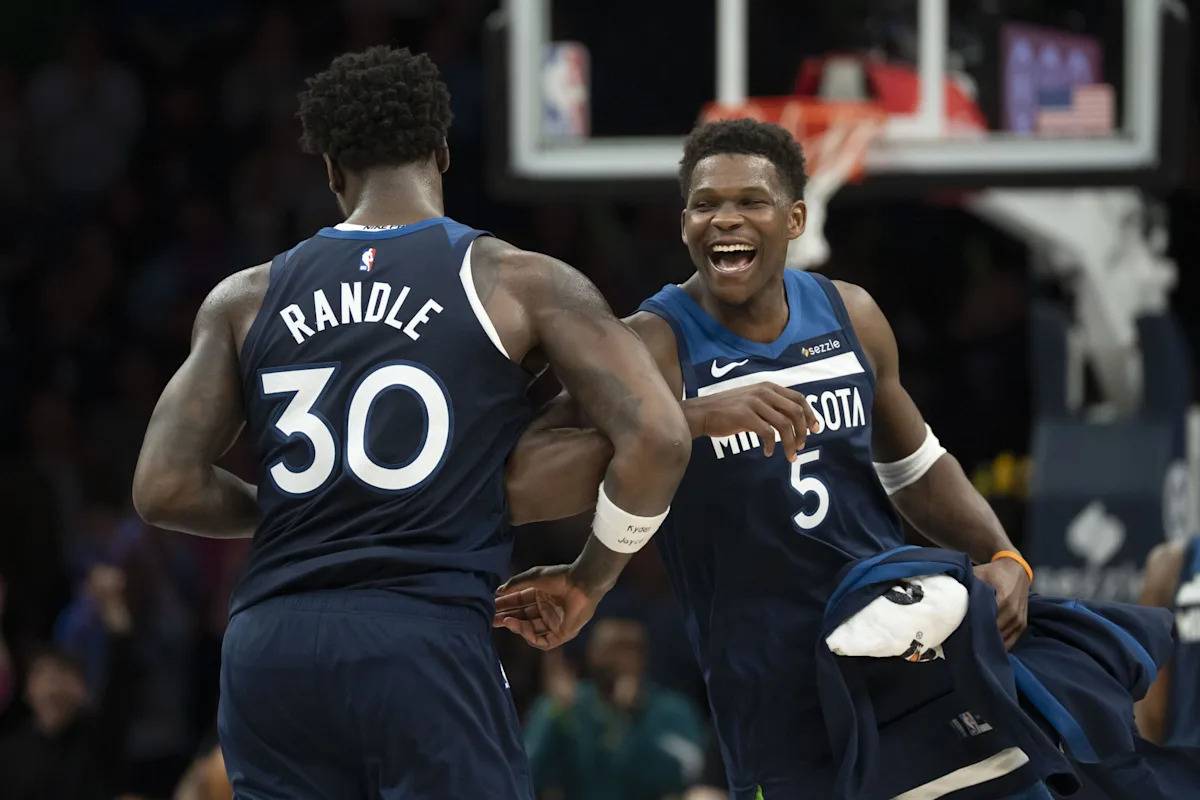
The NBA is as talented as ever, and the Minnesota Timberwolves boast one of the top rosters in the league.
Should a league expansion happen, they have several players that they must protect and a few players that they wouldn’t mind cutting ties with.
Advertisement
The NBA Board of Governors is reportedly expected to vote this summer on whether to expand the league by adding two franchises. If approved, those teams would likely land in Las Vegas and Seattle — a move that would reshape a league that hasn’t expanded since the Charlotte Bobcats (now the Hornets) entered in 2004.
The expansion feels less like a question of “if” and more like “when.” And if it happens, the ripple effects will reach every roster in the league — including the Minnesota Timberwolves’.
What Expansion Could Mean for Minnesota
One immediate consequence of adding teams in Seattle and Las Vegas is conference realignment. The Timberwolves have long been viewed as a prime candidate to shift to the Eastern Conference in a 32-team NBA. Geographically, Minnesota fits far more naturally alongside teams like the Milwaukee Bucks, Chicago Bulls, and Detroit Pistons — cities it already shares rivalries with across other major sports.
If Minnesota doesn’t move east, the Memphis Grizzlies or the New Orleans Pelicans would be the most logical alternatives. Any of the three franchises would likely welcome the competitive relief that comes with leaving the brutal Western Conference for a thinner East.
Advertisement
But realignment is only part of the equation. Expansion would also trigger an expansion draft, forcing each team to protect eight players while leaving the rest of the roster exposed.
So who should the Timberwolves protect? Some choices are obvious. Others are far more complicated.
Let’s work through the eight players Minnesota should prioritize.
UntouchablesAnthony Edwards
This is the easiest decision on the board.
Anthony Edwards is already one of the NBA’s elite scorers and, at just 24-years-old, remains the centerpiece of Minnesota’s present and future. He’s a high-volume three-point shooter, a powerful finisher at the rim, and has expanded his midrange game significantly this season.
While consistency — particularly on defense — still fluctuates, Edwards has improved every year. He’s the driving force behind the most successful era in franchise history and one of the most beloved athletes in Minnesota sports.
Advertisement
If there’s an expansion draft, Edwards isn’t just a lock to be protected — he’s the entire foundation of the exercise.
Jaden McDaniels
Jaden McDaniels should also be untouchable.
He may not be Minnesota’s clear-cut No. 2 option offensively, but his two-way impact makes him arguably the team’s second-most valuable piece long-term. At 25, McDaniels continues to grow into his prime, and his offensive leap this season — averaging a career-high 15 points per game while shooting efficiently from both the field and beyond the arc — has raised his ceiling.
Pair that offensive growth with elite perimeter defense, and McDaniels becomes an ideal running mate next to Edwards. While some fans may overstate his upside, his blend of age, versatility, and defensive value makes protecting him a no-brainer.
Advertisement
It Gets Tricky HereNaz Reid
This is where things get more debatable.
Naz Reid might not be the third-best player on the roster today, but he should rank as the third-highest player to prioritize. At 26-years-old and on a team-friendly contract around $25 million annually, Reid offers rare offensive versatility for a big man.
The 2024 Sixth Man of the Year has developed into a legitimate scoring weapon — stretching the floor from three while improving as a finisher around the rim. His defense remains inconsistent, but there have been encouraging signs of growth this season.
Age, contract value, and offensive skill set push Reid ahead of some more established names.
Advertisement
Rudy Gobert
In terms of immediate winning impact, Rudy Gobert is reasonably higher on this list.
He remains one of the league’s most dominant defensive anchors, and Minnesota’s identity shifts dramatically depending on whether he’s on the floor or not. With the four-time Defensive Player of the Year, the Timberwolves defend at an elite level; without him, they’re dreadful.
But expansion decisions are about the future as much as the present. Gobert turns 34 this summer, and while his defensive instincts should age well, decline is inevitable. His offensive limitations also complicate long-term roster building.
Advertisement
He’s still worth protecting, but age keeps him from ranking higher.
Julius Randle
Julius Randle presents one of the toughest evaluations.
He may be Minnesota’s second-best player right now, but his timeline doesn’t align with Edwards’ long-term trajectory. At 31, and with defensive effort that fluctuates, Randle’s fit alongside the franchise cornerstone remains imperfect.
His strong playoff stretches have shown how valuable he can be, yet deeper postseason matchups — particularly against elite, physical defenses — have exposed limitations in his shot creation and decision-making.
Unless he elevates his postseason impact moving forward, Randle feels more like a short-term competitive piece than a long-term foundational player. That places him lower on the protection hierarchy.
Advertisement
Joan Beringer
Protecting upside matters in expansion drafts, and that’s where Joan Beringer enters the picture.
The 19-year-old rookie from France has shown flashes of high-level defensive potential despite limited minutes. Considering he’s relatively new to organized basketball, his rapid development as a rim protector and rim runner shows promise.
Beringer’s combination of length, mobility, and rebounding instincts gives him a pathway to becoming a future starter. Even if his offensive game remains raw, the upside alone makes him worth protecting.
Ayo Dosunmu
In a short time with Minnesota, Ayo Dosunmu has carved out a valuable role.
He adds pace, ball movement, and secondary playmaking — traits that help ease the offensive burden on Edwards. Defensively, his activity and point-of-attack pressure provide another layer of versatility.
Advertisement
At 26, Dosunmu fits neatly into the Timberwolves’ competitive window. If Minnesota envisions sustained playoff runs, having a reliable two-way guard like him becomes increasingly important.
Donte DiVincenzo
The final protection spot comes down to dependable role players — and Donte DiVincenzo checks that box.
His energy, shooting, and connective play make him a seamless fit in Minnesota’s rotation. Even when his three-point shot runs hot and cold, his willingness to defend and make quick decisions keeps the offense flowing.
At 29, he remains firmly in his prime and profiles as the type of veteran contending teams rarely want to lose in an expansion scenario.
Advertisement
Who is the Odd Man Out?
That leaves players like Rocco Zikarsky, Bones Hyland, Jaylen Clark, Terrence Shannon Jr., Johnny Juzang, Joe Ingles, Julian Phillips, and Enrique Freeman unprotected.
Zikarsky may be the toughest omission given his developmental upside, but the lack of NBA sample size makes it difficult to prioritize him over more proven contributors. Losing players such as Clark, Phillips, or Shannon Jr. would sting, yet none present a stronger long-term case than the eight listed above.
Whenever expansion arrives, Minnesota’s front office will face difficult choices balancing immediate contention with long-term sustainability.
Advertisement
The bigger question is whether the Timberwolves would see this list the same way — or if they’d value upside, age, and contracts differently when forced to choose.
Who would you protect?
The post Who Should the Timberwolves Protect in an NBA Expansion Draft? appeared first on The Lead.