
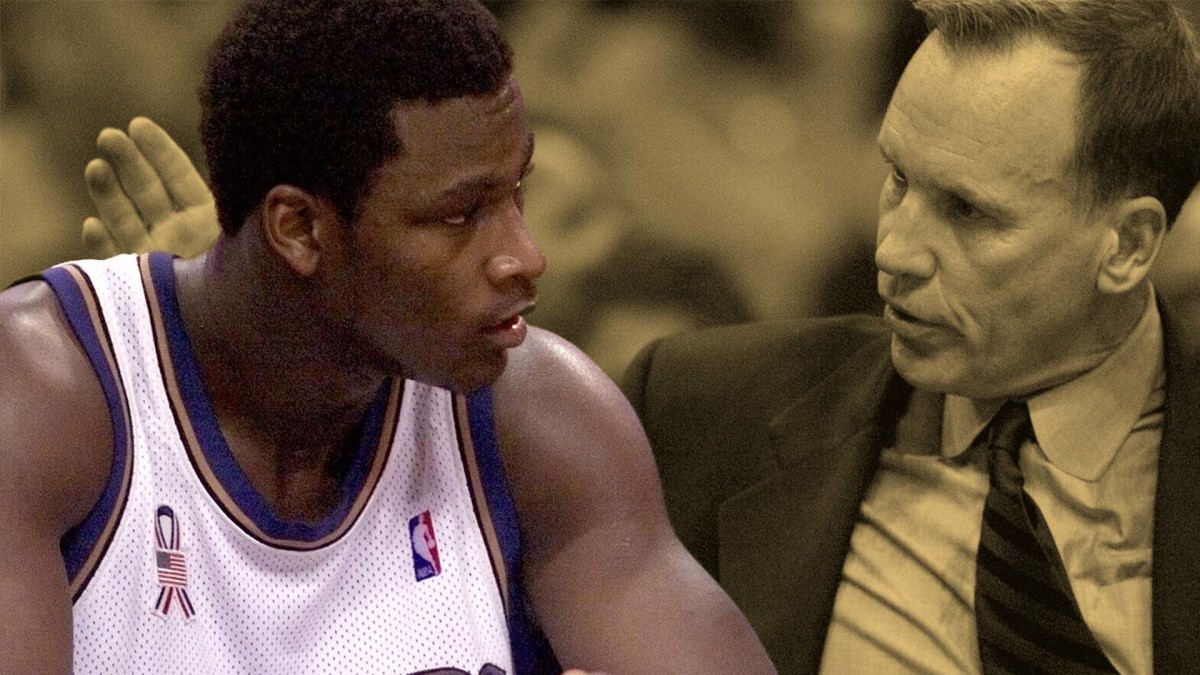
The Washington Wizards selected Kwame Brown with the number one overall pick in the 2001 NBA Draft. Barely two and a half years later, then-general manager Ernie Grunfeld was already pleading for patience with the 6’11” youngster.
That alone said plenty. Things hadn’t gone as anyone had hoped. In fact, the partnership looked strained long before it ever had a real chance to work.
Advertisement
Early criticism
The Wizards made a bold move when they took Brown straight out of high school. It was the kind of gamble that made headlines and came with sky-high expectations.
Those expectations? They didn’t hold up.
The headlines? They stayed. Not the good kind, though,
By December 2003, Brown was already under heavy scrutiny. The media came first. Then the fans. Pretty soon, everyone piled on.
If you average 6.2 points and 4.6 rebounds in your first two seasons as a former top pick, the criticism is bound to come. And when you lose your starting job — Brown was replaced by veteran Christian Laettner for the Wizards — it only makes more sense.
Advertisement
In short, the “draft bust” tag had already started to stick. Consequently, the question became impossible to ignore: had the experiment already failed? Grunfeld, for his part, didn’t think so. He made that clear by publicly defending his young player.
“I think people tend to forget that he’s still only 21 years old,”said Grunfeld. “He’s shown that he has all the physical tools necessary to be a very successful player at our level. I think we have to have patience.”
And to be fair, “Coffee” did flash some of that potential.
Advertisement
Reportedly, he had put together a three-game stretch of dominance earlier that year. A stretch in which he averaged 17.6 points and 8.3 rebounds. All while shooting 67 percent from the floor, that was.
You could call it a glimpse of what could’ve been. But only if you ignore the fact that the sample size was about as small as it gets.
Related: Michael Jordan’s Daytona 500 victory comes with a massive payday: “I can’t even believe it”
Patience eventually ran out
Grunfeld was in his first year as Wizards GM back then. Was he really patient? Or just pumping up Brown to squeeze something out of him? Maybe trying to fool other teams into thinking they could fix the kid on their own.
Advertisement
Nobody knows for sure. One thing was clear, though. The Wizards’ big gamble had flopped early. Then it fell apart for good.
Brown wrapped up that year at 10.6 points and 7.4 rebounds a night. Those were actually his career bests. He stuck around Washington one more season. Started just 14 games. Put up 7.0 points and 4.9 boards.
Injuries pounded the 2001 McDonald’s All-American that year. Off-court drama probably didn’t help either. He’d, for instance, turned down their contract offer. Also clashed with Gilbert Arenas, teammates and head coach Eddie Jordan.
Advertisement
The knocks on his flawed game? Meanwhile, they just kept coming. And coming.
Then, in early August 2005, things really came to a head.
Brown and Laron Profit were traded to the Los Angeles Lakers. In return, the Wizards got Caron Butler and Chucky Atkins.
Ultimately, patience is a virtue. It has an expiry date, though. Say what you want about the Washington front office at that time — they blew it, sure. Still, they kept giving Brown shot after shot.
Advertisement
Related: Kwame Brown accused his financial advisor of forging his signature to steal $17.4 million
This story was originally published by Basketball Network on Feb 17, 2026, where it first appeared in the Old School section. Add Basketball Network as a Preferred Source by clicking here.