
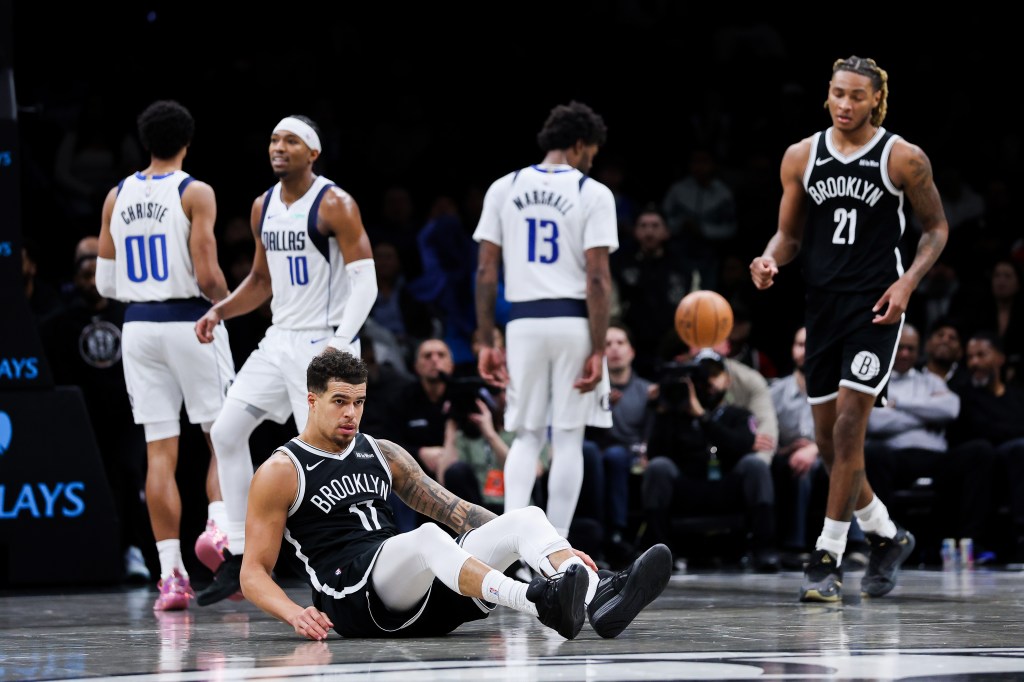
Michael Porter Jr. has looked like two different players on either side of the All-Star break, and the numbers don’t need much help telling the story.
Before the break, Porter was building the kind of season that usually earns you a real All-Star conversation. In 41 games, he averaged 25.0 points, 7.2 rebounds and 3.2 assists while shooting 47.7% from the field, 38.5% from 3-point range and 85.3% at the free-throw line. That wasn’t a hot week. That was a half-season of production, the kind that puts a scorer in the room even if he doesn’t end up getting the call.
Since the break, it’s been a different picture. In four appearances, Porter’s averaging 20.0 points, 5.3 rebounds and 4.0 assists, and his efficiency has slipped with it: 43.8% overall from the field, 17.2% from deep.
The long ball, in particular, has betrayed him. He’s 5-for-29 from distance over his last four games.
The thing is, this slump has a shape. Porter’s still converting his 2-point field goals at a 65.7% clip. That’s not a player who’s lost his touch everywhere. That’s a player whose jumper isn’t cooperating, even while the rest of the scoring package is still alive. The misses stand out because that shot is usually the cleanest part of what he does.
Porter doesn’t shy away from it. He’ll tell you he hasn’t been good enough lately and he’ll tell you why he thinks it happened. He pointed to the timing and routine around the All-Star break, to the way rhythm can disappear when a shooter stops playing, even briefly.
“I could be playing better,” Porter said. “I’ve got to get back in rhythm. Before the All-Star break I didn’t play a couple games, and then I honestly didn’t do much over the break, so I’ve got to get back in rhythm and play better.”
He explained it the way real shooters do, with words that sound less like a press conference and more like a guy talking through his own film in his head. Timing is fragile. Feel isn’t guaranteed.
“It’s the feel. It’s the timing,” Porter said. “My shot hasn’t felt this off for the last four or five games. That’s what happens when you’re out of rhythm and you don’t play for a while. People don’t understand that you can lose your timing in two or three days of not playing. I think not playing before the break and not getting in the gym much during it, I’m paying the price for it, but I think I’ll get back to it sooner rather than later.”
If you’re looking for a tactical explanation, he doesn’t offer much mystery there, either. Porter insists defenses haven’t changed the rules on him. He’s seeing the same closeouts and the same attention, and he’s missing shots he normally expects to make.
“No, they’re still guarding me the same way,” Porter said. “They’re closing out tough, trying to blitz handoffs. I’m shooting tough shots, but they’re shots I normally make and I’m missing some I feel like I should make. I just have to get back to that good feeling when it leaves my hand.”
That’s where Jordi Fernández keeps it, too. The Nets head coach isn’t selling panic, and he’s not pretending the drop-off doesn’t exist. He’s basically saying the math will normalize if Porter keeps doing the right things, because the process hasn’t collapsed.
Fernández has repeatedly stressed that he doesn’t think opponents are guarding Porter any differently than they were before the break, even when the best defender is attached to him and a second body shows up. He’s also liked what he’s seen from Porter when he’s cutting with purpose, finishing those plays and putting pressure on the rim. The shots haven’t fallen, but the work hasn’t stopped.
Fernández’s bigger point is the one every coach makes to a shooter who’s pressing: there are ways to impact the game when the 3 isn’t falling. Get into the paint. Cut. Make the simple play. Force help to move, then re-space and keep the floor honest. Keep letting it fly, too, because the worst thing a shooter can do is start acting like he’s not one.
And that’s worth remembering when the post-break stat line starts to feel like a verdict. This is four appearances since the All-Star break, and 41 games before it. Four games can twist any perimeter shooter’s splits. Forty-one games usually tell you who a player is.
There’s also a human layer here that isn’t hard to see. It was clear the idea of getting his first All-Star nod meant a lot to Porter. He didn’t get it. Maybe that’s weighing on him. Maybe it isn’t. Maybe this is just the kind of slump every great scorer is entitled to, because that’s the nature of the game. Maybe with the season almost over and the playoffs well out of reach, motivation comes and goes in waves.
Either way, the point is the same: a cold stretch shouldn’t swallow the season whole.
Porter’s admitted this year has required a different kind of mental approach. He’s called it a learning curve, a new experience, and an adjustment from seasons when the calendar after the break was all about ramping up for playoff basketball. But he’s also been adamant the work still matters, even in a developmental stretch where the standings aren’t the point.
“This is a new situation that I’ve been in, but no basketball game is meaningless,” Porter said. “It’s all part of the journey. We’re not just looking at this year — we’re looking at the next one, two, three, four, five years. All these games matter for growth, continuity and chemistry. Sometimes it’s hard to focus on that, but we’ve got to come in and work every day and realize it’s a bigger picture. At the end of the day, we’re playing basketball, a game we all love.”