
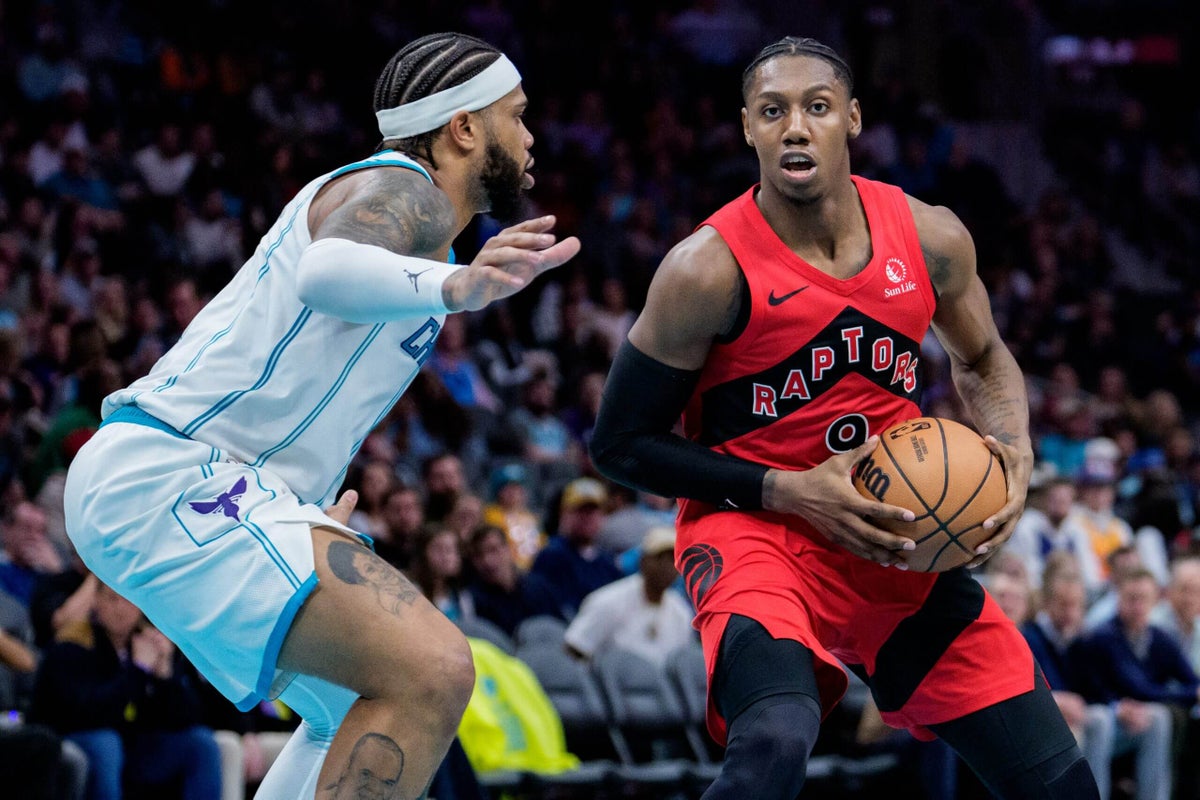
The Toronto Raptors’ half-court offence will be their fatal flaw this season.
That’s been a fair guess for a while, but it became very clear over the last two nights during losses to the Oklahoma City Thunder on Tuesday and San Antonio Spurs and Wednesday. Against the Thunder, the Raptors got to just 107 points, despite hitting 18 3s. It was one of their best shooting nights of the year, but it wasn’t good enough to produce an offensive rating better than Indiana’s league-worst mark. Against San Antonio, they managed just 17 points in the fourth quarter as another double-digit lead evaporated, this time in a 110-107 loss.
“I think sometimes we almost get in our own way,” Raptors centre Jakob Poeltl said. “We’re so used to when we’re playing fast, when we’re getting these steals, the offence comes free. But when we get into half court, we let other teams be physical with us. We don’t play with the same intensity that we do on defence on offence.”
The Thunder and the Spurs have the first- and third-ranked defences in the league. They make a lot of offences look bad, including Toronto’s. The playoffs are full of good teams with good defences, and even if the ones Toronto faces won’t belong to Oklahoma City or San Antonio, they will be good enough to put Toronto into painful situations, making sure the Raptors have to slow things down and execute. That isn’t their specialty.
Which brings us to RJ Barrett. That the Raptors’ offence is so rickety isn’t Barrett’s fault more than anyone else’s. Since he got to town, he has altered his game to fit in with head coach Darko Rajaković’s movement-heavy offence.
However, Barrett represents the most obvious means of improvement. And if he cannot exceed his recent play, and the Raptors can’t get beyond being a team that takes care of bad teams and loses to good ones — Toronto is now 4-15 against the best 10 teams in the league — the Raptors will explore every path to get better in the offseason. Trading Barrett is the clearest one.
This realization stings, as Barrett badly wants to be a Raptor. From nearby Mississauga, Ont., he has loudly declared how much playing for his hometown team means to him this season, especially as the Raptors got off to a hot start. Yet he and the Raptors did not agree to a contract extension in the offseason when he still had two years left on his current deal. He will be extension-eligible again this offseason.
Perhaps there is a framework for a deal, although he hasn’t been playing himself into a raise lately. In his 12 games since returning from an ankle injury, he is averaging just 14.8 points per game on 40.1 percent shooting. Before the injury, he had been averaging 19.6 points on 49.6 percent shooting. He was 4 for 14 against the Spurs, one of many Raptors grasping for efficiency with Victor Wembanyama patrolling the paint.
Overall, Barrett has been about as effective as he has been during the rest of his Toronto tenure, with his role diminishing with the addition of Brandon Ingram. His true-shooting percentage, which accounts for the extra value of 3-pointers and free-throw attempts, is steady at a fine-but-not-great level for a wing. The Raptors are better with him on the court in the manner you’d expect: Their defence is worse but their offence is better. They are 12-12 when he is out of the lineup and 22-13 when he plays. There is no evidence that the Raptors are better off without him.
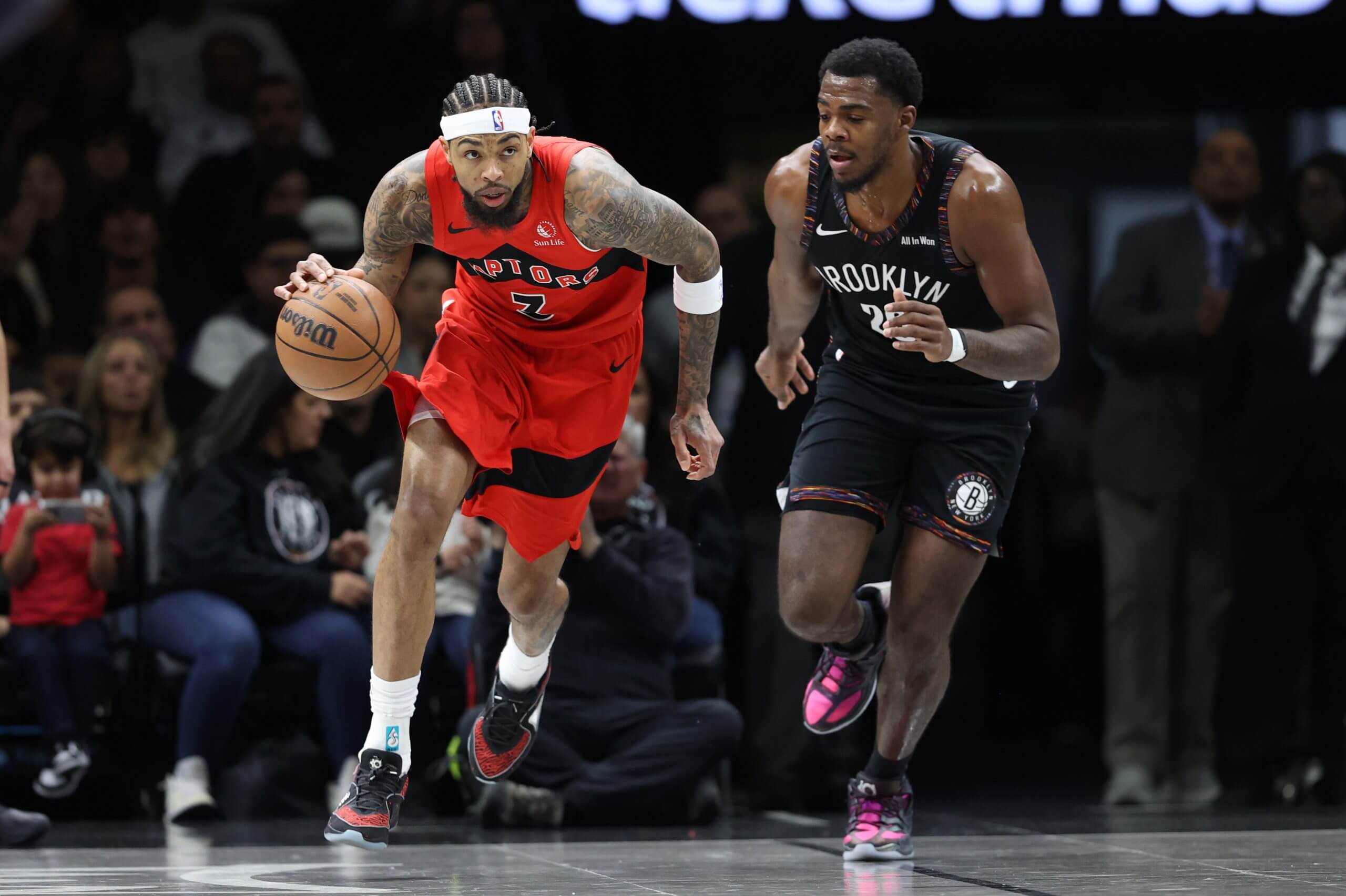
Brandon Ingram is having his healthiest season in ages, which could help his trade value if Toronto were so inclined. (Pamela Smith / Getty Images)
Alas, as Lester Freamon said: Follow the money. It puts Barrett on shaky ground in Toronto.
“Can we perfectly time this, where every year we have a $25 million expiring (contract)? No,” Raptors general manager Bobby Webster told The Athletic earlier this month when asked about the franchise’s flexibility. “That was maybe the one we didn’t have this year.”
Webster was not speaking about Barrett when he said that. However, it was clear at the trade deadline that teams don’t see value in taking on long-term contracts such as the ones Immanuel Quickley and Poeltl have, even if Quickley is quietly making his look better. Ingram’s contract could be expiring next year, but he has a $41.9 million player option for 2027-28. Barrett is owed $29.6 million next year and then will become an unrestricted free agent.
His contract would go a long way toward helping the Raptors upgrade, given that most trades in the NBA require approximately the same amount of annual salary switching sides.
If the Raptors attach picks and prospects to Barrett, they could get in the market for a player who either drives more efficient offence for himself and his teammates or can be a top-end perimeter defender, allowing Scottie Barnes to spend more of his time wrecking shop on the back end, which is his best defensive quality among many good ones.
Barrett has improved as a defender since he came to Toronto, but he is closer to neutral than a positive. A team acquiring him would get a good starter, plus not be committed to him beyond next season.
There is an argument that Ingram, not Barrett, should be the player Toronto tries to use for such an upgrade. The Raptors are moderately better when Ingram is not playing — not enough to conclude that they are actually better without him, but enough to imagine a scenario in which he’s replaced with a different player to greater benefit.
Ingram was named an All-Star and is having his healthiest season in ages, which could help his trade value. He is also a less flexible player than Barrett, with his 27.3 percent usage this year among the lowest of his career since he went from the Lakers to the Pelicans. (Usage percentage accounts for how often a player finishes a possession with a field-goal attempt, turnover or free throws when he is on the floor.) He has improved the Raptors’ half-court offence, but not to the point where it is no longer a problem.
Maybe there is a market for Ingram. However, the Raptors have seen how a player such as Ingram, who can get his own shot in close quarters, has allowed Barnes to play the best basketball of his career, which has actualized the team’s defensive potential. Barnes is not going to become a go-to option, but his lack of consistent shooting requires consideration when assembling the rest of the roster. Even if Ingram isn’t the best version of his player type, he is a pretty good version, one that is not easy to find.
Mostly, it’s the money. If Barrett ends the season well, contributing to the team’s offensive improvement and enhancing its playoff profile, there could be an agreeable extension for both team and player. More likely: The Raptors just don’t have enough offensively, and Barrett represents the easiest path to addressing that.