
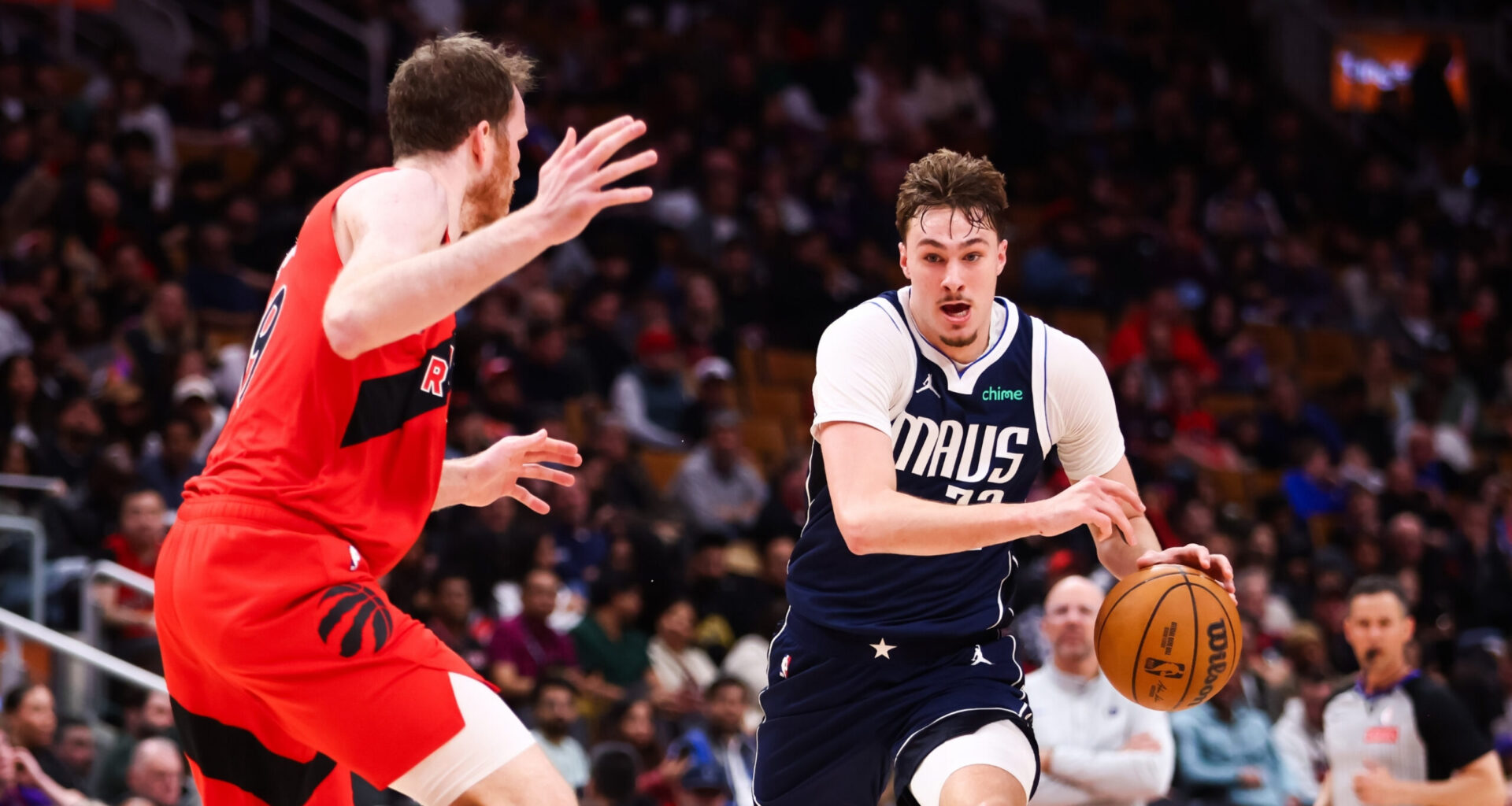
The Toronto Raptors did not make things easy for Cooper Flagg during the Dallas Mavericks‘ 122-92 loss on Sunday night. It was an experience the Dallas Mavericks rookie can appreciate as he goes through his rookie NBA season, eager to grow in any way that he can.
From the opening tip Sunday at Scotiabank Arena, Toronto deployed a coverage designed specifically to take away what Flagg does best. Entering the game averaging 20.2 points, 6.6 rebounds, and 4.2 assists across 52 games — numbers that have drawn comparisons to LeBron James and Michael Jordan‘s rookie seasons — Flagg is not a player defenses can afford to let beat them off the dribble.
Toronto applied full-court pressure that forced early decisions and sped Dallas up before its half-court offense could take shape. On half-court possessions, the Raptors loaded up at the nail and sent an early low man — pre-rotating off weaker perimeter shooters to collapse any driving lane before Flagg could build a head of steam toward the basket. The Mavericks, operating without a traditional point guard in the starting lineup, had no easy answers.
Flagg acknowledged the difficulty of what he was up against and the cost to Dallas when the answers didn’t come quickly enough.
“Yeah, they were just being physical,” he said. “High-level pressure, full court, speeding us up and being really physical. We just didn’t do a great job of being organized.”
The result was 19 Dallas turnovers, a 21-4 fastbreak points disadvantage, and a 122-92 final that represented the largest margin of defeat in Mavericks history against the Raptors, and by any measure, Toronto got exactly what it was looking for. But Flagg’s response to it over the course of 30 minutes offered something worth examining beyond the box score.
Cooper Flagg Found Answers, Even When His Teammates Could Not Convert Them
Rather than force his way through a defense built to stop him, Flagg adapted. He used his size and vision to make live-dribble reads over the top of the collapsing defense — identifying Daniel Gafford rolling to the rim when the low man committed and spraying passes to the perimeter when Toronto’s rotations overloaded the paint. The reads were there. He still finished with eight rebounds and six assists.
But Toronto’s pressure pushed him to four turnovers, nearly double his season average of 2.3, and held him to 7-of-17 from the field — well below his 47.2% season mark. Flagg was creating advantages in a game in which his team’s defense allowed 21 fastbreak points and its shooters went cold.
The problem was that Dallas’s perimeter options couldn’t capitalize. Max Christie went 1-of-11 from the field and 0-of-7 from three. Klay Thompson, who was being top-locked off the ball to prevent the Mavericks from running actions for him, finished with five points on 2-of-10 shooting.
The open looks were there in enough volume to keep the game competitive. They just didn’t fall, and Toronto never had to pay for loading up on Flagg.
“It’s a good learning experience,” Flagg said. “We haven’t played a ton of teams like that, so it’s good for us to see it, feel it, and then have the film to go back and look at how we can improve. It helps us learn how to stay organized and have the correct spacing.”
That answer was more precise than most 19-year-olds give after a 30-point loss. He wasn’t making excuses. He was pointing to the film.
The Technical Was the Exception, Not the Pattern
The sequence most discussed after the final buzzer came at 9:28 of the fourth quarter, when Flagg earned his first career technical foul following a drive to the paint that went uncalled. The Raptors led 98-72 at the time, and the game was long decided. Flagg had been attacking the basket all night against a defense committed to stopping him, and the accumulation of uncalled contact finally broke through his composure.
He had never received a technical in his lone season at Duke. For it to happen on March 8, in his first year in the NBA, is as much a testament to what he had absorbed before that moment as it is a note to correct going forward. Flagg acknowledged that directly.
“Yeah, it is what it is,” he said. “I’ve got to do better, just slowing down a little bit. I’ve been playing a little too fast since I got back. I was frustrated and kind of let it out. I’ve just got to move on.”
Jason Kidd had been asked before tip-off to compare Flagg to young versions of Giannis Antetokounmpo and Luka Dončić, two players Kidd coached through their formative years, and singled out Flagg’s maturity as his most striking quality at 19 years old. Hours later, he found himself addressing Flagg’s first technical — not with alarm, but with context.
“He has a right to express his feelings to the officials, and he did that,” Kidd said. “I don’t mind that. But I also understand we’re on the road, and frustration can set in. You’ve got to keep your composure and continue to keep attacking until they blow the whistle. That’s just part of the game. He received his first tech — it won’t be his last. But understanding he is driving and some of them might be fouls — if the whistle doesn’t blow, you’ve got to keep playing.”
Daniel Gafford, who has watched Flagg navigate the league’s learning curve from a front-row seat all season, did not frame the moment as a setback.
“I think he’s getting the full effect of what the league is all about at the end of the day,” Gafford said. “He’s learning on a day-to-day basis for sure. He hasn’t been doing that too much throughout the season, where he just goes off the rails. So this was kind of his first game doing that. I feel like he’s taking a step in the right direction because he’s voicing his opinion. He’s the No. 1 pick, so there’s going to be a lot thrown at him. At a young age, he’s holding himself to a high standard.”
Why This Tape Matters for Cooper Flagg
Toronto’s defensive scheme on Sunday was not unique to this game. Most teams around the NBA may not be as well-equipped defensively as the Raptors, but it’s a copycat league. Teams will reference how to slow Flagg using the Raptors’ approach, including nail loading, early low men, full-court pressure, and top-locking shooters.
The film session from Sunday’s game will matter more than Sunday’s final score. Flagg now has 30 minutes of live experience reading and reacting to a defense specifically constructed to eliminate his advantage, and he has a technical foul that showed exactly where his patience runs out when the whistle stays in the referee’s pocket. Both sharpen him for the next time a defense tries the same thing.
Kidd pointed to this kind of accumulation when explaining what separates Flagg from comparable young players.
“When you look at Cooper, at the age of 18 — turning 19 — just his maturity, the way he plays the game, and how much he loves competition,” Kidd said. “He’s played on the biggest stage at a young age in college, and also with Team USA — being able to go against LeBron and Steph and those guys. He understands what he has to do, and as a 19-year-old, he’s doing it at the highest level.”
Sunday was another game on a long list of situations Flagg has now lived through before turning 19. The Mavericks lost by 30. He’ll be ready for it the next time.
Latest Dallas Mavericks News & NBA Rumors